
Ethics and trust in the investment profession describe why clients hand their money to people they cannot fully monitor, and why that decision depends on conduct rather than performance alone. Clients rely on an adviser's knowledge, judgment, and care because they often cannot judge the work themselves. When that reliance is honored, trust holds. When it is broken, the cost reaches past one relationship and into the wider market.
Quick Answer
Ethics is the set of principles and standards that guide good choices, especially when rules are silent or unclear. Trust is the confidence that a professional will use specialized knowledge for the client and the market rather than for personal advantage. The two work together. Strong ethics earns trust, and trust is what lets the investment profession function at all.
Key Takeaways: Ethics and Trust in the Investment Profession
Ethics gives you principles for making good decisions when written rules do not cover the situation.
A code of ethics states shared expectations and helps the public understand what a profession stands for.
Trust is the working capital of investment management, because clients depend on knowledge they do not have themselves.
The trust comes from specialized knowledge, service to clients, shared standards, and accountability for misconduct.
Exam questions test whether you can apply these ideas to a scenario, not just define them.
What You Need to Know for CFA Level I
This module is the foundation for the whole Ethics topic, so it earns more weight than its length suggests. Five ideas carry the rest of the cluster.
Ethics guides choices when rules are incomplete or unclear, which is most of the hard cases.
A code of ethics communicates expected conduct to members and to the public.
A profession combines expert knowledge, service to others, and standards that members share.
Investment management depends heavily on client and market trust because the service is hard to verify.
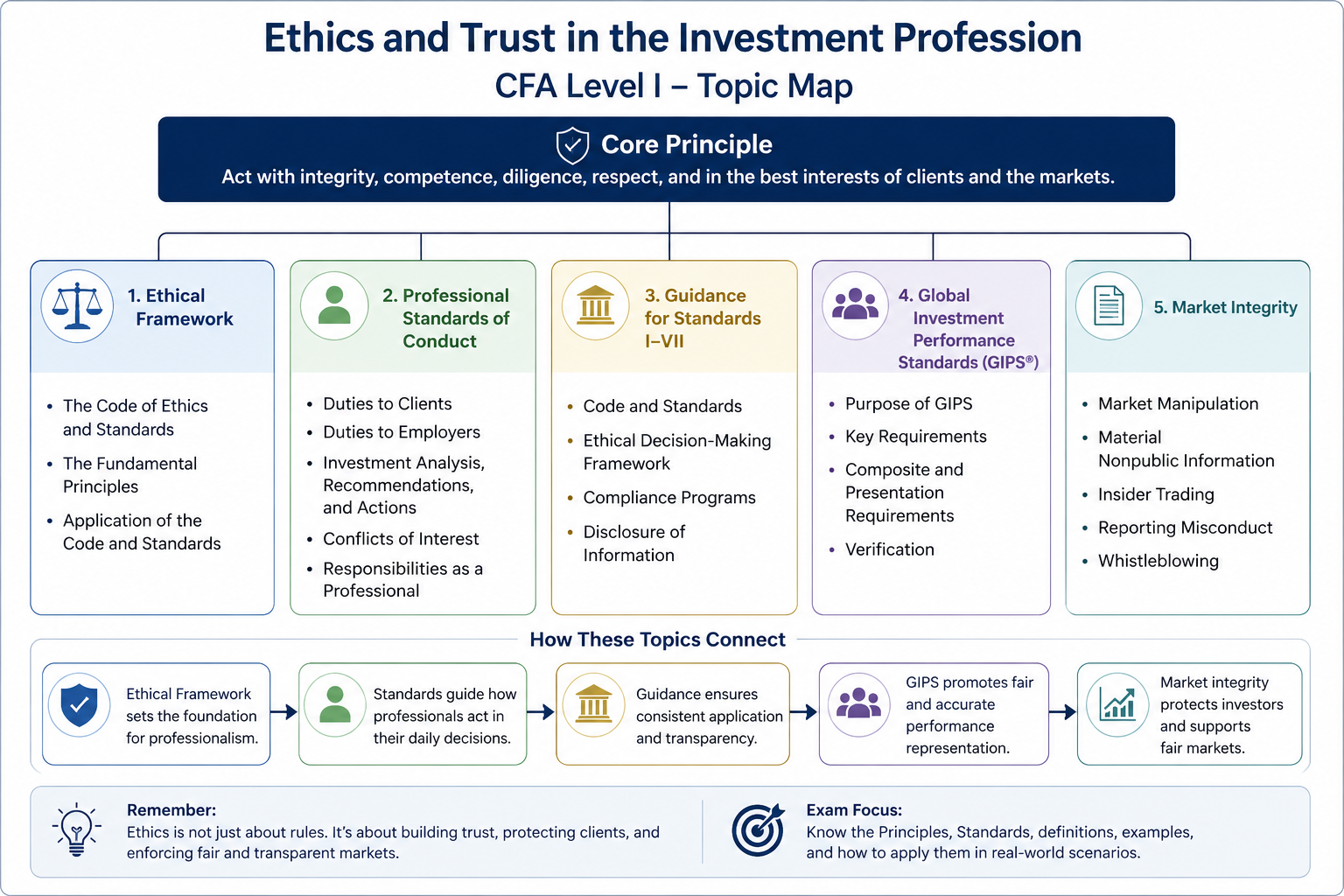
The module also opens four further topics: professional conduct, challenges to ethical behavior, law versus ethics, and a decision-making framework.
What Are Ethics in Investment Management?
Ethics is a set of shared principles and standards of conduct that help you decide what is right when a situation is not covered by a clear rule. In investment management, those principles point toward acting in the client's interest, being honest about risk and cost, and protecting the fairness of the market.
Investment ethics is not the same as personal preference. A choice can feel comfortable and still fail a client. It is also not reputation management, which is about how conduct looks rather than whether it is right.
Ethics in investment also goes beyond legal compliance. The law sets a floor that everyone must meet. Ethical duties can ask for more than the floor, especially where a client trusts you to act on their behalf and cannot check the work in detail.
How Does a Code of Ethics Help Define a Profession?
A code of ethics turns private good intentions into a public standard. It tells members what conduct is expected and tells clients what they have a right to expect in return.
A code does several jobs at once. It states the principles a group agrees to share. It communicates expected behavior to clients and the public in plain terms. It supports consistency, so two members in the same situation are held to the same standard. And it creates a basis for accountability when someone falls short.
The CFA Institute Code of Ethics works this way for the investment profession. This page keeps the explanation at the module level rather than walking through each component. For the full breakdown, see the CFA Code of Ethics and Standards.
How Do Professions Establish Trust?
Professions earn trust by combining expertise with responsibility, not by claiming either one alone. A surgeon and a portfolio manager are trusted for the same underlying reason. They know things the client does not, and they accept duties that come with that knowledge.
Five features build that trust:
Specialized education and knowledge that takes real effort to acquire.
A focus on serving clients and society, not only earning a living.
Common standards and some form of oversight across the group.
Continuing competence, so skills stay current.
Accountability when a member acts improperly.
The deeper comparison between a profession and an ordinary occupation belongs to the next note. Here, the point is simpler. Trust is not given because of a title. It is given because the group has shown, over time, that it holds members to a standard.
Why Investment Ethics Matters
Why investment ethics matters comes down to how much a client must take on faith. Several features of investment management make the stakes unusually high.
The first is information asymmetry. The professional usually knows far more than the client about products, risk, and pricing. That gap is the reason the client needs help, and also the reason the client can be taken advantage of.
The second is discretion. Many managers hold authority over client assets or shape the recommendations a client acts on. Small abuses of that authority can be hard to detect.
The third is that the service is intangible. You cannot inspect advice the way you inspect a car before buying it. You often learn the quality only later, sometimes years later.
Conflicts of interest sit on top of all three. A fee structure, a sales target, or a firm relationship can pull a recommendation away from the client's interest. Ethics is the discipline that keeps the client's interest first when those pressures appear.
The link between trust and ethics also reaches past any single client. When misconduct becomes visible, confidence in the whole market falls. Investors pull back, costs rise, and honest professionals pay for the actions of dishonest ones. That is why the profession treats ethical conduct as a shared responsibility, not a private matter.
What This Module Covers
Four focused notes build on this foundation. Each one takes a single idea and works it in depth.
Professionalism in Investment Management: What separates a profession from an ordinary job, and what it means to apply expertise with care, judgment, and service. This note gives you the test for whether conduct is genuinely professional or only technically skilled.
Challenges to Ethical Behavior: Why people who think of themselves as ethical still make poor choices. This note covers the pressures, incentives, and rationalizations that bend judgment, plus practical safeguards.
Ethical Standards vs Legal Standards: How law and ethics overlap, where they part, and why legal permission does not always make conduct ethical.
Ethical Decision-Making Framework: A repeatable process for working through a hard case, so your answer comes from a method rather than a gut reaction.
Example Scenario
Elena manages a discretionary account for a retired client with a low tolerance for risk. Her firm has just launched an in-house balanced fund and is offering advisers extra compensation for assets placed into it during the launch quarter. A comparable third-party fund has a longer track record and lower fees, and fits the client's profile at least as well.
Notice what is at risk before any specific rule enters the picture. The client cannot easily compare the two funds and is relying on Elena to weigh them honestly. The extra compensation creates a pull toward the in-house product that has nothing to do with the client's interest. If Elena places the assets to earn the bonus and does not disclose the conflict, the client may never know the recommendation was shaped by her pay rather than their needs.
The damage to trust happens whether or not the in-house fund later performs well. A good outcome does not repair a recommendation that put the adviser's interest first. To work the case properly, Elena would move through the ethical decision-making framework and check the relevant Standards on conflicts and suitability rather than trusting her first instinct.
Common Exam Traps
Treating ethics as identical to law. Conduct can be fully legal and still breach an ethical duty. Test both.
Assuming technical skill alone makes someone a professional. Knowledge without care, disclosure, and accountability is not professionalism.
Focusing only on client trust. Misconduct also harms market and societal trust, and questions often hinge on that wider effect.
Memorizing definitions without applying them. Ethics questions are scenarios. Practice spotting the pressure and the duty, not reciting a definition.
Practice Question
A new analyst argues that her firm should be considered part of a profession because its staff hold advanced degrees and pass demanding technical exams. Which point most accurately corrects this view?
Advanced knowledge is enough to define a profession once the exams are difficult.
A profession also requires that expert knowledge be used in service of clients and society under shared standards, with accountability for misconduct.
A profession is defined mainly by the size of the firm and the length of its track record.
Correct Answer: B
A profession is more than a pool of expertise. It pairs specialized knowledge with service to others, common standards, continuing competence, and accountability when a member acts improperly. That combination is what earns trust.
Option A is wrong because difficult exams prove knowledge, not the duties and accountability that define a profession.
Option C is wrong because firm size and track record may build reputation, but they do not establish the shared standards or the service orientation that a profession rests on.
Continue Your CFA Level I Prep With KeyPoint
Use structured lessons, practice questions, mock exams, and progress tracking to focus on the time you have left