
The Global Investment Performance Standards (GIPS®) are a voluntary set of ethical rules for calculating and presenting investment performance. They exist so that a firm reports its track record fairly and fully, and so that prospective clients can compare firms on the same basis. For CFA Level I, this is the parent note that maps the topic before you move into the focused notes on compliance, firm concepts, composites, discretion, and verification.
Think of this page as the map. It defines what the GIPS standards are and how the pieces connect, then points you to the detailed notes for each concept.
Quick Answer
The GIPS standards are voluntary ethical standards for calculating and presenting investment performance, built around fair representation and full disclosure. For CFA Level I, you should understand who may claim compliance, how firm-level reporting and composites work, how a firm's definition and discretion affect what gets included, and what independent verification does and does not do.
Key Takeaways: The Global Investment Performance Standards
The GIPS standards support consistent, comparable investment performance reporting across firms.
Compliance is organization-wide under the applicable GIPS chapter. It is not a label for one portfolio or composite.
A composite groups portfolios managed to a similar mandate, objective, or strategy.
A firm's definition and its discretion over portfolios affect which accounts belong in the compliance framework.
Verification is independent and firm-wide, but it does not certify that every figure in every report is correct.
What Are the GIPS Standards?
The GIPS standards are a standardized set of ethical principles for how a firm calculates and presents its investment performance. They focus on a firm's historical record rather than any promise about future results. The aim is information that is fairly represented, fully disclosed, calculated consistently, based on complete data, and comparable from one firm to the next.
Two ideas sit at the center of everything else. Fair representation means the numbers are not arranged to flatter the firm. Full disclosure means the firm provides the context a reader needs to interpret those numbers correctly.
Why Do the GIPS Standards Matter?
They matter because performance figures can be technically correct and still mislead. Without common rules, a firm could highlight a flattering number that does not reflect what an investor would have actually experienced.
Consider a strategy that gains 50% in year one and loses 40% in year two. A firm could present the simple average of those two yearly returns as positive 5% a year. Yet a $1,000,000 account would grow to $1,500,000, then fall to $900,000, an actual loss of $100,000 over the period. The GIPS standards push firms toward presentation that reflects the real result rather than the more attractive arithmetic.
What Does CFA Level I Require You to Know About GIPS?
CFA Level I builds GIPS around five learning outcomes. Use them as your study spine:
Why the GIPS standards were created, who can claim compliance, and who benefits.
The key concepts of the GIPS standards for firms.
The purpose of composites.
The fundamentals of compliance, including firm definition and discretion.
The purpose and scope of independent verification.
Each one has its own focused note. This page keeps each at overview depth so the notes do not repeat one another.
The Five Core GIPS Concepts for Level I
These five concepts connect into a single picture. The map below shows how they relate, and each short summary links to the full note.
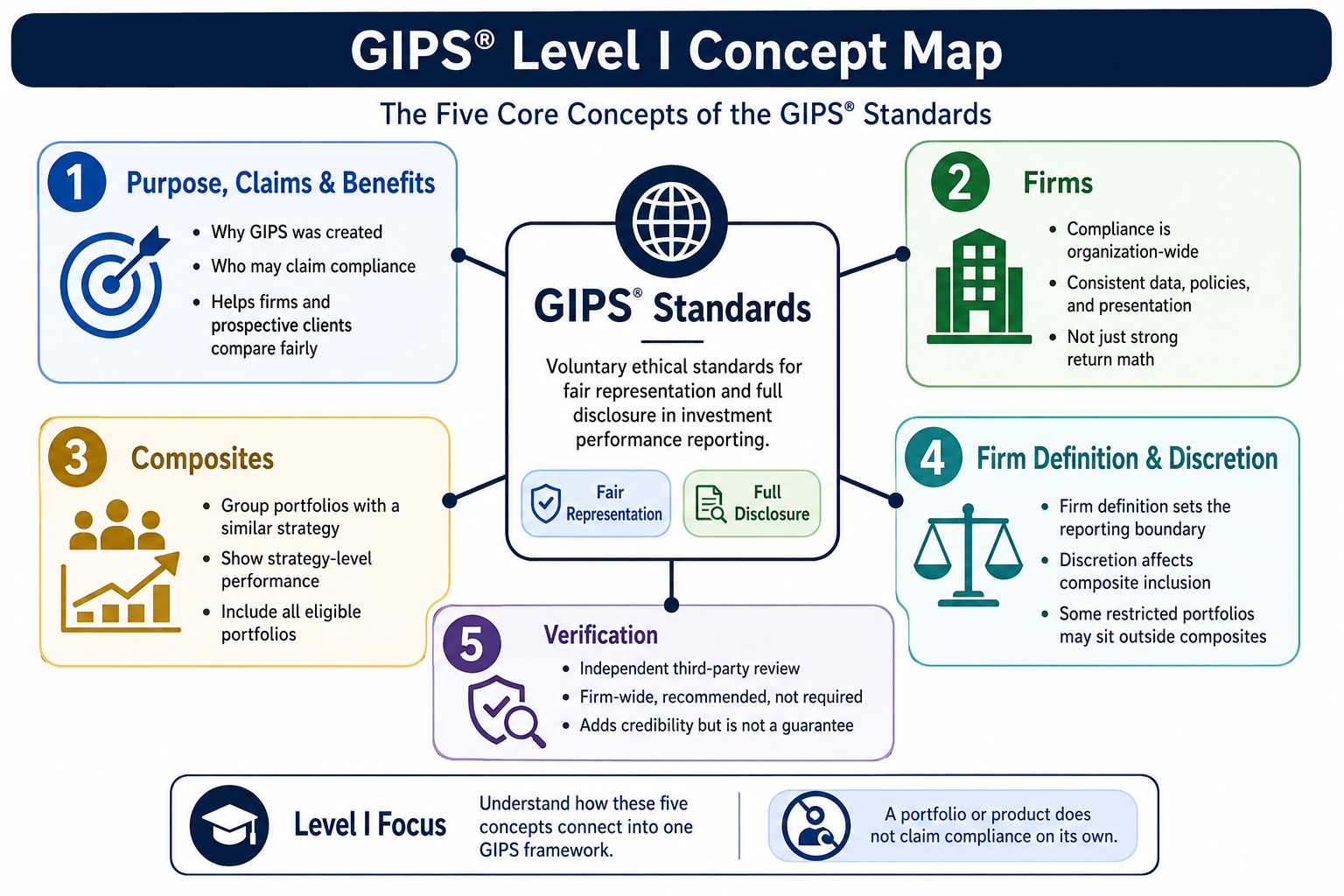
Purpose, Compliance Claims, and Benefits
The GIPS standards were created to reduce inconsistent and selective performance reporting. An eligible organization, such as a firm, claims compliance for itself under the applicable chapter, and a single product or portfolio cannot claim compliance on its own. Prospective clients gain comparability, while firms gain a recognized framework and fairer competition. See why GIPS standards exist and who benefits.
Key Concepts for Firms
Firm compliance is a system, not a single disclosure. A firm has to apply the standards across the whole organization, use reliable data and consistent methods, build composites properly, present results fairly, and keep documented policies. Strong return math alone does not establish compliance.
Composites
A composite is a group of portfolios managed to a similar strategy, mandate, or objective. Its purpose is to show how the firm performed when it applied a defined strategy across client accounts, rather than spotlighting one lucky portfolio. All eligible portfolios that fit a composite definition must be included, which is what prevents a firm from showing only its winners. See GIPS composites for more information.
Firm Definition and Discretion
How a firm defines itself sets the boundary of its compliance, so the definition should be broad and meaningful rather than shaped to hide weak results. Discretion matters too, because a portfolio that client restrictions prevent the manager from running as intended may sit outside the composites even while its assets still count toward total firm assets. See GIPS fundamentals of compliance, firm definition, and discretion.
Verification
Verification is an independent review by a qualified third party of whether the firm's composite construction and its policies and procedures meet the standards on a firm-wide basis. It is recommended, not required, and it applies to the whole firm rather than to a single composite. It can add credibility, but it does not guarantee that every number is error-free. See GIPS verification.
How the GIPS Standards Differ From the CFA Code and Standards
Candidates sometimes blur these two systems together. They are related parts of CFA Institute's ethical work, but they govern different things.
Area | GIPS Standards | CFA Code and Standards |
|---|---|---|
Main focus | Investment performance calculation and presentation | Professional conduct of members and candidates |
Typical claimant or subject | An eligible organization under the applicable GIPS chapter | A CFA Institute member or candidate |
Core principle | Fair representation and full disclosure | Ethical and professional duties |
The two work side by side. One governs how a firm reports performance, while the other governs how individuals behave.
Common Exam Traps
Treating the GIPS standards as mandatory law in every jurisdiction.
Saying a single product, portfolio, or composite is "GIPS compliant."
Confusing verification with a guarantee that every performance figure is accurate.
Assuming GIPS only concerns return calculations and not presentation or disclosure.
Using an older "nine sections" count as the main Level I framework instead of the current concepts.
Practice Question
Which statement best describes the purpose and scope of the GIPS standards?
They require firms to guarantee a minimum level of future investment performance for prospective clients.
They provide voluntary ethical rules for fair representation and full disclosure, so that historical performance is calculated consistently and is comparable across firms.
They apply only to individual portfolio managers, who each claim personal compliance for the accounts they run.
Correct Answer: B
Voluntary ethical rules, fair representation, full disclosure, and comparable historical performance together describe the purpose and scope.
Option A. The GIPS standards address historical performance and presentation. They never promise future results.
Option C. Compliance is an organization-level claim under the applicable chapter, not a personal claim by an individual manager.
Continue Your CFA Level I Prep With KeyPoint
Use structured lessons, practice questions, mock exams, and progress tracking to focus on the time you have left
FAQs About GIPS
What does GIPS mean in finance?
GIPS stands for the Global Investment Performance Standards. They are voluntary ethical standards for how investment firms calculate and present their performance, built on fair representation and full disclosure so that prospective clients can compare firms fairly.
Are GIPS standards mandatory?
No. The GIPS standards are voluntary. A firm chooses to claim compliance, and once it does, it must meet all applicable requirements rather than picking and choosing among them. Some jurisdictions or clients may expect compliance, but the standards themselves are not law.
Is GIPS part of the CFA Level I curriculum?
GIPS appears in the published 2026 CFA Level I topic outline. It is not listed in the published 2027 Level I topic outline. If you are sitting a 2026 exam, treat this material as in scope, and check the current outline for your own exam year before relying on it.