
The key concepts of the GIPS® standards for firms describe a firm-wide system for reporting investment performance, not a checklist of disclosures. To claim compliance, a firm has to meet all applicable requirements, use reliable data and consistent methods, build composites properly, present results fairly, and keep documented policies. The GIPS standards work together as one framework, which is why accurate return math alone does not make a firm compliant.
This note stays at concept level. The detailed rules for composites, firm definition, discretion, and verification each have their own notes.
Quick Answer
The GIPS standards for firms operate as a firm-wide performance-reporting framework. A compliant firm must meet all applicable requirements, use reliable data and consistent calculation methods, construct composites appropriately, present information fairly, provide required disclosures, and maintain documented policies and procedures.
Key Takeaways: Key GIPS Standards Concepts for Firms
Compliance applies to the firm as defined, not to selected products.
A firm cannot claim partial compliance.
Fair representation and full disclosure guide every stage of the process.
Data, calculations, composite membership, and reporting must follow the applicable requirements consistently.
Requirements are mandatory for compliance, while recommendations are encouraged best practices.
What You Need to Know for CFA Level I
For this outcome, you should recognize:
A selective or product-only claim as incorrect.
The role of documented policies and procedures.
Why accurate input data and consistent methodology matter.
How composites reduce selective performance presentation.
The difference between a requirement and a recommendation.
What Are the Key GIPS Concepts for Firms?
The key concepts fit together as a lifecycle, from defining the firm to reporting results and maintaining compliance over time. Reading them as a sequence keeps you from treating GIPS as a loose list of disclosures.
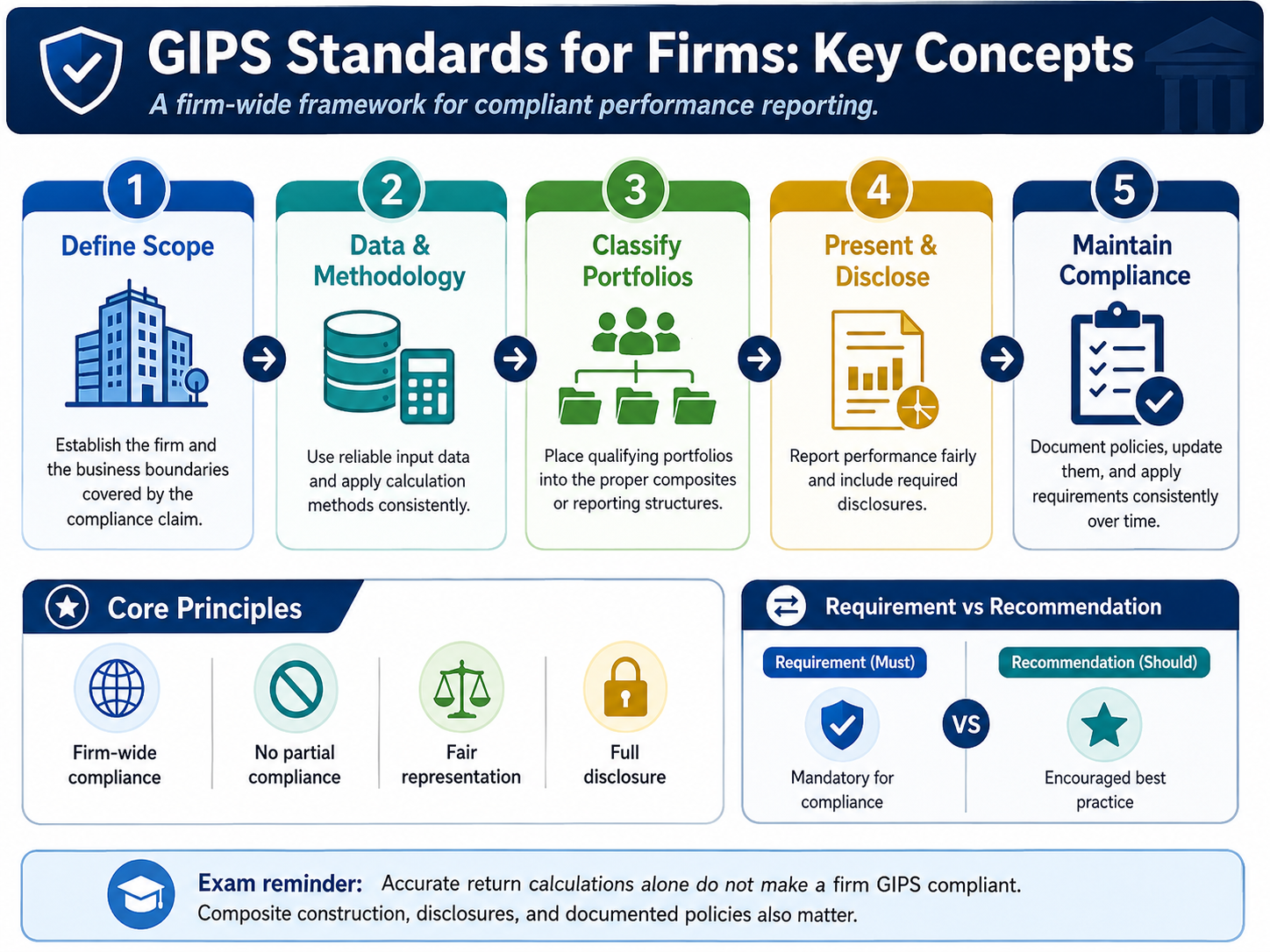
Define scope. Establish the firm and the business boundaries the compliance claim covers.
Maintain data and methodology. Use accurate inputs and consistent calculation methods.
Classify portfolios. Place qualifying portfolios into the appropriate composites or reporting structures.
Present and disclose. Provide fair, complete, and required information to the relevant audience.
Maintain compliance. Document policies, update them, and apply current requirements consistently.
The sections below expand each stage.
Firm-Wide Compliance and No Partial Compliance
Compliance covers the whole firm as defined, and it is all-or-nothing. A firm either meets every applicable requirement and claims compliance, or it does not claim compliance at all. Statements like "partially compliant" or "compliant with most requirements" are not allowed, because they let a firm imply a standard it has not fully met.
Fair Representation and Full Disclosure
These two principles run through every stage. Fair representation means the firm presents performance honestly rather than arranging it to look better than it was. Full disclosure means the firm provides the context a reader needs to interpret the numbers. A technically correct figure can still mislead if the firm leaves out information that changes how a reader would read it.
Input Data and Calculation Methodology
Reliable output depends on reliable input. A firm has to maintain accurate, complete records, because flawed data distorts composite returns, risk statistics, and disclosures. Calculation methods then need to be applied consistently, so that results are comparable across periods and across portfolios rather than shifting from one report to the next.
Composite and Pooled-Fund Construction
A composite groups portfolios managed to a similar strategy, and it is one of the main defenses against cherry-picking. Because all qualifying portfolios that meet a composite definition must be included, a firm cannot quietly drop a weak account to lift the reported result. Pooled funds and other structures follow the applicable rules for how they are presented within the framework.
Presentation, Reporting, and Disclosures
A GIPS report presents performance together with the disclosures a reader needs to understand it. Presentation is not an afterthought to the calculations. It is where fair representation and full disclosure actually reach the audience, so the required disclosures are part of compliance rather than optional polish.
Requirements vs Recommendations
The GIPS standards separate what a firm must do from what it is encouraged to do. Knowing which is which is a frequent exam point, because a question may describe a recommendation and ask whether failing to follow it breaks compliance.
Area | Requirement | Recommendation |
|---|---|---|
Effect on compliance | Must be followed when applicable | Encouraged but not mandatory |
Language signal | "Must" | "Should" |
Exam focus | Failure may invalidate the compliance claim | Adoption reflects best practice but is not required |
Example Scenario
Brookfield Quant Partners calculates its returns accurately and applies a consistent methodology across periods. When it builds its large-cap equity composite, though, it leaves out two qualifying portfolios that happened to underperform, and its report omits several required disclosures.
Accurate math does not save this claim. By excluding qualifying portfolios from the composite, Brookfield engages in exactly the selective presentation the GIPS standards are built to prevent, and the missing disclosures break the full-disclosure principle. Compliance depends on the whole system working, so strong calculations alongside a flawed composite and incomplete disclosures still fail.
Common Exam Traps
Treating the GIPS standards as only a return-calculation standard.
Assuming a firm may comply with selected sections.
Confusing recommendations with requirements.
Believing a disclosure can correct deliberate cherry-picking.
Ignoring the need for documented, consistently applied policies.
Practice Question
Which statement incorrectly describes a recommendation as if it were a requirement under the key GIPS concepts for firms?
A firm must include all qualifying, discretionary portfolios in the appropriate composite.
A firm must obtain independent verification before it can claim compliance.
A firm must apply its calculation methodology consistently across the periods it presents.
Correct Answer: B
B is the statement that is incorrect. Independent verification is recommended, not required. Calling it a "must" wrongly turns a recommendation into a requirement, which is the error the question targets.
Option A is correct as stated and is a requirement. Including all qualifying portfolios in the appropriate composite is mandatory, so describing it as a "must" is accurate. This is not the error the question asks for.
Option C is correct as stated and is a requirement. Consistent application of calculation methodology is mandatory, so describing it as a "must" is accurate.
Continue Your CFA Level I Prep With KeyPoint
Use structured lessons, practice questions, mock exams, and progress tracking to focus on the time you have left
FAQs About the Key Concepts of the GIPS Standards for Firms
What is a GIPS report?
A GIPS report presents a firm's investment performance along with the disclosures a reader needs to interpret it correctly. It reflects fair representation and full disclosure, so the numbers and the context that explains them appear together rather than the performance figures standing alone.
What is the difference between a GIPS requirement and a recommendation?
A requirement is mandatory. A firm must follow it when applicable to claim compliance, and failing to do so can invalidate the claim. A recommendation is an encouraged best practice that a firm should consider but is not obligated to adopt. The standards signal the difference with "must" for requirements and "should" for recommendations.