
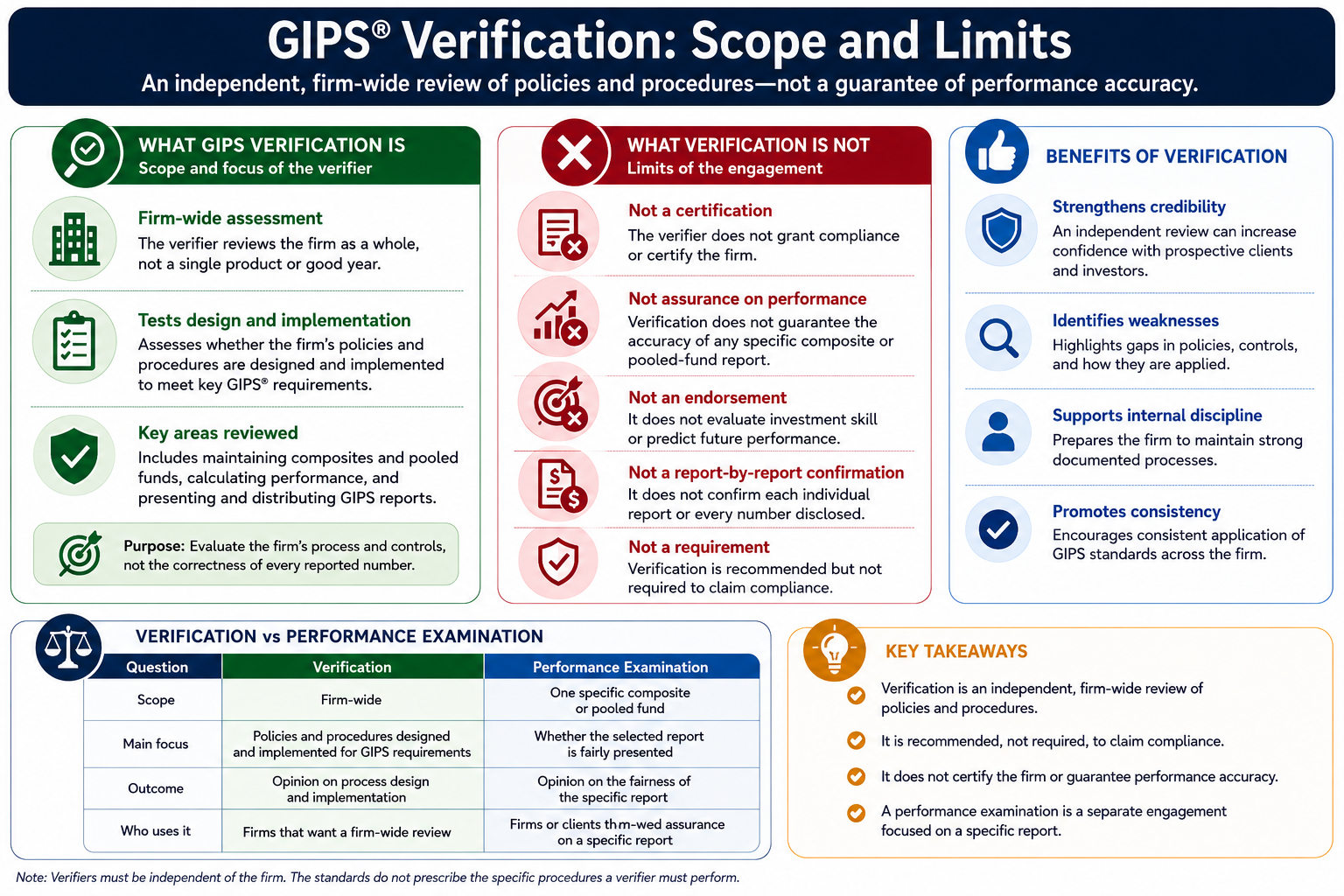
GIPS® verification is an independent, firm-wide review of whether a firm's policies and procedures are built and applied to meet key requirements of the Global Investment Performance Standards. It is recommended, not required, and a firm can claim compliance without it. Verification also does not promise that any single performance report is accurate. For CFA Level I, the main risk is overstating what verification proves, so this note focuses on its scope and its limits.
Quick Answer
GIPS verification is an independent, firm-wide assessment of whether a firm's policies and procedures are appropriately designed and implemented for key GIPS requirements. Verification is recommended but not required to claim compliance, and it does not provide assurance on the accuracy of a specific composite or pooled-fund report.
Key Takeaways About GIPS Verification
The verifier must be independent of the firm.
Verification is conducted on a firm-wide basis.
The work tests whether policies and procedures are designed and implemented across specified areas.
Verification can strengthen credibility and reveal process weaknesses.
It does not grant compliance or assure every reported number.
A performance examination is a separate engagement focused on a specific composite or pooled fund.
What You Need to Know for CFA Level I
Verification is recommended, not a prerequisite for claiming compliance.
The verifier does not create or own the firm's compliance claim.
Firm-wide scope is what distinguishes verification from a performance examination.
Verification does not cover every possible requirement or give certainty on each report.
"Certification" and "audit guarantee" are misleading ways to describe it.
What Is GIPS Verification?
Verification is carried out by an independent third party, not by the firm itself. The verifier looks at the firm as a whole, not at one product or one good year.
The work checks whether the firm's policies and procedures are designed and implemented to meet GIPS requirements. It is a review of process, not a sign-off on each reported number.
What Does an Independent Verifier Test?
A verifier assesses whether the firm has designed and put in place policies and procedures for the areas the standards cover. At a high level, that includes:
Maintaining composites and pooled funds as applicable.
Calculating performance under the applicable requirements.
Presenting and distributing GIPS reports as required.
This is not an exhaustive audit of every transaction. The verifier reviews whether the firm's processes are set up to meet the standards across the firm.
Is GIPS Verification Required?
No. Verification is recommended but voluntary. A firm may claim compliance once it determines that it meets all applicable requirements, with or without an outside verifier.
Many firms still choose verification because an independent review can add credibility with prospective clients. That benefit is real, but it does not turn verification into a requirement.
What Are the Benefits of Verification?
Verification adds an independent check to the firm's own process. It can raise confidence among prospective clients and investors, and it can surface weaknesses in policies, controls, or how they are applied.
It also supports internal discipline, since a firm preparing for review tends to tighten its documentation. None of this proves investment quality or predicts future performance.
What Does Verification Not Establish?
Verification does not certify a firm, and it does not guarantee that every number in a report is correct. It is not an endorsement of a strategy, and it says nothing about future results.
It also does not, on its own, confirm a specific composite report. Confirming a particular report is the job of a separate engagement, described next.
Verification vs Performance Examination
A performance examination is narrower than verification. It looks at a specific composite or pooled fund, rather than the whole firm.
Question | Verification | Performance Examination |
|---|---|---|
Scope | Firm-wide | One specific composite or pooled fund |
Main focus | Whether policies and procedures are designed and implemented for GIPS requirements | Whether the selected report was prepared and presented under the applicable requirements |
Required to claim compliance? | No | No |
Assurance on every report? | No | Limited to the selected subject and the engagement's scope |
Example Scenario
A firm completes firm-wide verification. Pleased with the result, its marketing team prepares a flyer for one composite that calls the strategy fully certified and guaranteed accurate.
That wording overstates what happened. Verification reviewed the firm's policies and procedures across the whole firm. It did not certify the strategy, and it did not guarantee the accuracy of that composite's specific numbers. If the firm wanted independent review of that one composite's report, it would need a performance examination, which is a separate engagement with a narrower focus.
Common Exam Traps
Saying verification must happen before a firm can claim compliance.
Calling verification GIPS certification.
Assuming verification covers only one composite.
Believing verification assures the accuracy of every performance report.
Mixing up firm-wide verification with a performance examination.
Practice Question
A firm has completed independent, firm-wide GIPS verification. Which conclusion may the firm NOT draw from that result?
An independent party assessed whether the firm's policies and procedures meet GIPS requirements.
The accuracy of every number in a specific composite report has been confirmed.
The review was conducted on a firm-wide basis.
Correct Answer: B
Verification is firm-wide and reviews policy and procedure design and implementation, so A and C are valid conclusions. B is not, because verification does not confirm the accuracy of a specific report. That kind of assurance would require a performance examination, and even then only within that engagement's scope.
Continue Your CFA Level I Prep With KeyPoint
Use structured lessons, practice questions, mock exams, and progress tracking to focus on the time you have left
FAQs About GIPS Verification
Is GIPS verification mandatory?
No. Verification is recommended but voluntary. A firm can claim compliance once it has determined that it meets all applicable requirements, without hiring an external verifier.
Who may perform GIPS verification?
An independent, qualified third party. The firm cannot verify itself, because the value of verification comes from an outside party reviewing the firm's policies and procedures.
What is the difference between GIPS verification and a performance examination?
Verification is firm-wide and reviews whether policies and procedures are designed and implemented for GIPS requirements. A performance examination is narrower and focuses on whether a specific composite or pooled-fund report was prepared and presented under the applicable requirements.
Does GIPS verification confirm that a firm's reported performance is accurate?
No. Verification reviews whether the firm's policies and procedures are designed and implemented to meet GIPS requirements across the firm. It does not confirm that every number in a specific report is correct.
Is GIPS verification the same as GIPS certification?
No. There is no "GIPS certification." Verification is an independent review of a firm's firm-wide policies and procedures. Describing it as certification suggests an approval or guarantee that verification does not provide.
Can a firm have only one composite verified?
No. Verification covers the firm as defined, on a firm-wide basis. A review limited to one composite or pooled fund is a performance examination, which is a separate engagement.