
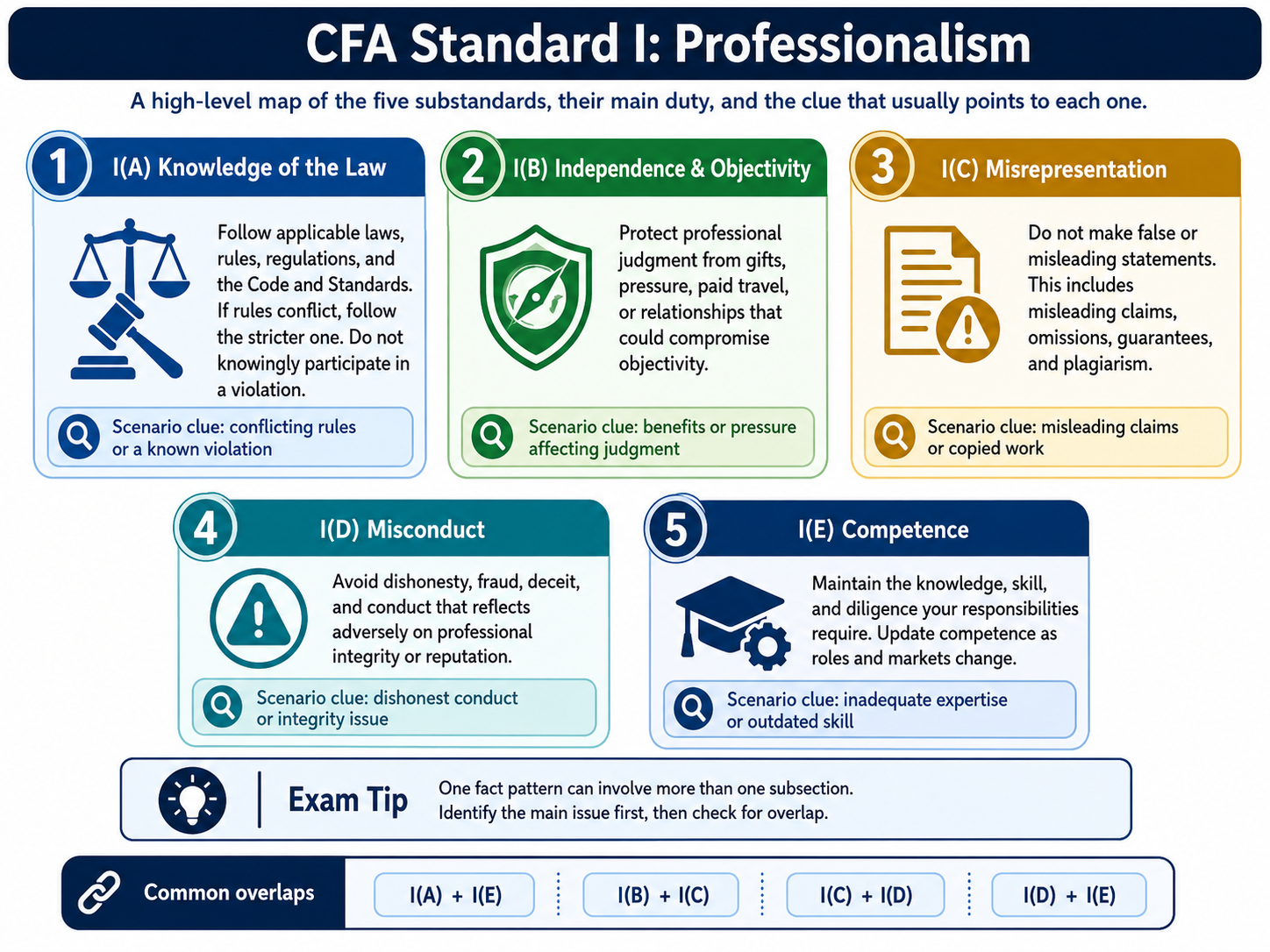
CFA® Standard I Professionalism covers five duties: legal compliance, independent judgment, truthful representation, professional conduct, and competence. One fact pattern can involve more than one of these at the same time, which is what makes exam scenarios tricky. This note helps you identify the main issue in a scenario and move to the detailed child note that covers it in full.
Quick Answer
Standard I has five sections.
I(A) Knowledge of the Law requires following applicable requirements and the stricter rule when they conflict.
I(B) Independence and Objectivity protects judgment from improper influence.
I(C) Misrepresentation prohibits knowing false or misleading statements, including plagiarism.
I(D) Misconduct addresses dishonesty and conduct that reflects adversely on professional integrity.
I(E) Competence requires the knowledge and skill needed for your responsibilities.
Key Takeaways About CFA Standard I Professionalism
I(A) is about applicable requirements and dissociating from violations.
I(B) protects independent and objective judgment from gifts, pressure, and relationships.
I(C) prohibits knowing misrepresentation, and plagiarism is a form of it.
I(D) addresses dishonesty and conduct that reflects adversely on professional integrity.
I(E) requires appropriate competence that is maintained as roles and markets change.
Mixed scenarios are common, so careful classification matters more than memorizing a single label.
What You Need to Know for CFA Level I
Know the names and order of I(A) through I(E), and the main trigger for each one. A trigger is the fact in a scenario that points you toward a particular subsection.
You should also recognize the overlap pairs that show up most often, and the high-level preventive practices for each duty. The skill the exam rewards is selecting the most relevant subsection when a scenario could touch several.
Keep in mind that the outcome alone does not decide compliance. Conduct can violate a Standard even when nothing bad happens, and a poor result does not always mean a Standard was broken.
What Does Standard I: Professionalism Cover?
Standard I(A): Knowledge of the Law
Members and candidates must understand and comply with the applicable laws, rules, and regulations that govern their work, including the Code and Standards. When requirements conflict, follow the stricter one. They must not knowingly participate in or assist a violation, and they must dissociate from an ongoing violation when required.
See the Standard I(A): Knowledge of the Law note for jurisdiction tests, escalation, and dissociation detail.
Standard I(B): Independence and Objectivity
Members and candidates must use reasonable care and judgment to keep their independence and objectivity. They must not offer, solicit, or accept benefits that could compromise that judgment. Pressure can come from issuers, clients, brokers, employers, and other parties, and recognizing it is the first defense.
See the Standard I(B): Independence and Objectivity note for gifts, travel, issuer-paid research, and pressure scenarios.
Standard I(C): Misrepresentation
Members and candidates must not knowingly make false or misleading statements about their professional activities. This covers misleading omissions, overstated capabilities, misleading performance, guarantees of returns, and plagiarism. Proper attribution of work and sources is part of meeting this duty.
See the Standard I(C): Misrepresentation note for compliant and violating examples.
Standard I(D): Misconduct
Members and candidates must not engage in professional dishonesty, fraud, or deceit, and must not commit acts that reflect adversely on their professional reputation, integrity, or competence. Not every personal act automatically violates this Standard. The professional connection and the effect on professional integrity are what matter.
See the Standard I(D): Misconduct note for the boundary between personal and professional conduct.
Standard I(E): Competence
Members and candidates must act with and maintain the knowledge, skills, and diligence their responsibilities require. As roles, tools, products, laws, or markets change, competence has to be updated to match. When a task exceeds current ability, the response can be to seek training, bring in expert input, or limit the scope of the work.
See the Standard I(E): Competence note for how competence is assessed and maintained.
Standard I Professionalism Comparison Table
Substandard | Main Duty | Common Scenario Clue | Typical Violation Pattern | Preventive Action |
|---|---|---|---|---|
I(A) Knowledge of the Law | Follow applicable requirements and dissociate from violations | Conflicting rules, cross-border activity, a known violation | Joining or staying associated with a violation | Stay informed, seek advice, document, and dissociate |
I(B) Independence and Objectivity | Protect judgment from improper influence | Gifts, pressure, paid travel, issuer relationships | Accepting or offering benefits that may sway judgment | Limit benefits, disclose, pay your own costs where practical, use controls |
I(C) Misrepresentation | Communicate truthfully and attribute work | Performance claims, credentials, service claims, copied research | A knowing false statement, omission, guarantee, or plagiarism | Verify claims, retain support, attribute sources |
I(D) Misconduct | Avoid dishonesty and conduct that damages integrity | Fraud, deceit, impairment, professional dishonesty | Dishonest conduct or conduct reflecting adversely on integrity | Firm code, supervision, personal conduct controls |
I(E) Competence | Maintain capability for assigned responsibilities | New role, new product, outdated skill, changing requirements | Acting without sufficient knowledge, skill, or diligence | Training, continuing education, expert support, scope limits |
Each row connects to its dedicated child note for the full rule and examples.
How to Identify the Relevant Standard I Subsection
Use this routing sequence when a scenario could touch several duties:
Is the main issue an applicable law, rule, or a known violation? Start with I(A).
Is a benefit or pressure affecting judgment? Start with I(B).
Is a professional statement, omission, attribution, or claim misleading? Start with I(C).
Is the issue dishonesty, fraud, deceit, or conduct reflecting adversely on professional integrity? Start with I(D).
Is the person unable to perform the responsibility with adequate knowledge, skill, or diligence? Start with I(E).
Then check whether another subsection also applies.
Common Standard I Overlaps
I(A) and I(E). Keeping current with the requirements that directly apply to your work can also be a matter of competence, since you have to understand the rules to follow them.
I(B) and I(C). Biased judgment can lead to research or a presentation that misleads, so a loss of independence can produce a misrepresentation.
I(C) and I(D). A knowing false statement can be both a misrepresentation and dishonest professional conduct.
I(D) and I(E). Impairment or reckless professional behavior can affect both integrity and competence at once.
The detailed facts decide which Standards actually apply in a given scenario.
Mixed Standard I Example Scenario
Consider Marcus, an analyst asked to initiate coverage on a specialty chemicals company he has not analyzed before. The company invites him to tour a new facility and covers his flights and lodging. During the visit, management hands him a set of forward revenue projections. Working under a tight deadline, Marcus builds his report largely on those projections without independent review, and he presents the conclusion as his own independent research. He has limited experience valuing companies in this sector.
Several Standard I issues appear at once. Accepting the paid travel and relying on it raises a question under I(B), because the benefit could compromise his independence. Presenting issuer-supplied projections as independent research raises a question under I(C), because the report misrepresents the basis of the work. His limited experience with the sector, combined with skipping independent review, raises a question under I(E), because he may lack the competence the task required.
The corrective steps follow the duties. For I(B), he could decline or limit the benefit, disclose the arrangement, and rebuild the analysis on independent inputs. For I(C), he should describe the actual basis of the work and attribute the issuer's figures rather than passing them off as his own. For I(E), he could seek training or expert support, or narrow the scope until he can cover the sector competently. Finding only the first issue and stopping there is the trap.
Common Exam Traps
Using an outdated four-part Standard I list that leaves out I(E) Competence.
Treating every gift as automatically prohibited without examining the source, value, purpose, and controls.
Classifying every false statement as Misconduct and missing that it is also Misrepresentation.
Assuming personal conduct is never relevant, when conduct that reflects adversely on professional integrity can be.
Treating a designation or job title as proof of competence.
Stopping after finding one subsection in a scenario that involves several.
Practice Question
An analyst accepts a luxury weekend trip paid for by a company she covers, then writes a favorable report based mainly on the company's own projections and presents it as independent analysis. She also has little experience with the company's industry. Which Standard I subsection is most directly implicated by presenting the issuer-funded, issuer-sourced work as her own independent research?
I(A) Knowledge of the Law.
I(C) Misrepresentation.
I(E) Competence.
Correct Answer: B
Presenting work that relied on the issuer's hospitality and figures as independent research misstates the basis of the report, which goes to I(C) Misrepresentation. The scenario also raises I(B) and I(E) concerns, but the specific act described, presenting the work as independent, is most directly a misrepresentation.
Option A is incorrect because no applicable-law or known-violation issue is the focus of the described act.
Option C is a genuine concern given her limited industry experience, but the act of presenting the work as independent is misrepresentation rather than a competence failure, so I(C) is the most direct fit.
Continue Your CFA Level I Prep With KeyPoint
Use structured lessons, practice questions, mock exams, and progress tracking to focus on the time you have left
FAQs About Guidance for Standard I: Professionalism
What is CFA Standard I: Professionalism?
CFA Standard I Professionalism is the first Standard of Professional Conduct. It covers five duties: legal compliance, independence and objectivity, truthful representation, professional conduct, and competence.
What are the five sections of Standard I?
The five sections are I(A) Knowledge of the Law, I(B) Independence and Objectivity, I(C) Misrepresentation, I(D) Misconduct, and I(E) Competence.
Is Competence part of CFA Standard I?
Yes. I(E) Competence is part of the current Standard I. Older guidance for standard I that lists only four subsections is out of date.
What is the difference between Misrepresentation and Misconduct?
Misrepresentation under I(C) is about knowingly false or misleading professional statements, including plagiarism. Misconduct under I(D) is about dishonesty, fraud, deceit, or conduct that reflects adversely on professional integrity. A single false statement can raise both.
How is Standard I tested in CFA Level I Ethics?
Professionalism cfa ethics questions usually describe a scenario and ask which subsection applies or which preventive action fits. The harder items mix duties, so you have to classify carefully rather than stop at the first issue you spot.