
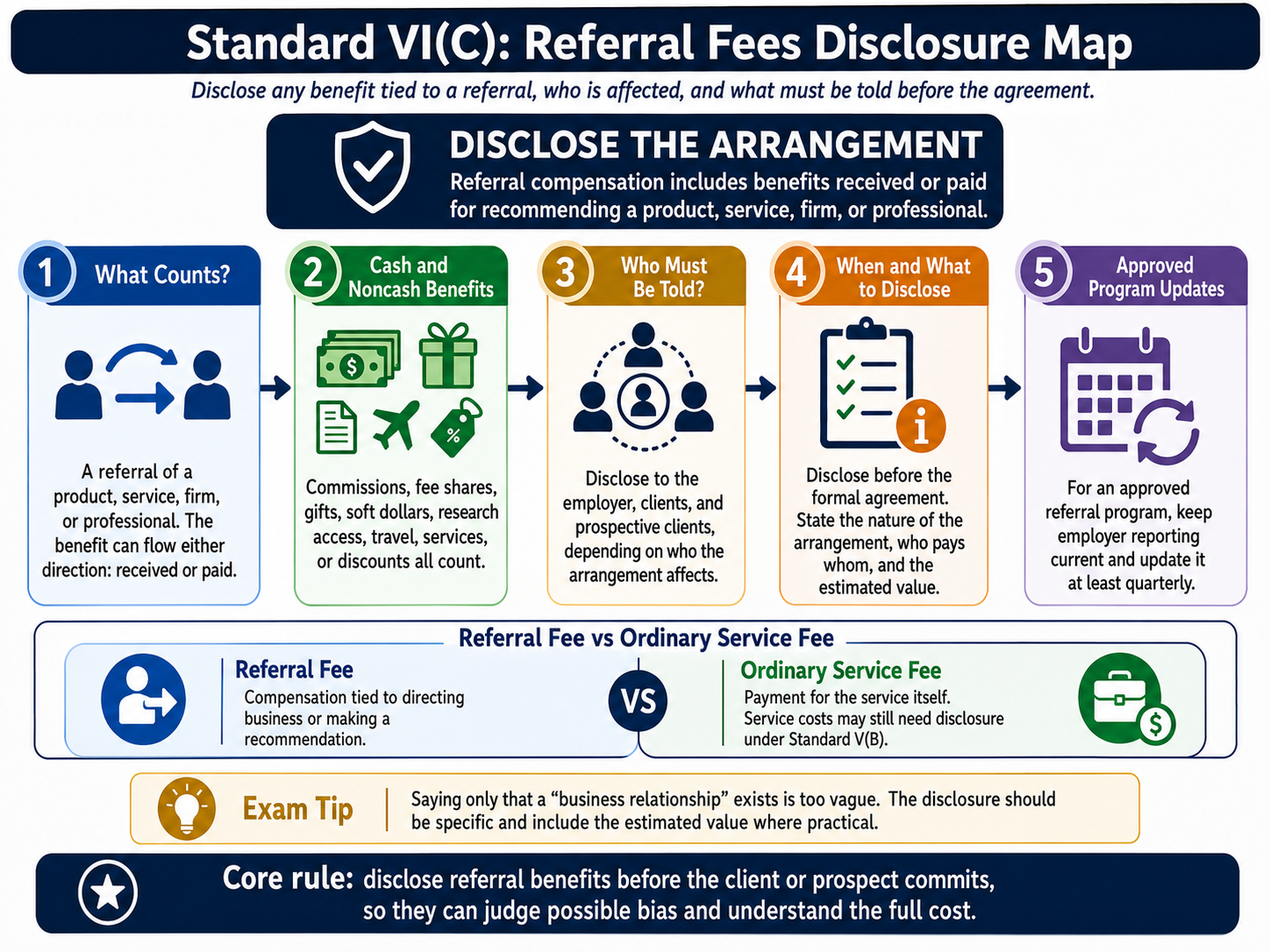
Standard VI(C): Referral Fees requires you to disclose any benefit received from or paid to others for recommending products, services, or other professionals. The benefit can be cash or noncash, the arrangement can be external or internal, and the disclosure goes to the employer, clients, and prospective clients as appropriate, before they enter the agreement. The point is to let people judge possible bias and understand the full cost of the service.
Quick Answer
Standard VI(C) tells you to disclose any compensation, consideration, or benefit you receive from or pay to others for a referral or recommendation. That covers cash and noncash benefits, one-time and ongoing arrangements, and internal as well as external referrals. Disclose to the affected parties before the formal agreement, state the nature and estimated value, and update your employer at least quarterly for approved referral programs.
Key Takeaways on Standard VI(C): Referral Fees
The rule covers any benefit connected to a referral, not only cash fees.
It applies to benefits you receive and benefits you pay.
Noncash benefits count: soft dollars, gifts, services, travel, research, and discounts.
Disclose to the employer, clients, and prospective clients, depending on who is affected.
Disclose before the formal agreement, and state the nature and estimated value of the benefit.
Approved referral programs should be reported to the employer and updated at least quarterly.
What You Need to Know
Standard VI(C) turns a narrow idea, a "referral fee," into a clear disclosure test. Work through four questions. What is the referral? What benefit is connected to it? Who is affected and must be told? When and how should the disclosure happen?
The benefit can flow either way. You disclose when you receive something for steering business to another provider, and you disclose when you pay someone for steering business to you. Disclosure lets clients and prospects evaluate whether your recommendation is impartial, whether you have a financial incentive, and whether the cost of the service includes compensation they could not otherwise see.
The Referral Disclosure Test
Question | What to confirm |
|---|---|
What is the referral? | A recommendation of a product, service, firm, or professional. |
What benefit is connected to it? | Cash or noncash, paid or received, one-time or ongoing, external or internal. |
Who is affected and must be told? | The employer, clients, or prospective clients, depending on the arrangement. |
When and how should disclosure occur? | Before the formal agreement, stating the nature and estimated value, with employer updates as required. |
Cover Every Form of Benefit, Both Directions
The scope is broad on purpose. Referral compensation includes cash, commissions, revenue sharing, soft dollars, gifts, discounts, free or reduced-price services, travel, research access, and other economic advantages. It can be one-time, continuing, or performance-based. And it includes benefits you receive and benefits you pay to another party for client introductions. Internal or interdepartmental referrals, where one part of a firm compensates another for sending business, can also create a disclosure duty.
Tell the Right People, Before They Act
Disclosure goes to the parties the arrangement affects: the employer, clients, and prospective clients. Timing is often decisive. You disclose before the client enters the agreement or acts on the recommendation, so they can weigh the conflict before they commit. A disclosure made only after the contract is signed is too late.
For content, state the nature of the arrangement and an estimated dollar value, or equivalent value, where that is practical. Vague wording that a "relationship exists" does not meet the Standard, because it does not let the client judge the size or effect of the incentive. For an approved referral program, report it to your employer and update that report at least quarterly.
Referral Fees Versus Ordinary Service Fees
These are not the same thing. Referral compensation is tied to directing business or making recommendations. An ordinary advisory or service fee compensates a provider for the service itself. The ordinary fee may still need disclosure, but under Standard V(B): Communication with Clients and Prospective Clients, as part of the nature-and-cost-of-services duty. It is not automatically a referral fee. Keeping the two straight prevents a common mix-up.
Recommended Procedures for Compliance
Firms should require disclosure of referral arrangements, maintain records of approved programs, and set the frequency of employer updates. You should identify referral benefits in both directions, disclose them to affected parties before the agreement, state the nature and estimated value, and keep your employer reporting current for any approved program.
Scenarios
Violation: a vague, annual disclosure of an ongoing benefit
Situation. Mara directs some of her clients to an outside asset manager. In return, she receives free access to the manager's research and a continuing share of the fees those referred clients pay.
Conduct. Her employer has approved the program, but she tells clients only that the two firms "have a relationship," does not mention the research access or the ongoing fee share, gives no estimated value, and reports the arrangement to her employer once a year.
Analysis. The arrangement includes noncash and continuing benefits that must be disclosed. Telling clients a "relationship" exists is not specific enough, and the disclosure omits the estimated value. Annual employer reporting falls short of the at-least-quarterly update expected for an approved program. Mara violates Standard VI(C) on several points.
Takeaway. Noncash and ongoing benefits count, the disclosure must be specific and include estimated value, and approved programs need at least quarterly employer updates.
Compliant: a complete disclosure before the client signs
Situation. An adviser refers prospective clients to an outside tax specialist and receives a flat fee for each referral.
Conduct. Before a prospect signs the engagement, the adviser explains the referral arrangement, says who pays whom, describes the benefit, and gives the estimated dollar value per referral. The adviser also reports the arrangement to the employer and updates it quarterly.
Analysis. The disclosure identifies the arrangement, the direction of payment, the nature of the benefit, and its estimated value, and it reaches the prospect before the agreement. This meets Standard VI(C).
Takeaway. Specific, valued, and delivered before the client commits is the standard to hit.
Common Exam Traps
Assuming only cash payments count.
Covering benefits received but not benefits paid.
Ignoring internal or interdepartmental referrals.
Disclosing after the client has entered the agreement.
Using vague wording without the nature or estimated value of the benefit.
Telling the employer but not affected clients or prospects.
Treating annual reporting as sufficient when quarterly employer updates are expected for an approved program.
Confusing referral compensation under VI(C) with additional compensation under IV(B), or with ordinary service costs disclosed under V(B).
Practice Question
An adviser will refer a prospective client to an outside manager and will receive a continuing share of the fees the client pays. Which disclosure most likely complies with Standard VI(C)?
Before the prospect signs, the adviser identifies the referral arrangement, states who pays whom, describes the benefit, and gives its estimated value.
Before the prospect signs, the adviser says only that the adviser and the manager "have a business relationship."
After the prospect signs the agreement, the adviser discloses the fee share but not the value.
Correct Answer: A
It identifies the arrangement, the direction of payment, the nature of the benefit, and the estimated value, and it reaches the prospect before the agreement, which is what the Standard requires.
Option B is incorrect. Stating only that a relationship exists is too vague. It does not let the prospect judge the size or effect of the incentive.
Option C is incorrect. Disclosure after the agreement is signed is too late, and omitting the estimated value leaves the disclosure incomplete.
Continue Your CFA Level I Prep With KeyPoint
Use structured lessons, practice questions, mock exams, and progress tracking to focus on the time you have left
FAQs About Standard VI(C): Referral Fees
Do only cash payments count as referral fees?
No. The Standard covers any benefit connected to a referral, including soft dollars, gifts, services, travel, research access, and discounts. Noncash benefits are a frequent blind spot on the exam.
Do I disclose only fees I receive?
No. You disclose benefits you receive for a referral and benefits you pay to another party for introductions. Both directions can require disclosure.
When does the disclosure have to happen?
Before the client enters the agreement or acts on the recommendation. A disclosure made only after the contract is signed is too late, because the client could not weigh the conflict before committing.
How is a referral fee different from an ordinary service fee?
A referral fee is tied to directing business or making a recommendation. An ordinary service fee pays a provider for the service itself. The ordinary fee may still need disclosure under Standard V(B), but it is not automatically a referral fee under VI(C).