
Standard IV(A) sets your duty of loyalty to your employer in work matters. You should act for the employer's benefit and not deprive it of your skills, its profit, its confidential information, or its property. Loyalty in ethics has limits, though, and it never outranks the law, market integrity, or your clients. Most CFA® Level I exam questions turn on timing: when preparation becomes competition, and when a resignation actually ends the duty.
Quick Answer
Standard IV(A) requires you to act for your employer's benefit in employment matters and not deprive it of your skills, profit, confidential information, property, or business opportunities. You may prepare to leave or start a competing business, but you must not compete, solicit clients, or misuse employer property before the relationship ends without consent. Loyalty to the employer never overrides duties to clients, market integrity, or applicable law.
Key Takeaways
The duty is loyalty to the employer in work matters, not control over your whole life.
Preparing to leave is allowed. Competing, soliciting clients, or using firm property before you leave is not.
A resignation letter or notice period does not automatically end the duty. It lasts until the relationship actually ends.
Employer records, files, and firm-approved accounts stay with the employer. Your general skills and experience go with you.
A frequent trap is assuming loyalty to the employer outranks duties to clients or markets. It does not.
What You Need to Know for CFA Level I
Employer policies apply only where they do not conflict with the law or the Code and Standards.
Independent outside work may be allowed, but you cannot provide competing services until the employer consents to the arrangement.
Preparation such as forming an entity or leasing space can be fine when it does not use firm resources, solicit clients, or harm the employer.
A notice period does not necessarily end employment. The duty continues until your responsibilities and compensation end.
Employer records, client files, models, reports, devices, and firm social-media accounts must be returned, transferred, or deleted as directed.
After you leave, you may use general skills, experience, and public information unless law or an enforceable agreement says otherwise.
What Does Loyalty to an Employer Require?
At its core, the Standard asks you not to harm your employer in work matters and not to take its value for yourself. That covers depriving the firm of your skills during employment, diverting its profit, misusing its confidential information, self-dealing, and quietly appropriating its business opportunities. What it does not do is demand that you place work above every personal and family obligation. It governs your professional conduct toward the employer, not your private life.
How Are Employer, Client, and Market Duties Prioritized?
When duties pull in different directions, the employer's interests can yield. Client interests and the integrity of the markets can take priority over what your employer would prefer. You also follow the law and the Code and Standards rather than an improper instruction from a manager. This is where a conflict of loyalty becomes a real exam issue: an employer cannot direct you into conduct that harms clients or breaks the law, and loyalty does not require you to go along with it.
Can You Start an Independent or Competing Business While Employed?
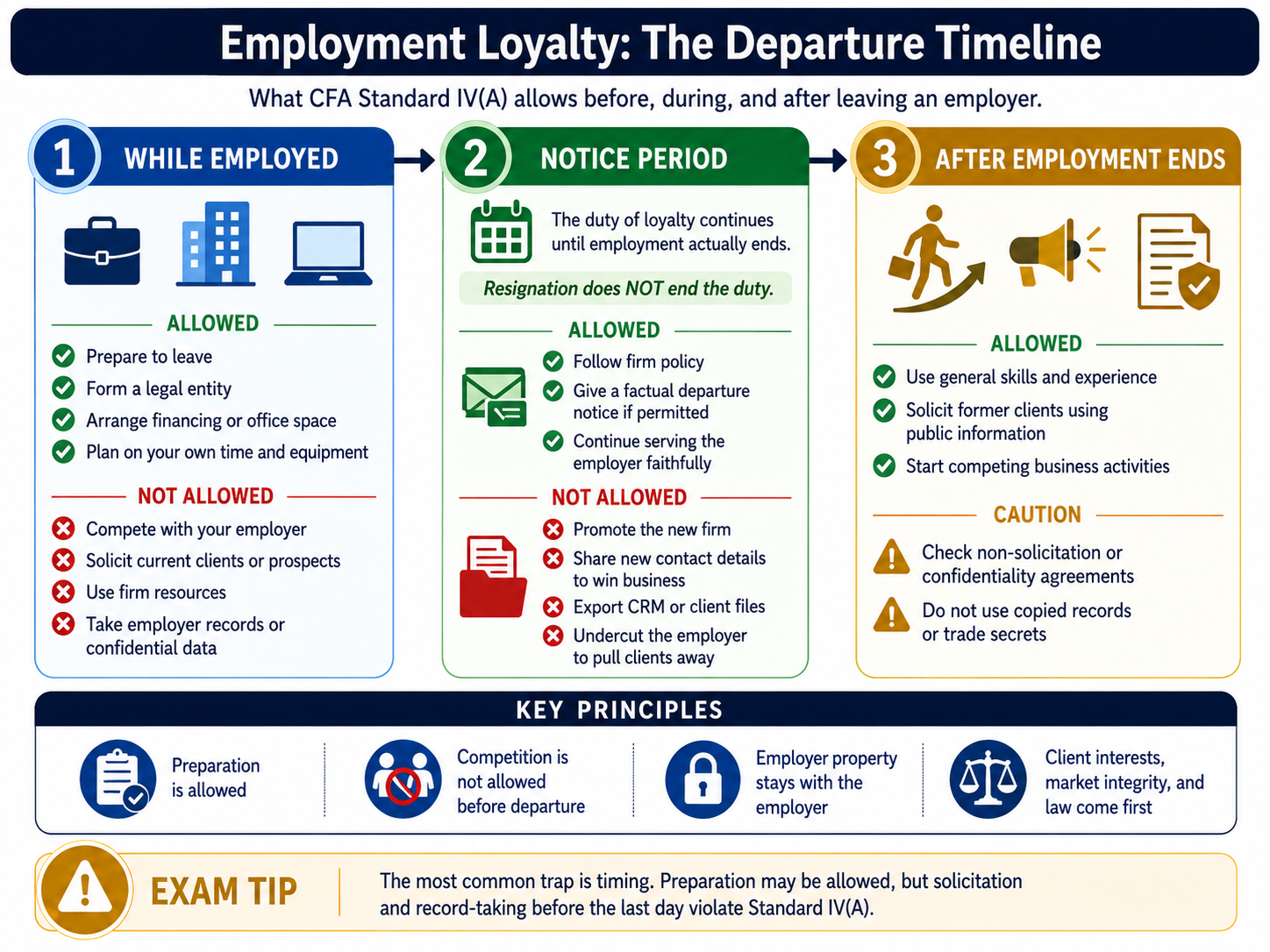
Yes, you can prepare, and no, you cannot compete yet. Planning a business, forming a legal entity, arranging financing, and handling logistics are usually fine while you are still employed, as long as you do not use the firm's resources or its clients. The line is crossed when you start providing competing services, take on conflicting outside compensated work, or pull the employer's clients toward your new venture before the employer consents. Where the new work brings outside pay, Standard IV(B): Additional Compensation Arrangements adds a written-consent requirement.
What Can You Do Before Your Employment Ends?
The duty runs through your notice period until the relationship actually ends, which means the days between handing in a resignation and your last day are still on the clock. You must not solicit the firm's current clients or prospects for your new employer, directly or through someone else. A factual departure notice may be allowed within firm policy, but it should not promote the new firm, hand out new contact details, or push clients to follow you unless that is permitted. Running down your current employer to win business is also off-limits.
What Employer Property and Information Must Be Left Behind?
Client lists, CRM data, account records, models, reports, recommended lists, presentations, work files, and trade secrets belong to the employer, including any copies sitting on your personal devices. Work you created for the employer normally belongs to the employer, not to you, even though you built it. Return, transfer, or delete it as directed, unless you have written permission to keep something. What does travel with you is different in kind: your general knowledge, your skills, your experience, and information that is genuinely public.
Can You Solicit Clients of a Former Employer?
Generally yes, once you have left, using public information, when no law or agreement prohibits it. Reaching a former client through publicly available contact details is different from working off a client list you copied on the way out. Retained, copied, or memorized confidential records are off-limits where law or an agreement protects them. Before you act, review any non-solicitation, confidentiality, or similar agreement you signed, because those terms can restrict otherwise permitted contact. The specifics vary by jurisdiction, so this is a point to check rather than assume.
Social Media, Independent Contractors, and Whistleblowing
A professional social-media account set up and approved through the firm may be firm property, along with the connections built on it for the firm. Keeping a clear line between personal and professional accounts avoids an ugly dispute later. Independent contractors are governed by the scope and expectations in their agreements rather than an employee relationship. Whistleblowing sits inside a narrow exception: acting against your employer's interest is justified only when it protects clients or market integrity, not when it serves a grievance or personal gain.
Recommended Procedures for Compliance
These are recommended practices that support the Standard.
Read and understand your firm's policies on outside business, resignation, client notification, record return, and social media.
Document employer consent before any competing service begins.
Keep personal and firm data, devices, accounts, and communications separate.
After leaving, use public sources for client contact and keep evidence of where the information came from.
Seek legal or compliance advice before acting on a restrictive agreement or a whistleblowing concern.
Compliant Scenario
Situation. While still employed, an analyst quietly plans to launch an advisory firm. She forms a legal entity, signs a future lease for office space, and drafts a business plan on her own time and equipment.
Relevant issue. She wants to prepare to compete without breaching loyalty while she is still on the payroll.
Correct action. She uses no firm property, contacts no clients, and waits until her employment ends before marketing her services to anyone.
Why it complies. Preparation that does not use employer resources, solicit clients, or harm the employer is allowed. She crosses no line because she does nothing competitive until the relationship is over.
Violation Scenario
Situation. During his notice period, a departing adviser messages current clients directly with his new firm's contact details and a note that its fees are lower. Before his final day, he exports the firm's CRM records to a personal email account.
Violation. Messaging current clients with the new firm's details is solicitation during employment. Promoting the new firm's lower fees compounds it. Exporting CRM records takes employer property.
Required alternative. Wait until employment ends, then contact clients using public information, and leave all firm records behind.
Why the original action fails. The duty of loyalty runs through the notice period, so soliciting clients and removing records before the last day breaches it. That the contact happens "while leaving" does not make it acceptable.
Common Exam Traps
Assuming a resignation letter ends the duty. It continues until the relationship actually ends, including the notice period.
Treating all preparation as prohibited. Forming an entity or leasing space can be fine when no firm resources or clients are involved.
Believing you can solicit clients early because you built the relationships. Client relationships developed at work do not become yours to solicit before you leave.
Assuming files you created belong to you. Work produced for the employer is normally the employer's property.
Confusing skills with property. Remembered skills and general experience travel with you. Copied records do not.
Thinking loyalty to the employer outranks clients and markets. It does not. Client interests, market integrity, and the law come first.
Practice Question
An adviser is leaving her firm. In the week before her final day she does four things: she registers a new company, copies a client spreadsheet to a personal drive, posts a factual departure announcement permitted by firm policy, and emails several current clients the new firm's service details and lower fee schedule. Which action most clearly violates Standard IV(A)?
Registering the new company
Posting the factual departure announcement
Copying the client spreadsheet and emailing current clients the new firm's details and fees
Correct Answer: C
Two of her actions are clear breaches bundled together. Copying the client spreadsheet takes employer property, and emailing current clients the new firm's details and fees is solicitation and promotion during employment, while the duty of loyalty is still running.
Option A. Wrong because registering a company is permitted preparation, not competition, as long as no firm resources or clients are used.
Option B. Wrong because a factual departure notice allowed under firm policy is acceptable, since it does not promote the new firm or push clients to move.
Continue Your CFA Level I Prep With KeyPoint
Use structured lessons, practice questions, mock exams, and progress tracking to focus on the time you have left
FAQs About Standard IV(A): Loyalty
Can you start a competing business while still employed?
You can prepare for one. Forming an entity, arranging financing, and planning logistics are usually fine if you do not use firm resources or solicit clients. You cannot provide competing services or pull clients across until the employer consents or your employment ends.
When can you solicit clients of a former employer?
Generally after you leave, using public information, when no law or agreement prohibits it. You cannot use copied or retained confidential client records, and any non-solicitation or confidentiality agreement you signed can restrict the contact.
Does a resignation letter immediately end the duty of loyalty?
No. The duty continues until the employment relationship actually ends, which includes your notice period. Soliciting clients or taking firm property before your last day still breaches the Standard.