
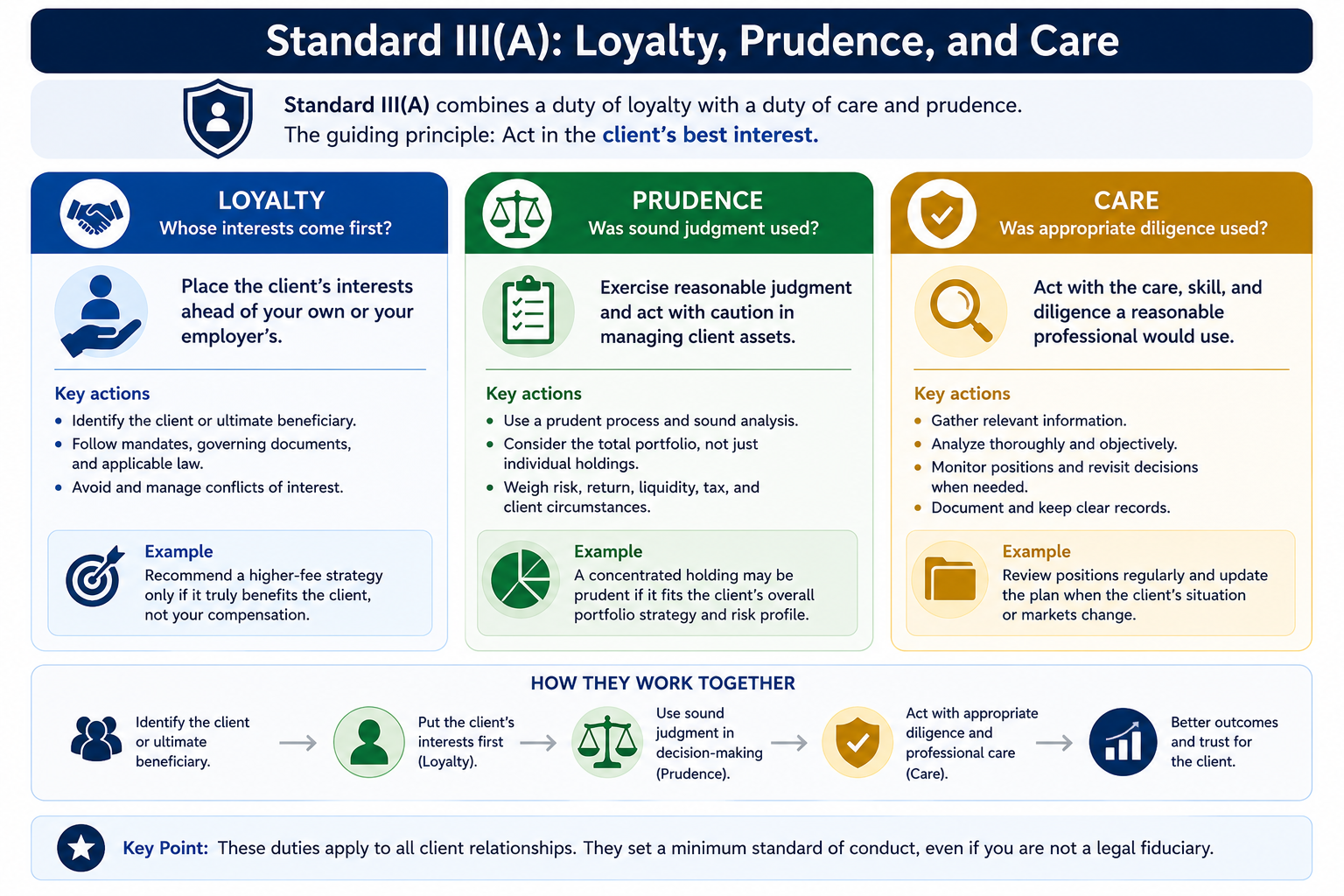
Standard III(A) sets the baseline for how you treat clients. It combines a duty of loyalty and a duty of care, plus the prudence to use sound judgment with client assets. In a scenario question, you usually start by working out who the client actually is, then ask whether a decision was made for that client's benefit or for someone else's. Most loyalty and care questions come down to that single test: who benefits.
Quick Answer
Standard III(A) requires you to place client interests ahead of your own or your employer's, and to act with the care, skill, and judgment a reasonable professional would use in similar circumstances. Loyalty asks whose interests come first. Prudence and care ask whether you acted carefully and competently. The Standard is a minimum benchmark for everyone it covers, but it does not automatically make every member a legal fiduciary.
Key Takeaways
The Standard combines a duty of loyalty with a duty of care and prudence toward clients.
Identify the client or ultimate beneficiary first. The person who hires you is not always the client.
Standard III(A) is a minimum benchmark. It does not by itself make you a legal fiduciary.
Client brokerage is a client asset. Soft-dollar and directed-brokerage decisions must benefit the client.
A common trap is treating the lowest commission as automatically equal to best execution.
What You Need to Know for CFA Level I
Identify the client or ultimate beneficiary before deciding whose interests come first. Follow governing documents, client mandates, and applicable law. Judge investment decisions in the context of the whole portfolio rather than holding by holding. Client brokerage belongs to the client, so soft-dollar arrangements have to provide a matching client benefit. Seek best price and best execution unless the client directs brokerage, and disclose when directed brokerage may reduce execution quality. Vote proxies when voting benefits the client, using a sensible cost-benefit judgment rather than a rule that every proxy must be voted.
What Do Loyalty, Prudence, and Care Require?
Standard III(A) requires loyalty to clients, the prudent exercise of judgment, and the care a competent professional would bring to managing someone else's money. The three duties work together, but they answer different questions.
Loyalty asks whose interests come first, and the answer is the client's, ahead of your own and your employer's. Prudence asks whether your judgment is cautious and reasonable for the circumstances. Care asks whether you acted diligently to avoid harming the client. The duties overlap in practice, but they are not interchangeable, and a scenario can satisfy one while breaching another.
Who Is the Client?
The client is the person or party whose interests you are bound to serve, and that is not always the one who signs the engagement. For an individual advisory relationship, the client is straightforward. For a pension plan or a trust, the client is the beneficiaries, not the plan sponsor or the trustee who hired you.
This distinction decides a lot of scenarios. When a sponsor's preference and the beneficiaries' interests pull in different directions, the duty of loyalty runs to the beneficiaries. For a portfolio managed to a stated mandate, the duty is shaped by that mandate. Settle who the client is before you judge whose interests should win.
Is Standard III(A) the Same as a Fiduciary Duty?
No, not automatically. Legal fiduciary status depends on the law, the regulation, your role, and the specific relationship. Some members are legal fiduciaries and some are not.
What Standard III(A) does is set a minimum benchmark for client treatment, and it requires you to comply with any stricter legal duty that applies to you. So the Standard can sit alongside a legal fiduciary duty, but it does not create one on its own. Calling every member a fiduciary simply because the Standard applies is a mistake the exam likes to test.
How Do You Apply Prudence and Care to a Portfolio?
Prudence and care play out at the portfolio level. You work from the client's objectives, guidelines, and governing documents, and you weigh diversification, liquidity, tax effects, cash-flow needs, risk, and return together.
The key principle is total-portfolio context. An asset that looks risky on its own can be appropriate inside a diversified portfolio, because what matters is its effect on the whole, not its standalone profile. Judging a single holding in isolation, without that context, is how careful analysis goes wrong. For the detailed process of matching investments to a specific client, see Standard III(C): Suitability.
How Do Soft Dollar Arrangements and Directed Brokerage Work?
Brokerage commissions belong economically to the client, because they are paid with client money. That single idea drives the soft-dollar rules. You can use client brokerage to buy research or services only when those purchases provide a corresponding benefit to the client.
Best execution means seeking the best combination of price and execution quality for the client, not just the lowest stated commission. Directed brokerage is different. When a client instructs you to route trades through a particular broker, you can usually follow that instruction, but you should confirm that the arrangement benefits the client and disclose that best execution may not be achieved through the directed broker. The cheapest commission is not automatically best execution, and a soft-dollar deal that mainly benefits your firm is a loyalty problem.
What Are the Duties for Proxy Voting and Client Assets?
Proxies have economic value, so you should vote them in an informed way when voting benefits the client. That said, you are not required to vote every proxy regardless of cost. A reasonable cost-benefit analysis can justify not voting where the effort plainly outweighs the value to the client.
When you hold or control client assets, your responsibility rises. Keep client assets separate from firm assets, disclose where they are held, report transactions accurately, and apply heightened care wherever you have custody. The thread through all of it is the same: client assets and client decisions exist for the client's benefit.
Recommended Procedures for Compliance
Start by identifying the client and documenting the obligations that govern the relationship, then set objectives, constraints, and a review schedule. Put your soft-dollar, best-execution, proxy-voting, and custody approaches in writing, and keep client assets separate with clear account reporting.
When something looks questionable, disclose it and get informed client approval where that is appropriate. Consent has limits, though. A client's agreement does not turn a breach of the Standard into compliant conduct, so disclosure is a safeguard, not a license.
Compliant Scenario
Situation. A municipal pension plan sponsor instructs Hannah Osei to route a portion of the plan's trades through a named broker. The arrangement gives the plan access to specialized research that genuinely helps manage the beneficiaries' assets. The directed broker's execution is sometimes slightly less favorable than the cheapest available.
Relevant issue. The instruction is directed brokerage. The question is whether Hannah can follow it without breaching her duty of loyalty to the beneficiaries.
Correct action. She confirms that the research benefits the beneficiaries, follows the instruction, and discloses that execution through the directed broker may not always be the most favorable.
Why it complies. The client directed the brokerage, the arrangement provides a real benefit to the beneficiaries, and the possible execution trade-off was disclosed.
Violation Scenario
Situation. Desmond Park routes client trades through a broker that charges higher commissions than other available options. In exchange, the broker provides his firm with office software and pays for staff to attend an industry conference. These benefits go to the firm, not to the clients whose commissions paid for them.
Violation. Desmond used client brokerage, a client asset, to obtain benefits that primarily helped his firm, with no corresponding benefit to the clients.
Required alternative. He should have sought best execution for clients and used soft dollars only for research or services that benefit those clients.
Why the original action fails. Client commissions were spent for the firm's advantage rather than the client's, which breaches the duty of loyalty even if the trades were otherwise reasonable.
Common Exam Traps
Treating the person who hires you as the client. For a pension or trust, the client is the beneficiaries, not the sponsor or trustee who signed the contract.
Calling everyone a fiduciary. Standard III(A) is a minimum benchmark. Legal fiduciary status depends on law and role, and the Standard does not create it on its own.
Equating the cheapest commission with best execution. Best execution weighs price and execution quality together, not just the lowest stated commission.
Treating all soft dollars as banned or all as fine. Soft-dollar arrangements are acceptable only when the research or service benefits the client. The blanket version, either way, is wrong.
Voting every proxy no matter what. Proxies should be voted when it benefits the client, judged with a cost-benefit analysis. Not every proxy must be voted.
Judging a holding in isolation. A standalone risky asset can be appropriate in total-portfolio context. Context, not the single holding, drives the analysis.
Practice Question
A portfolio manager runs a corporate pension plan. The plan sponsor asks the manager to direct trades to a specific broker because the broker supplies research the sponsor believes will help the plan. The directed broker's execution is occasionally less favorable than other brokers. The manager wants to satisfy the duty of loyalty under Standard III(A).
Which action best satisfies that duty?
Decline the request, because directing brokerage to a specific broker always breaches the duty of loyalty.
Follow the instruction only after confirming the research benefits the plan beneficiaries and disclosing that execution may be less favorable.
Follow the instruction without further steps, because the sponsor hired the manager and is therefore the client.
Correct Answer: B
The client is the plan's beneficiaries, not the sponsor who hired the manager. The manager can follow a directed-brokerage instruction, but the duty of loyalty runs to the beneficiaries, so the manager must confirm the arrangement benefits them and disclose the possible execution trade-off.
Option A is wrong because directed brokerage is not banned. It is allowed when the client directs it and the client benefits.
Option C is wrong because it misidentifies the client. The sponsor signed the contract, but the beneficiaries are the client, and following the instruction blindly skips the required confirmation and disclosure.
Continue Your CFA Level I Prep With KeyPoint
Use structured lessons, practice questions, mock exams, and progress tracking to focus on the time you have left
FAQs About Standard III(A): Loyalty, Prudence, and Care
What is the difference between duty of care and duty of loyalty?
The duty of loyalty asks whose interests come first, and the answer is the client's, ahead of your own and your employer's. The duty of care asks whether you acted with the skill, diligence, and prudent judgment a competent professional would use. One is about priority; the other is about competence and diligence.
Does CFA Standard III(A) make every member a fiduciary?
No. The Standard is a minimum benchmark for client treatment and requires compliance with any stricter legal duty that applies. Legal fiduciary status depends on law, regulation, role, and relationship, not on the Standard alone.
When are soft dollar arrangements allowed?
Soft-dollar arrangements are allowed when client brokerage buys research or services that provide a corresponding benefit to the client. Because commissions are a client asset, using them mainly for the firm's benefit breaches the duty of loyalty.
Must an investment manager vote every client proxy?
No. Proxies should be voted in an informed way when voting benefits the client. A reasonable cost-benefit analysis can justify not voting where the cost clearly outweighs the value to the client.