
Standard IV(B) governs benefits you receive from someone other than your employer. The concern is conflict: an outside payment or perk can pull your judgment away from the employer's interests. The Standard protects the employer by requiring written consent before you accept anything that competes with, or could reasonably create a conflict with, its interests. Many CFA® Level I exam questions hinge on whether the benefit was cash and whether consent came before acceptance.
Quick Answer
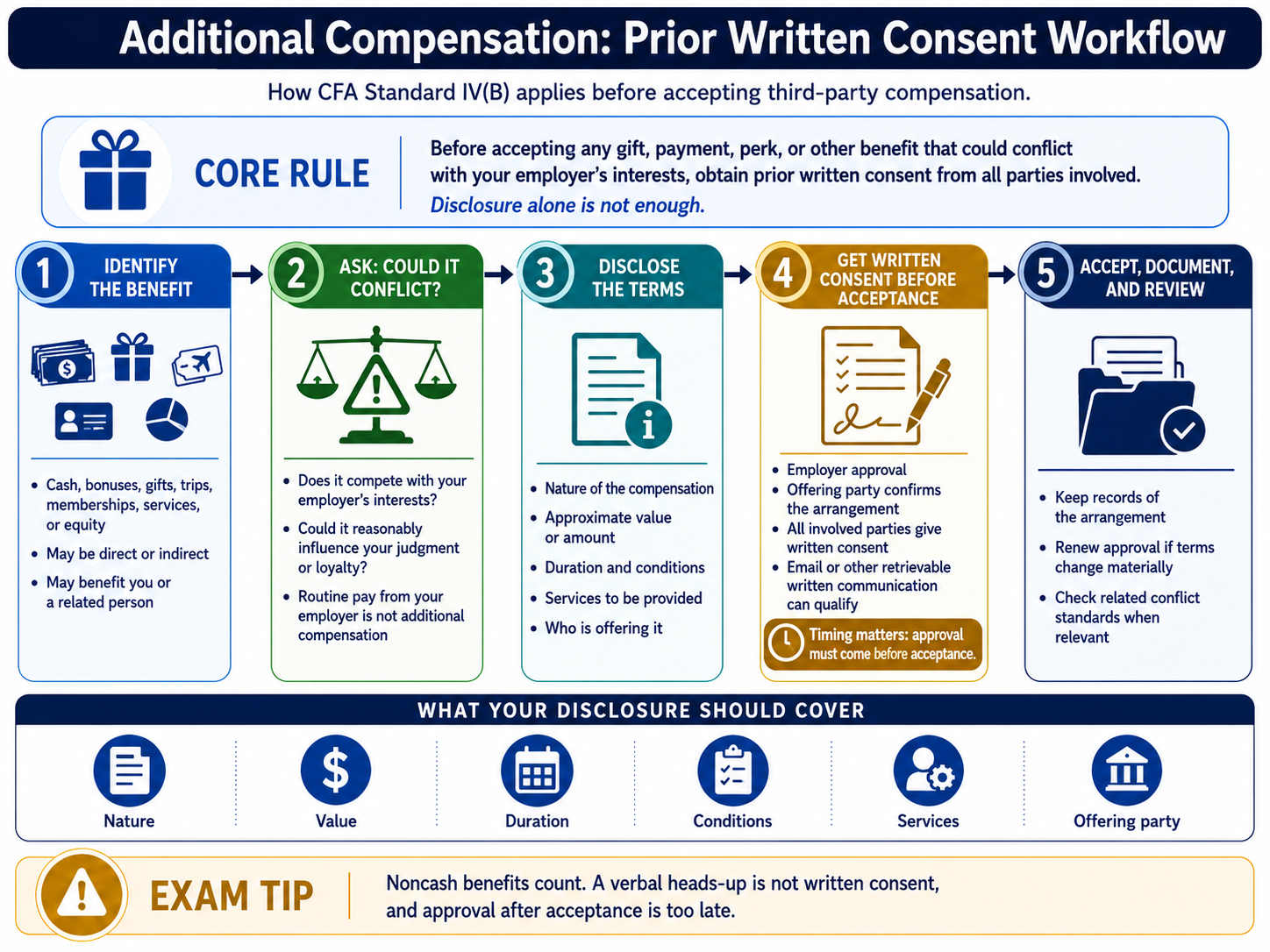
Additional compensation is a gift, benefit, payment, or other advantage from a client or third party that competes with, or could reasonably create a conflict with, your employer's interests. You must obtain written consent from all parties involved before accepting it. Noncash and indirect benefits count, and disclosing the arrangement after you have already accepted it is too late.
Key Takeaways
The trigger is conflict with the employer's interests, not whether the benefit is cash.
The benefit can be monetary or nonmonetary, direct or indirect, and may go to you or a related person.
Written consent must come from all parties involved and must come before acceptance.
Disclosure and consent are different steps. Telling someone is not the same as getting approval.
Routine pay from your employer under your existing arrangement is not additional compensation.
A common trap is assuming only cash counts, or that mentioning it afterward is enough.
What You Need to Know for CFA Level I
The arrangement may be monetary or nonmonetary and may benefit you or people related to you.
The real question is whether the benefit competes with, or could reasonably create a conflict with, your employer's interests.
Written consent can be documented through retrievable electronic communication such as email.
The disclosure should describe the nature, approximate amount or value, duration, and terms of the compensation.
The party offering the benefit should confirm or acknowledge the arrangement.
Part-time employees and contractors should set outside-work parameters when the relationship begins.
What Is Additional Compensation?
It is any benefit from a client or third party that could pull against your employer's interests. The form is wide: salary supplements, client performance bonuses, board benefits, consulting fees, trips, memberships, gifts, services, and equity all qualify. The nature of compensation does not have to be a paycheck for the Standard to apply. What does not count is the routine pay your employer already provides under your existing arrangement.
What Is an Example of Third-Party Compensation?
Several short examples show the range, and not every one is automatically a violation:
A client offers you a paid trip if a portfolio beats a target return. This ties a benefit to your work and can affect how you treat that client's account, so it likely creates an employer conflict.
A company gives you free membership privileges for serving on its board. The benefit is nonmonetary, but it still has economic value and a potential conflict.
An issuer pays you a consulting fee. Outside paid work that touches your professional role can conflict with your employer and may also raise independence concerns.
A vendor offers a benefit linked to where you place the firm's business. That ties a personal reward to a firm decision.
A small social gift with no tie to your services is not automatically additional compensation. Look at purpose, value, and connection to your work rather than reacting to the word "gift."
What Does Written Consent Require?
Disclosure and consent are not the same step, and the exam rewards candidates who separate them. You disclose the arrangement, then obtain prior written consent from your employer and all parties involved before you accept the benefit. A retrievable email or other documented communication satisfies the written requirement. Silence, a verbal heads-up, or approval that arrives after you accept does not meet the safest answer.
What Information Must Be Disclosed?
Give the employer enough to weigh the conflict: the nature of the compensation, the approximate amount or value, the duration, the conditions, any performance triggers, the services you would render, and who is offering the benefit. The offering party should confirm the terms. The detail is practical, because the employer needs to assess your loyalty, objectivity, workload, and the true cost of your services before it can sensibly agree.
How Does Standard IV(B) Interact With Other Standards?
One set of facts can engage several Standards at once. A client gift that could sway how you treat the account can reach Standard I(B): Independence and Objectivity. Outside business that competes with the employer reaches Standard IV(A): Loyalty. A conflict the client needs to weigh reaches Standard VI(A): Disclosure of Conflicts. Referral compensation reaches Standard VI(C): Referral Fees. Clearing the written-consent test under IV(B) does not automatically satisfy any of those, so check each one that the facts touch.
Recommended Procedures for Compliance
These are recommended practices that support the Standard.
Submit the proposed arrangement to your supervisor or compliance officer before accepting it.
Use a standard written form that captures all terms and every affected party.
Get written confirmation from the offering party and written consent from the employer and other involved parties.
Renew consent when the amount, duration, service, or performance condition changes in a material way.
Keep a register of approved outside compensation arrangements.
Compliant Scenario
Situation. A client offers a portfolio manager a year-end cash bonus if the account beats a stated benchmark over the year.
Relevant issue. The bonus ties a personal reward to the manager's handling of that client's account, which can conflict with the employer's interests.
Correct action. Before accepting, the manager discloses the amount, the performance condition, the duration, and the services to the employer. The client confirms the terms in writing, and the employer and all involved parties provide written consent in advance.
Why it complies. The consent is written, specific, and obtained before acceptance, so the employer can judge the conflict with full information. Timing and detail are what make it work.
Violation Scenario
Situation. An analyst joins a company's board and receives free family travel and club membership privileges in return. He does not disclose any of it, reasoning that no cash changed hands.
Violation. The benefits are nonmonetary, but they carry clear economic value and a potential conflict with his employer, which brings them inside Standard IV(B). He accepted them without written consent.
Required alternative. Disclose the nature and value of the travel and membership, obtain written consent from the employer before accepting, and have the company confirm the terms.
Why the original action fails. "No cash" is not an exemption. The Standard reaches monetary and nonmonetary benefits alike, and skipping consent because the perk was not cash is a misread of the rule.
Common Exam Traps
Assuming only cash counts. Trips, memberships, services, and equity are additional compensation too.
Treating disclosure as consent. Telling the employer is one step. Getting written approval is the step that matters.
Getting approval after accepting. Consent has to come before you accept the benefit.
Dismissing a small or indirect benefit. Even a minor or indirect perk needs analysis for a possible employer conflict.
Disclosing the existence but not the terms. The value, duration, conditions, and services all have to be on the table.
Assuming IV(B) covers the client duty too. Satisfying IV(B) does not remove a separate obligation to disclose a conflict to clients.
Practice Question
An employee receives an annual client-funded vacation after a year of strong account performance. Before traveling, she mentions the trip verbally to her supervisor, who nods. Neither the client nor the employer ever documents consent. Does the arrangement comply with Standard IV(B)?
Yes, because she told her supervisor before the trip
No, because she did not obtain prior written consent from all parties involved
Yes, because the vacation is a noncash benefit and the Standard covers only cash
Correct Answer: B
The vacation is a third-party benefit tied to her work, so it competes with or could create a conflict with the employer's interests. The Standard requires prior written consent from all parties involved, and a verbal mention with a nod is not written consent.
Option A is wrong because disclosure and a casual verbal acknowledgment do not meet the written-consent requirement.
Option C is wrong because the Standard covers nonmonetary benefits as well as cash, so the trip is squarely within Standard IV(B).
Continue Your CFA Level I Prep With KeyPoint
Use structured lessons, practice questions, mock exams, and progress tracking to focus on the time you have left
FAQs About Standard IV(B): Additional Compensation Arrangements
What is an example of third-party compensation?
A client offering you a paid trip or bonus tied to portfolio performance, a company giving you board membership privileges, or an issuer paying you a consulting fee. Each comes from someone other than your employer and can create a conflict, so each needs prior written consent.
Does nonmonetary compensation require written consent?
Yes. Travel, memberships, services, gifts, and equity carry economic value and can conflict with your employer's interests, so they require the same prior written consent as cash.