
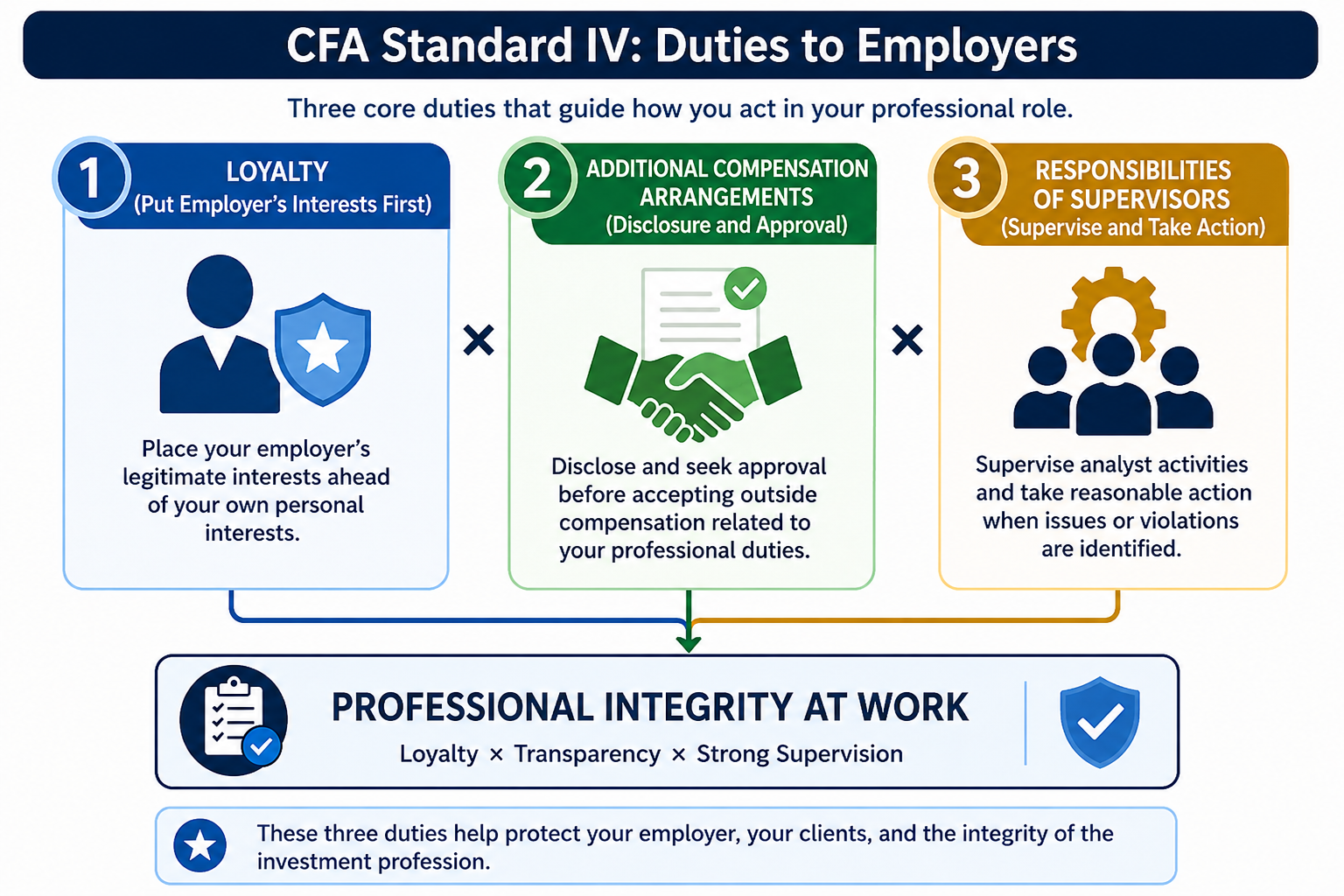
CFA® Standard IV is the framework for three employment-related obligations: loyalty to your employer, consent for outside compensation, and the duties you take on when you supervise others. Loyalty in ethics here is narrow, not absolute. It does not ask you to put your employer above the law or above your clients. The skill the exam tests is separating the employee's own conduct from the supervisor's systems and response.
Quick Answer
CFA Standard IV, Duties to Employers, has three parts.
IV(A) Loyalty asks employees to avoid conduct that harms the employer in employment-related matters.
IV(B) Additional Compensation Arrangements requires written consent before you accept compensation or benefits that could conflict with your employer's interests.
IV(C) Responsibilities of Supervisors requires supervisors to make reasonable efforts to promote compliance and to act on suspected violations.
Key Takeaways About CFA Standard IV Duties to Employers
Employees may prepare to leave, but they cannot harm the current employer while still employed.
Employer records and confidential information generally belong to the employer.
Competing after you leave may be allowed, subject to law and any agreement you signed.
Outside compensation that could conflict with employer interests needs written consent from the relevant parties.
Supervisors need reasonable compliance procedures that are communicated and enforced.
Supervisors must investigate and act when credible warning signs appear.
What You Need to Know for CFA Level I
Learn the names and order of IV(A) through IV(C). Know where employer loyalty starts and stops, and that it never overrides the law or your duty to clients. Understand what an employee may do while preparing to leave, what crosses into active competition, and when contact with clients becomes a problem. Know the consent rule for additional compensation and what a reasonable supervisory system looks like. Duties to employers cfa questions often connect to Standards I, III, and VI, so watch for the overlap.
What Does Standard IV Cover?
Standard IV covers loyalty, outside compensation, and supervision. The cleanest way to read a question is to ask whether the issue is the employee's own conduct, an outside incentive, or a control failure.
Standard IV(A): Loyalty
Standard IV(A) protects the employer's interests in employment-related matters. While employed, you should not deprive your employer of your skills, of profit, of a business opportunity, or of confidential information. A conflict of loyalty appears when your plans for the future start to harm the firm paying you today.
Preparing to leave can be fine on its own. It becomes a violation when it involves active competition, soliciting current clients, taking records, or other harmful conduct. Applicable law and your employment agreement set the outer limits, and loyalty never requires you to join in illegal or unethical acts.
Standard IV(B): Additional Compensation Arrangements
Standard IV(B) asks you to get written consent before accepting compensation, benefits, or consideration that could conflict with your employer's interests. The consent has to reflect the real nature of the arrangement. Noncash benefits can count, not just cash.
At the overview level, keep one distinction in mind: a future or contingent reward, such as a client-funded performance bonus, is different from a simple gift for past work. Where objectivity or a broader conflict is also in play, this connects to I(B) and VI(A).
Standard IV(C): Responsibilities of Supervisors
Standard IV(C) asks supervisors to make reasonable efforts to ensure that the people under them follow the law and the Code and Standards. That means establishing, communicating, monitoring, and enforcing suitable procedures.
When credible warning signs appear, a supervisor investigates rather than waits. Where needed, the supervisor restricts activity or increases oversight. If adequate compliance systems cannot be put in place, current guidance allows a professional to decline or limit supervisory responsibility.
Standard IV Comparison Table
Substandard | Main Question | Common Trigger | Required Response |
|---|---|---|---|
IV(A) Loyalty | Is the employee harming the current employer? | Competing business, departure, records, client contacts | Avoid harmful conduct and protect employer property |
IV(B) Additional Compensation | Could outside compensation conflict with employer interests? | Client bonus, third-party benefit, contingent reward | Obtain appropriate written consent |
IV(C) Responsibilities of Supervisors | Were reasonable compliance systems and responses in place? | Weak controls, ignored warning signs, subordinate misconduct | Implement procedures, investigate, restrict, and escalate |
Leaving an Employer Without Violating Standard IV(A)
Departure questions are easier once you split the timeline into before and after the resignation takes effect.
Before Resignation
Often permissible while still employed:
Updating a personal resume.
Exploring opportunities and interviewing.
Forming general plans for future work.
Seeking legal advice on your obligations.
Often problematic while still employed:
Soliciting current clients.
Taking employer records or client lists.
Using confidential information for your future venture.
Diverting a business opportunity away from the employer.
Doing competing work on the employer's paid time without consent.
After Resignation
Once you have left, the rules on soliciting clients of former employer relationships ease, and contact may be permissible when a few conditions hold:
No law or enforceable agreement prohibits it.
You do not use the former employer's records or confidential data.
You rely on publicly available information or lawful personal knowledge, such as remembering a contact.
The contact is not built on misconduct you committed before leaving.
This is not legal advice. Local law and the terms of any noncompete or nonsolicitation agreement control the outcome.
Standard IV and Related CFA Standards
Standard IV often meets its neighbors. Client interests under III(A) can outrank employer interests, so loyalty has a ceiling. Outside compensation under IV(B) can threaten objectivity under I(B) and can create a conflict that VI(A) expects you to avoid or disclose. A supervisor's duty under IV(C) ties back to I(A), since promoting compliance means promoting compliance with applicable law. And weak dissemination procedures, a supervisory gap under IV(C), can produce unfair dealing under III(B).
Mixed Duties to Employers Example
A senior analyst has accepted a job at a competing firm and will start in a month. Before resigning, he copies his current firm's client list to a personal drive. He has also agreed to a client-funded bonus tied to the performance of an account he manages, without telling his employer. Meanwhile, he supervises a junior analyst and notices unusual trading in a personal account but does nothing about it.
Separate the three issues. Copying the client list before leaving is a IV(A) loyalty problem, since the records belong to the employer. Accepting the client-funded performance bonus without written employer consent is a IV(B) problem. Ignoring the junior analyst's suspicious activity is a IV(C) supervisory failure. Each one stands on its own.
Common Exam Traps
Assuming an employee can never prepare to compete.
Treating every client contact after departure as automatically prohibited.
Ignoring local law and the employment agreement.
Accepting verbal consent as enough for conflicting compensation.
Treating a past-performance gift and a future contingent bonus as the same thing.
Assuming a supervisor violates the Standard every time a subordinate does.
Practice Question
While still employed, an analyst plans to open a competing advisory firm after she leaves her current employer. Which action is most likely compliant with Standard IV(A) before she resigns?
Emailing the firm's client list to her personal account for later use.
Registering the new business name and arranging office space for use after her start date.
Telling current clients to move their accounts to her once she launches.
Correct Answer: B
Preparing to leave, such as registering a business name and arranging premises for later use, is generally permissible when it does not harm the current employer, misuse confidential information, or solicit current clients.
Option A misappropriates employer property.
Option C solicits current clients while she is still employed, which harms the employer she still works for.
Continue Your CFA Level I Prep With KeyPoint
Use structured lessons, practice questions, mock exams, and progress tracking to focus on the time you have left
FAQs About Guidance for Standard IV: Duties to Employers
What is CFA Standard IV?
CFA Standard IV, Duties to Employers, covers employment-related loyalty, consent for outside compensation, and the responsibilities of supervisors. It applies to employees and to those who oversee them.
What does loyalty to an employer require?
It requires you to avoid conduct that harms your employer in employment-related matters, such as misusing confidential information or diverting business. It does not require you to follow your employer into illegal or unethical conduct, and it does not override your duties to clients.
Can an employee prepare to start a competing business?
Often yes. Preparing to leave, such as planning, interviewing, or seeking legal advice, can be permissible. It crosses into a violation when it involves soliciting current clients, taking records, or competing on the employer's time.
Can a former employee solicit former clients?
Sometimes. After leaving, soliciting former clients may be permissible when no law or enforceable agreement prohibits it and the former employee does not use the employer's records or confidential data. Local law and any agreement control.
Does additional compensation require written consent?
Yes, when the compensation or benefit could conflict with your employer's interests. Written consent from the relevant parties is the standard, and it should reflect the actual nature of the arrangement.
When does a supervisor violate Standard IV(C)?
A supervisor can violate IV(C) by failing to put reasonable compliance procedures in place, or by ignoring credible warning signs of misconduct. A subordinate's violation does not by itself prove the supervisor failed.