
Duration measures how much a bond's price changes when its yield changes. There are two ways to estimate it, and CFA® Level I expects you to tell them apart. Analytical duration is built from a formula or a pricing model. Empirical duration is built from history, by looking at how a bond's price has actually moved when benchmark yields shifted.
Quick Answer
Analytical duration comes from a formula or valuation model. Empirical duration comes from historical data, measured from how a bond's price has actually responded to benchmark yield changes. The two usually agree for high-quality bonds. They can diverge for lower-quality bonds, especially when credit spreads and benchmark yields move in opposite directions.
Key Takeaways: Analytical vs Empirical Duration
Analytical duration uses mathematical formulas or a valuation model to estimate price sensitivity.
Empirical duration uses historical data and observed price behavior instead of a formula.
Analytical duration works best when the relationship between yield changes and price changes is stable.
Empirical duration can matter more when credit spreads and benchmark yields move in ways a formula misses.
The common exam trap is assuming the two measures always produce the same number.
What You Need to Know for CFA Level I
Identify which measure is model-based (analytical) and which is history-based (empirical).
Explain why empirical duration can come out lower for a lower-quality bond during a flight to quality.
Compare the two measures for a government bond against a high-yield corporate bond.
Keep empirical duration separate from effective duration, which is a different idea.
Remember the outcome asks you to describe the difference, not to run a regression.
Analytical vs Empirical Duration: Main Difference
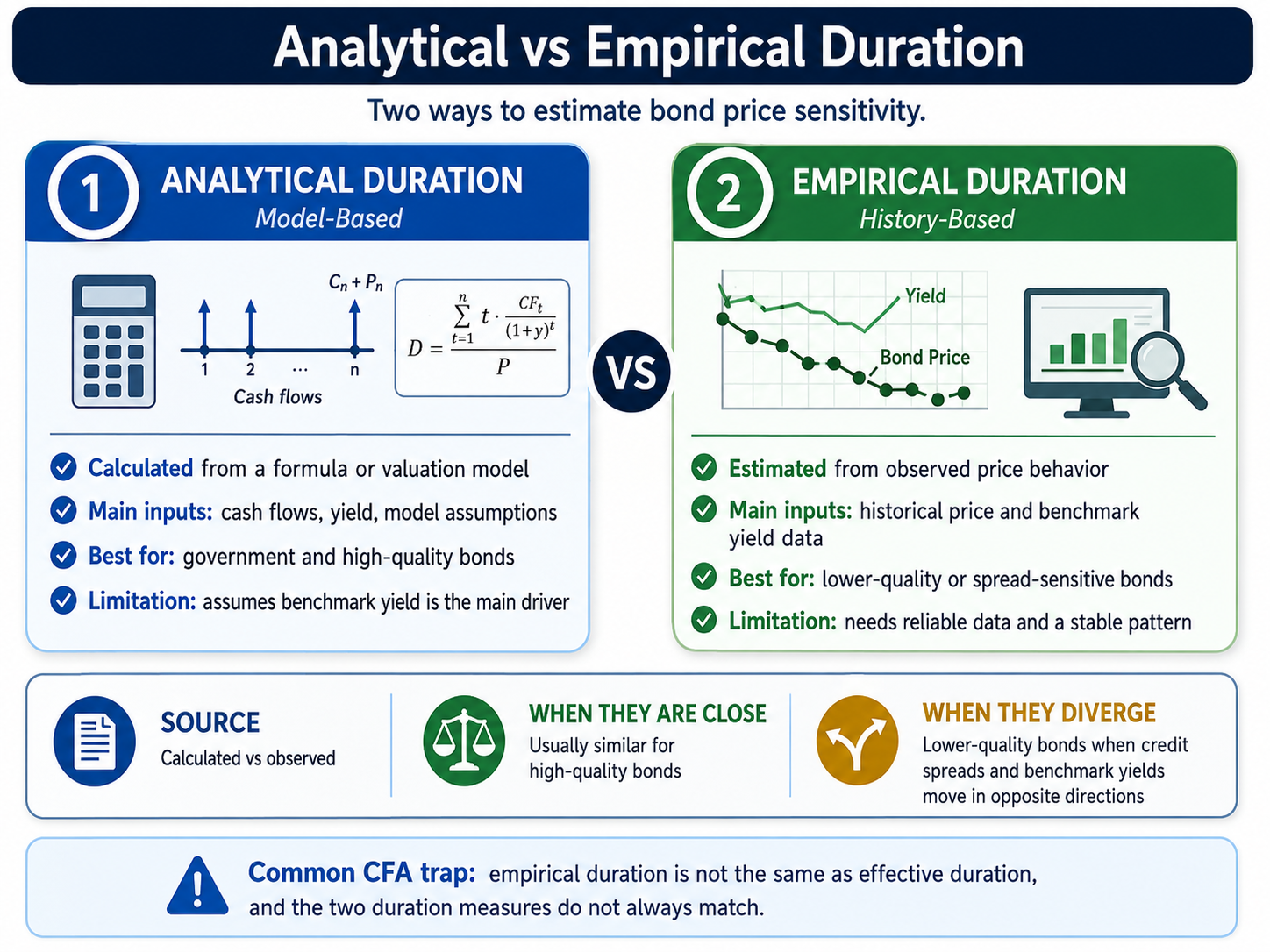
The main difference between analytical and empirical duration is the source of the estimate. Analytical duration is calculated. Empirical duration is observed.
Analytical duration starts with the bond's cash flows and a discount rate, then uses a formula or model to work out how price should respond to a yield change. Empirical duration starts with market history, then measures how the price has actually moved when the benchmark yield moved. One trusts the model. The other trusts the data.
What Is Analytical Duration?
Analytical duration is a model-based estimate of price sensitivity. It is the duration most candidates meet first, because measures such as modified duration and effective duration are all analytical.
The method assumes the benchmark yield is the main driver of price. It also assumes credit spreads are not moving against the benchmark at the same time. When that assumption holds, analytical duration is accurate and easy to apply. It is the natural choice for government bonds and other high-quality issues, where price really does track the benchmark yield closely.
What Is Empirical Duration?
Empirical duration is a history-based estimate. It does not assume how price should react. Instead, it measures how price has reacted, using past data on the bond or similar bonds.
This matters because real bond prices reflect more than the benchmark yield. They also reflect credit spreads, liquidity, and how investors behave under stress. Empirical duration captures those combined effects, because it reads them straight from observed prices. For a lower-quality bond, that often produces a smaller duration than the formula gives. The reason is that spread moves soften the bond's response to benchmark yields.
Comparison Table
Feature | Analytical Duration | Empirical Duration |
|---|---|---|
Definition | Model-based estimate of price sensitivity | History-based estimate from observed prices |
Main input | Cash flows, yield, and a formula or model | Past price and yield data |
Best use case | High-quality bonds with a stable yield-price link | Lower-quality bonds where spreads and yields interact |
Strength | Precise and easy to compute | Reflects real market behavior, including spreads |
Limitation | Assumes spreads do not move against the benchmark | Needs reliable data and a stable historical pattern |
Common CFA trap | Assuming it always matches observed behavior | Confusing it with effective duration |
When Does Empirical Duration Matter More?
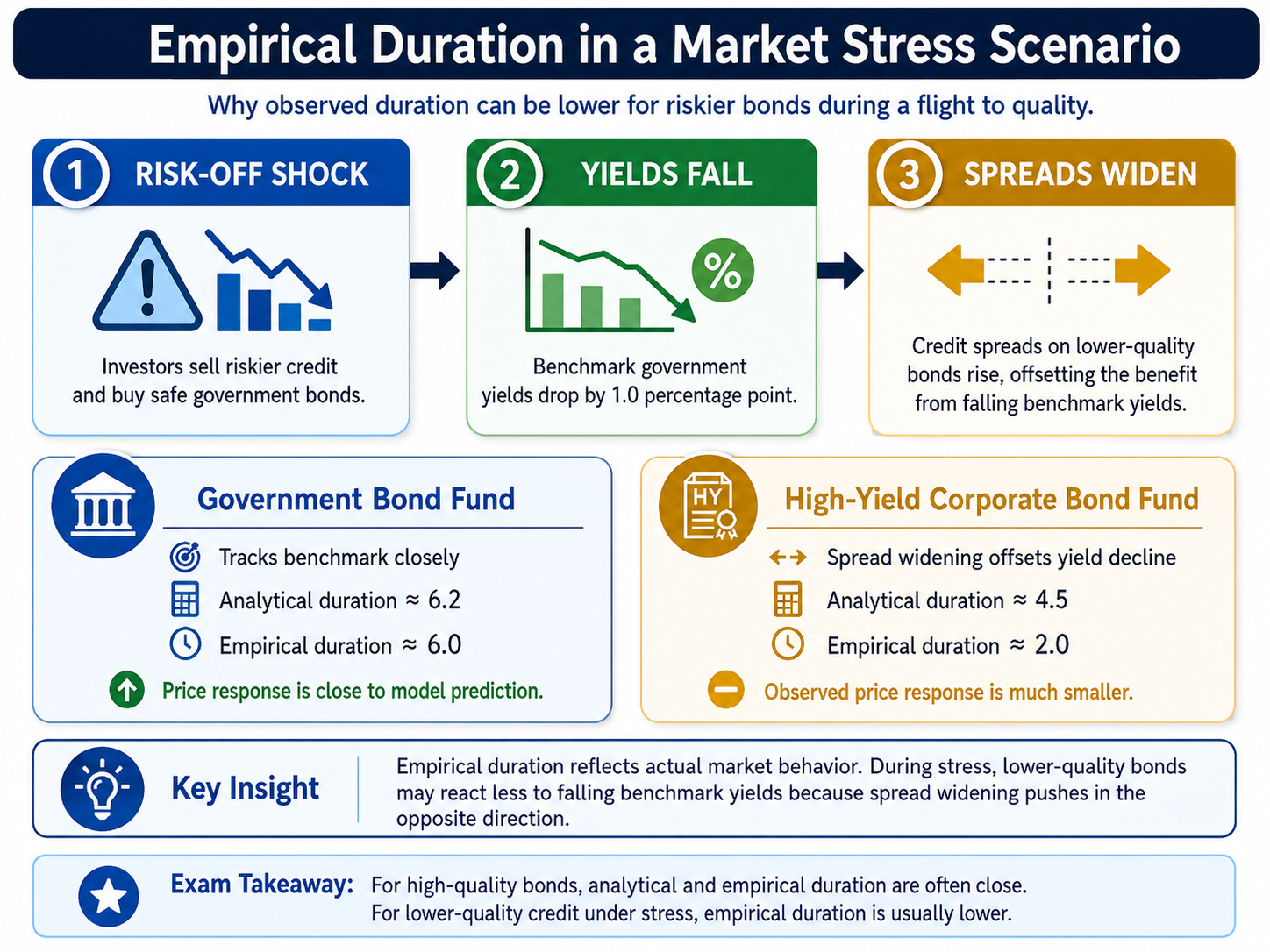
Empirical duration matters more when credit spreads and benchmark yields move in opposite directions. That is exactly what tends to happen during a risk-off market, also called a flight to quality.
In a flight to quality, investors sell riskier bonds and buy safe government bonds. Benchmark government yields fall, which would normally push every bond's price up. At the same time, credit spreads on riskier bonds widen, which pushes their prices down. For a lower-quality bond, those two forces fight each other. So its price moves far less than a formula based on benchmark yields alone would predict.
Example: Two Funds in a Risk-Off Market
Suppose a benchmark government yield falls by 1 percentage point during a sudden risk-off week. Compare two funds.
A government bond fund holds high-quality sovereign bonds. Its price tracks the benchmark closely, so its analytical and empirical durations sit close together, say around 6.2 and 6.0 years. The formula and the history tell roughly the same story.
A high-yield corporate bond fund is different. Its analytical duration might read about 4.5 years, suggesting a solid price gain when yields fall. But as government yields drop, credit spreads on these bonds widen, so the price barely moves. Measured from that behavior, its empirical duration could come out closer to 2.0 years. The history shows a far smaller response than the formula expected. These figures are made up, but the direction is the point. For lower-quality credit under stress, empirical duration is usually the lower and more realistic of the two.
Common Exam Traps
Treating empirical duration as a more precise version of analytical duration. It is a different method, not a refinement.
Confusing empirical duration with effective duration. Effective duration is still model-based and reprices the bond across a yield curve shift. Empirical duration reads actual historical prices.
Ignoring credit spread behavior when judging a lower-quality bond. The spread move is the whole reason the two measures split apart.
Reaching for regression math. Level I asks you to describe the difference, so save the statistics for later levels.
Practice Question
A portfolio manager is estimating the interest rate sensitivity of a fund holding lower-rated corporate bonds. The market is in a flight to quality, with government yields falling and credit spreads widening. Which duration measure is more likely to reflect how the fund's price actually behaves?
Analytical duration, because it is calculated from a precise formula
Empirical duration, because it reflects observed price behavior under these conditions
Both measures will give the same result, since duration is duration
Correct answer: B
Empirical duration is measured from observed price movements, so it captures the offset between falling benchmark yields and widening spreads. That offset is the key feature of a flight to quality for lower-quality credit.
Option A. A is wrong because analytical duration assumes spreads are not moving against the benchmark, which is the assumption that breaks down here.
Option C. C is wrong because the two measures often diverge for lower-quality bonds, and assuming they match is the classic trap.
Continue Your CFA Level I Prep With KeyPoint
Use structured lessons, practice questions, mock exams, and progress tracking to focus on the time you have left
FAQs About Analytical Duration and Empirical Duration
What is analytical duration?
Analytical duration is a model-based measure of price sensitivity. It uses a formula or valuation model to estimate how a bond's price changes when its yield changes.
What is empirical duration?
Empirical duration is estimated from historical data. It measures how a bond's price has actually moved when benchmark yields moved, so it reflects real market behavior.
When is empirical duration useful?
It is most useful for lower-quality bonds and during market stress, when credit spreads and benchmark yields move in different directions and a formula alone can mislead.
Is empirical duration the same as effective duration?
No. Effective duration is still model-based and reprices the bond for a change in the yield curve. Empirical duration comes from observed historical prices, not from a model.