
Assessing corporate creditworthiness means judging whether a company can and will meet its debt obligations. For CFA Level I, you do this by reviewing business risk, financial risk, cash flow, leverage, liquidity, and debt structure together, not one ratio in isolation. The goal is a single view of credit quality that explains the issuer's default risk and the yield investors demand to hold its bonds.
Quick Answer
Corporate creditworthiness is an issuer's ability and willingness to pay interest and repay principal on time. Analysts assess it by reviewing business risk, financial risk, cash flow, leverage, liquidity, and debt structure. CFA Level I questions often give you two issuers and ask which has stronger credit quality based on ratios and characteristics.
Key Takeaways: Assessing Corporate Creditworthiness
Creditworthiness drives default risk and the required yield, so weaker credit usually means a wider spread.
Strong and steady cash flow, low leverage, and solid liquidity tend to support better credit quality.
Business stability and industry position matter alongside the accounting ratios.
Financial ratios are inputs to the credit view, not the whole decision.
Collateral, covenants, and seniority affect how much investors recover if the issuer defaults.
What You Need to Know for CFA Level I
For the exam, you should be able to define corporate creditworthiness, name the main categories analysts review, read common credit ratios at a high level, tell a stronger issuer profile from a weaker one, and connect all of that to default risk, credit spread, and bond pricing.
What Does Corporate Creditworthiness Mean?
Corporate creditworthiness is the issuer's capacity and willingness to service its debt. Capacity is about the numbers. Does the company generate enough cash and hold enough cushion to pay what it owes? Willingness is about behavior and structure. It covers the issuer's payment history and the terms that protect lenders.
A useful way to hold this in mind is that creditworthiness sits behind a bond's price. When credit quality looks strong, investors accept a lower yield. When it looks weak, they demand more compensation, and the credit spread widens.
What Do Analysts Review When Assessing Creditworthiness?
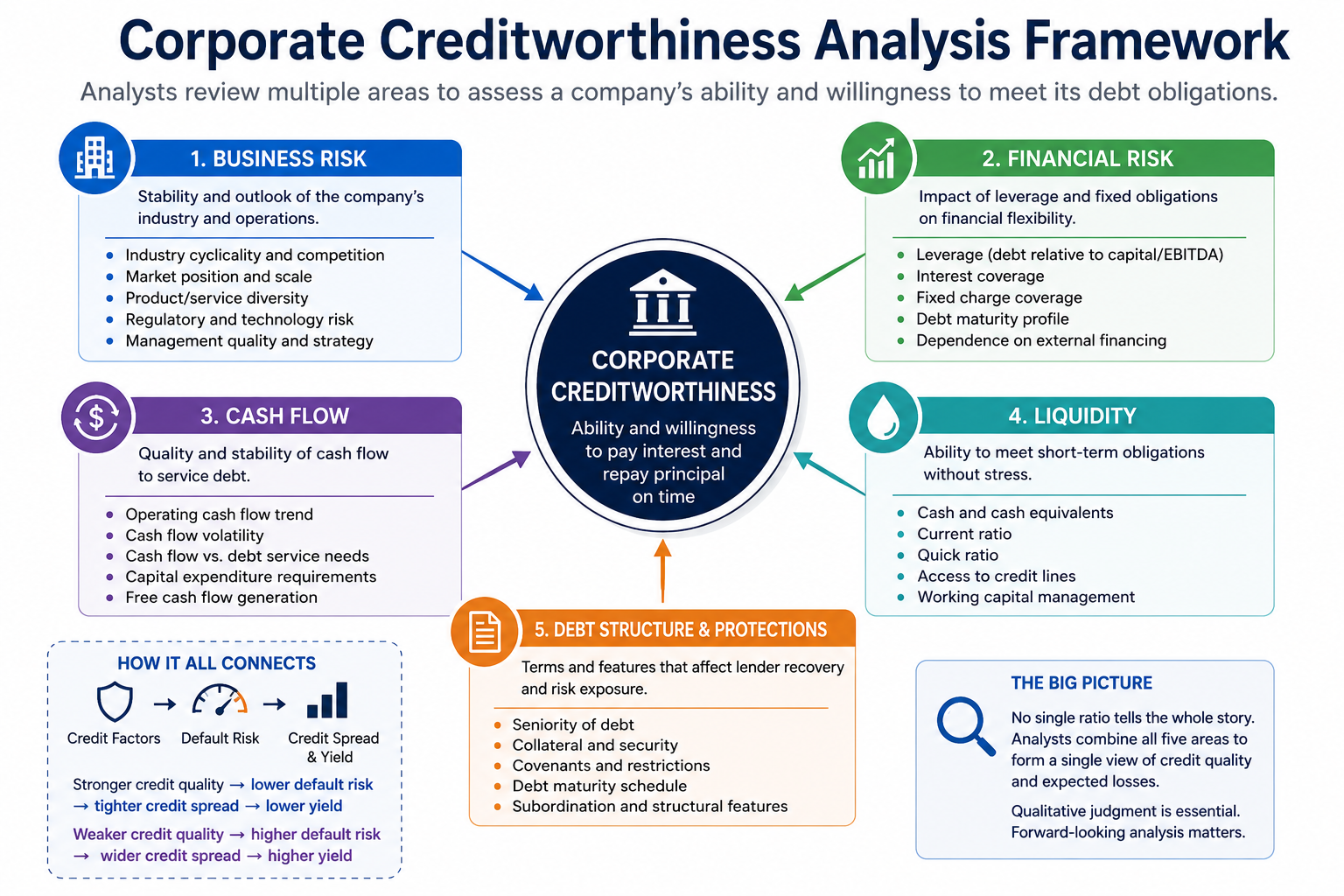
Analysts review creditworthiness across a few connected areas rather than scoring a single number. Each area tells you something different, and a weak reading in one place can outweigh strong readings elsewhere.
Business Risk
Business risk is the stability of the company's operations and its position in the industry. A firm with steady demand, a durable competitive position, and diversified revenue carries lower business risk than a firm in a cyclical market with a narrow product line. Two companies can show similar ratios today, yet the one with the more stable business is usually the safer credit through a downturn.
Financial Risk
Financial risk comes from how the company funds itself. Leverage measures the debt burden relative to capital or earnings, while coverage measures whether earnings can service interest and fixed charges. Lower leverage and higher coverage point to more room before a missed payment becomes likely.
Cash Flow and Liquidity
Cash flow shows whether the company can fund debt service from its own operations, and liquidity shows whether it can meet near-term obligations without strain. Profit on the income statement is not the same as cash in the bank. An issuer can report healthy earnings yet still face trouble if operating cash flow is thin or working capital is tight.
Debt Structure, Collateral, and Covenants
Debt structure covers seniority, collateral, covenants, and the maturity profile. Senior secured debt sits ahead of subordinated debt in a default, so it tends to recover more. Protective covenants and a manageable maturity schedule reduce refinancing pressure, while heavy near-term maturities can turn a manageable load into a crisis if markets tighten.
Management and Industry Position
Management quality and industry position are the qualitative layer. A disciplined approach to leverage, a credible plan for cyclical periods, and a strong position in a stable industry all support credit quality. These factors are harder to put in a ratio, but they shape how the numbers hold up under stress.
How Creditworthiness Affects Bond Yields and Spreads
Creditworthiness maps directly to the credit spread, which is the extra yield over a comparable government bond. Stronger credit quality supports a narrower spread, and weaker credit quality usually widens it. When an issuer's outlook deteriorates, investors reprice the bond to demand more yield, so its price falls and its spread widens, even if no payment has yet been missed.
Framework: Reading Stronger Versus Weaker Credit
The table below summarizes what each area assesses and the signals that point to stronger or weaker credit quality.
Credit Analysis Area | What It Assesses | Stronger Signal | Weaker Signal |
|---|---|---|---|
Business risk | Stability of operations and industry position | Stable demand and a durable position | Cyclical revenue or a weak position |
Leverage | Debt burden relative to capital or earnings | Lower debt burden | Higher debt burden |
Coverage | Ability to meet interest and fixed charges | Higher coverage ratios | Lower coverage ratios |
Liquidity | Ability to meet near-term obligations | Strong cash and working capital | Tight cash position |
Cash flow | Ability to fund debt service internally | Consistent operating cash flow | Volatile or negative cash flow |
Debt structure | Seniority, collateral, covenants, maturities | Protective terms, manageable maturities | Weak protection, refinancing pressure |
Worked Example: Comparing Two Issuers
Two companies in the same sector each want to issue a bond. You are asked which looks more creditworthy.
Indicator | Company A | Company B |
|---|---|---|
Debt to EBITDA | 2.0x | 4.5x |
Interest coverage (EBIT / interest) | 8.0x | 2.2x |
Current ratio | 1.80 | 1.00 |
Operating cash flow to total debt | 38% | 8% |
Revenue pattern | Stable | Cyclical |
Company A carries a lighter debt load. It covers its interest charges eight times over, holds more near-term liquidity, and generates cash flow worth more than a third of its debt each year. Company B is weaker on every measure. It carries more than twice the leverage, covers interest only about twice over, sits at a current ratio of 1.00, and converts far less of its debt into annual cash flow. Company A is the stronger credit. Lower leverage, higher coverage, better liquidity, steadier cash flow, and a more stable business all point the same way, so Company A would likely price at a narrower spread.
Common Exam Traps
Treating one ratio as the whole credit decision. A single strong number does not offset weakness elsewhere.
Assuming high profitability always means strong credit. A profitable firm with heavy leverage and thin cash flow can still be a weak credit.
Ignoring cash flow and liquidity when leverage looks acceptable. Timing of cash matters as much as the size of the debt.
Confusing creditworthiness with equity appeal. A good stock is not always a safe bond.
Forgetting that seniority, collateral, and covenants change risk and recovery, not just the headline ratios.
Practice Question
An analyst compares two issuers in the same industry. Issuer X reports debt to EBITDA of 2.3x, interest coverage of 6.5x, a current ratio of 1.7, and steady operating cash flow. Issuer Y reports debt to EBITDA of 5.0x, interest coverage of 1.8x, a current ratio of 0.9, and volatile cash flow. Which statement is most accurate?
Issuer Y is more creditworthy because higher leverage signals growth.
Issuer X is more creditworthy because lower leverage, higher coverage, and stronger liquidity support better credit quality.
The two issuers have equal credit quality because they operate in the same industry.
Creditworthiness cannot be judged without the issuers' equity valuations.
Correct Answer: B
Lower leverage, higher interest coverage, a stronger current ratio, and steadier cash flow all point to better capacity to service debt, so Issuer X has the stronger credit profile.
Option A misreads leverage, option C ignores the issuer-specific differences, and option D brings in equity valuation, which is not the basis for a credit decision.
Continue Your CFA Level I Prep With KeyPoint
Use structured lessons, practice questions, mock exams, and progress tracking to focus on the time you have left
FAQs About Corporate Creditworthiness
What does corporate creditworthiness mean?
It is an issuer's ability and willingness to meet its debt obligations on time. Analysts judge it from business risk, financial risk, cash flow, leverage, liquidity, and debt structure taken together.
Which ratios are used to assess corporate creditworthiness?
Common inputs include leverage measures such as debt to EBITDA, coverage measures such as interest coverage, and liquidity measures such as the current ratio. These ratios support the credit view, but they do not replace judgment about the business and its cash flow.
How does creditworthiness affect bond spreads?
Weaker credit quality usually pushes the credit spread wider because investors demand more yield for higher perceived risk. Stronger credit quality supports a narrower spread.
Is creditworthiness the same as a credit rating?
No. A credit rating is one agency's published opinion of credit quality, while creditworthiness is the underlying ability and willingness to pay that the rating tries to capture. Two issuers can share a rating yet differ in the details an analyst would weigh.