
Option-embedded bonds can have cash flows that change when interest rates change. Because those cash flows are not fixed, the risk measures that assume fixed cash flows do not capture interest rate risk well. Effective duration and effective convexity solve this by repricing the bond after an upward and a downward shift in the benchmark yield curve. For CFA Level I, focus on why these measures are used, what each input means, and how callable and putable bonds behave.
Quick Answer
Effective duration and effective convexity are used for option-embedded bonds because an embedded option can change a bond's expected cash flows when interest rates move. Effective duration estimates price sensitivity to a yield curve shift. Effective convexity measures how that sensitivity changes as rates move. For CFA Level I, focus on the formulas, the interpretation, and callable versus putable bond behavior.
Key Takeaways: Effective Duration for Option-Embedded Bonds
Effective duration is used when a bond's cash flows may change as rates change.
An embedded option can change expected cash flows, which is why effective measures are needed.
Effective duration uses the bond's value after an up shift and a down shift in the yield curve.
Effective convexity uses the same shifted values to measure curvature in the price-yield relationship.
Callable bonds can show negative convexity when rates fall, because the call limits price gains.
Putable bonds can gain downside protection when rates rise, because the investor can sell the bond back.
What You Need to Know for CFA Level I
Know why effective duration is preferred for option-embedded bonds, and be able to apply both the effective duration and effective convexity formulas using the inputs given. You should be able to read callable bond behavior when rates fall and putable bond behavior when rates rise. A common mistake is treating effective duration, modified duration, and Macaulay duration as interchangeable. They are not. Effective measures stand apart because they allow the bond's cash flows to change with rates.
Why Option-Embedded Bonds Need Effective Measures
A bond with no embedded option usually has promised cash flows that are fixed. You know the coupons and the timing, so a fixed-cash-flow measure works.
An option-embedded bond is different, because the option can be exercised. A callable bond gives the issuer the right to redeem the bond early. A putable bond gives the investor the right to sell it back to the issuer before maturity. Whether either option is exercised depends partly on where interest rates go. Because the expected cash flows can shift with rates, the bond must be revalued under different rate scenarios to estimate its risk, and that is exactly what effective measures do.
Effective Duration Formula for Option-Embedded Bonds
Symbol | Meaning |
|---|---|
Bond value when the benchmark yield curve shifts down | |
Bond value when the benchmark yield curve shifts up | |
Initial bond value | |
Size of the yield curve shift, stated as a decimal |
is usually higher than , because bond prices typically rise when rates fall and fall when rates rise. The formula estimates price sensitivity to a small parallel shift in the curve. For an option-embedded bond, and should come from a pricing model that lets expected cash flows change. State the curve shift as a decimal, so 100 basis points is 0.01.
Effective Convexity Formula for Option-Embedded Bonds
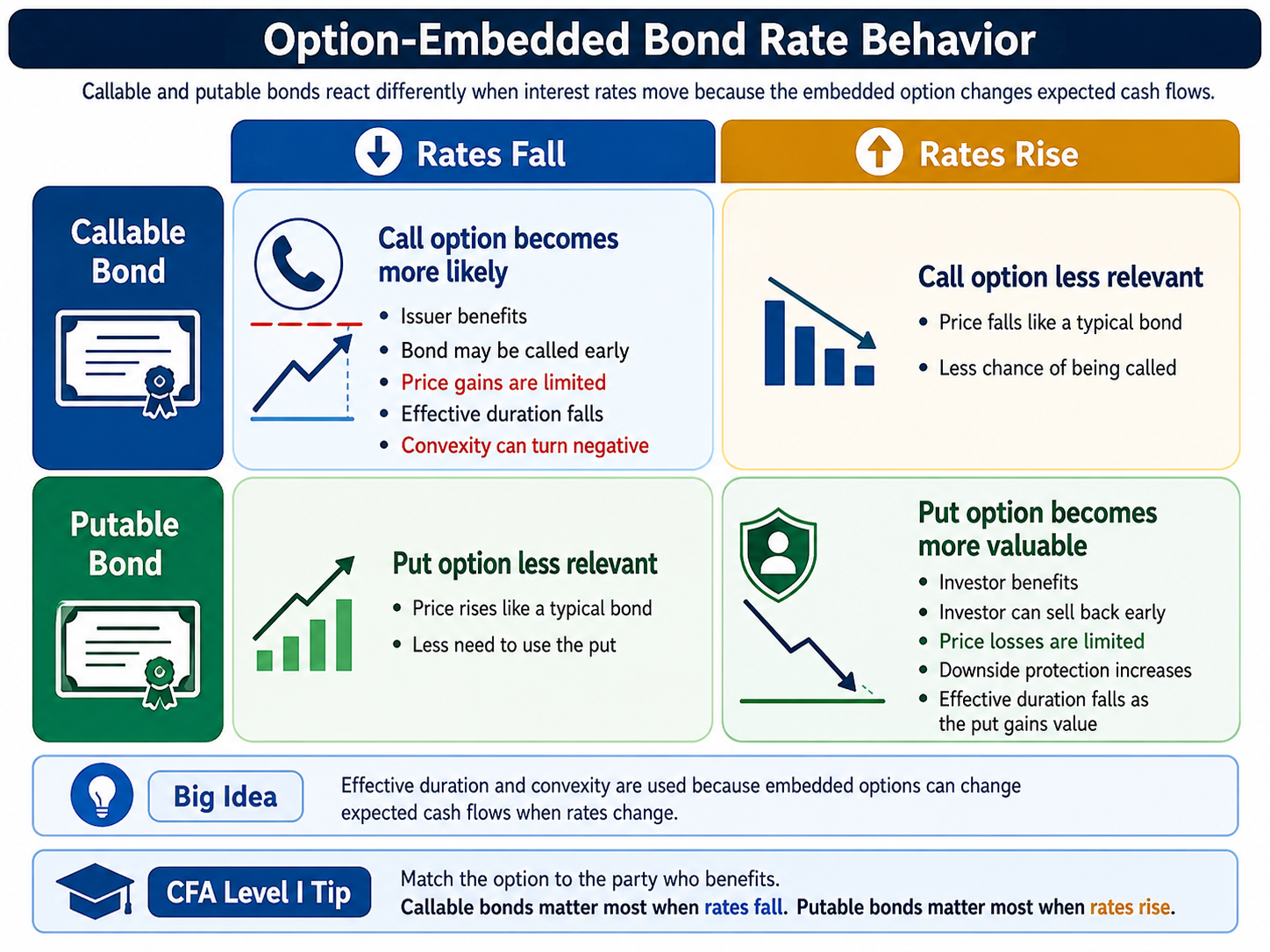
Effective convexity measures how the bond's price sensitivity changes as rates move. Positive convexity means the price gain from a rate decrease is larger than the price loss from an equal rate increase. A callable bond can show negative convexity when rates fall, because the call option caps how far the price can rise. A putable bond can behave differently, since the put can support the price when rates rise.
Callable vs Putable Bond Behavior
This is the section CFA Level I questions reward most, because they often ask you to connect an option to the party that benefits and the rate scenario where it matters.
Bond Type | Embedded Option | Who Benefits | Rate Scenario to Watch | Duration and Convexity Interpretation |
|---|---|---|---|---|
Callable Bond | Issuer can call the bond early | Issuer | Rates fall | Price gains may be limited as the issuer becomes more likely to call. Effective duration can fall, and convexity can turn negative. |
Putable Bond | Investor can sell the bond back early | Investor | Rates rise | Price losses may be limited as the put becomes more valuable. Effective duration can fall when the put gains value. |
A callable bond favors the issuer, so the investor gives up some upside when rates fall. A putable bond favors the investor, so the investor keeps some downside protection when rates rise. In the exam, tie the option to the party who holds it and to the rate move that makes it worth using.
See also: effective duration and interest rate risk
[Internal link opportunity: Link to /cfa/level-i/topics/fixed-income/study-notes/effective-duration-interest-rate-risk/ using anchor text "effective duration and interest rate risk".]
Worked Example
An option-embedded bond has an initial value of 100.00. If the benchmark curve shifts down by 50 basis points, the bond is valued at 103.20. If the curve shifts up by 50 basis points, it is valued at 96.90. The curve shift is 0.005. Calculate the effective duration.
An effective duration of 6.30 suggests that a 1% parallel rise in rates is associated with an approximate 6.30% price decline, before higher-order effects. Because this is an option-embedded bond, the two shifted values already reflect how expected cash flows may change as rates move.
For the same inputs, effective convexity is (103.20 + 96.90 − 200.00) divided by , which equals 0.10 divided by 0.0025, or 40. The positive figure here reflects how this particular bond responds across the two scenarios.
Common Exam Traps
Using modified duration when the question asks for effective duration on an option-embedded bond.
Forgetting that the curve shift must be in decimal form.
Reversing and in the formula.
Assuming a callable bond always shows the same positive convexity pattern as an option-free bond.
Treating spot rates, forward rates, and curve shifts as the same input.
Practice Question
For a callable bond, effective duration is generally more appropriate than modified duration because:
the bond's coupon rate changes automatically when interest rates change.
the bond's expected cash flows may change when interest rates change.
the bond's market price is not affected by changes in interest rates.
Correct Answer: B
A callable bond has an embedded option. When rates change, the chance the issuer calls the bond can change, so the expected cash flows can change. Effective duration captures this by valuing the bond under shifted curve scenarios.
Option A is wrong because a callable bond does not have an automatically changing coupon.
Option C is wrong because callable bonds are still affected by interest rate changes.
Continue Your CFA Level I Prep With KeyPoint
Use structured lessons, practice questions, mock exams, and progress tracking to focus on the time you have left
FAQs About Effective Duration for Option-Embedded Bonds
Why is effective duration used for option-embedded bonds?
Because an embedded option can change a bond's expected cash flows when rates move. Effective duration values the bond under up and down curve shifts, so it captures that change in a way fixed-cash-flow measures cannot.
What is the formula for effective duration?
Effective duration is approximately:
where and are the bond values after a downward and upward curve shift, is the starting value, and is the shift in decimal form.
Why can callable bonds have negative convexity?
When rates fall, the issuer is more likely to call the bond, which caps how far the price can rise. That limit on price gains can produce negative convexity in the range where the call becomes likely.
What is the difference between effective duration and modified duration?
Modified duration assumes fixed cash flows. Effective duration allows the cash flows to change with rates, so it is the right measure when a bond has an embedded option.