
Securitization pools cash-flow-producing assets, such as loans or receivables, and turns them into securities that investors can buy. The benefits of securitization show up across the whole chain, from the lender that originated the loans to the investor that buys the bonds. For CFA Level I, you need to recognize who gains, what they gain, and why that matters in a fixed income question.
Quick Answer
Securitization is the process of pooling assets that produce cash flows and issuing securities backed by those pooled assets. Its main benefits are added liquidity, lower funding costs, risk transfer off the originator's balance sheet, and a wider set of investment choices with tradeable credit and maturity profiles. On the exam, link each benefit to a specific party rather than treating it as one general advantage.
Key Takeaways: Benefits of Securitization
Securitization converts illiquid loans into tradeable securities, which raises liquidity in the financial system.
A special purpose entity (SPE) holds the assets, which separates them from the originator and supports risk transfer.
Issuers and originators gain funding, free up capital, and can move assets off the balance sheet.
Investors gain access to asset classes and risk-return profiles they could not reach by lending directly.
Securitization does not remove risk. It moves and repackages risk, including prepayment and default risk.
What You Need to Know for CFA Level I
The meaning of securitization as pooling assets and issuing asset-backed securities against them.
The role of the originator, the SPE, the servicer, and the investor in the structure.
The four benefit groups: issuers and originators, investors, borrowers, and financial markets.
Why the SPE matters for separating the assets from the originator.
That benefits come with tradeoffs, so securitization is risk transfer, not risk elimination.
What Securitization Means in Fixed Income
Securitization is the process of pooling assets that generate predictable cash flows and selling securities backed by that pool. The assets might be auto loans, mortgages, credit card receivables, or other loans. Instead of holding those loans to maturity, the originator sells them into a structure, and investors buy claims on the cash flows the loans produce.
A few parties make this work. The originator creates the loans. A special purpose entity, often called an SPE, buys the pool and legally separates it from the originator. The servicer collects payments from borrowers and passes them through. Investors buy the securitized products, usually called asset-backed securities, and receive the cash flows.
The legal separation is the part candidates skip. Because the SPE holds the assets, the pool is insulated from the originator's own credit problems. That separation is what lets investors price the securities on the strength of the assets rather than the health of the original lender.
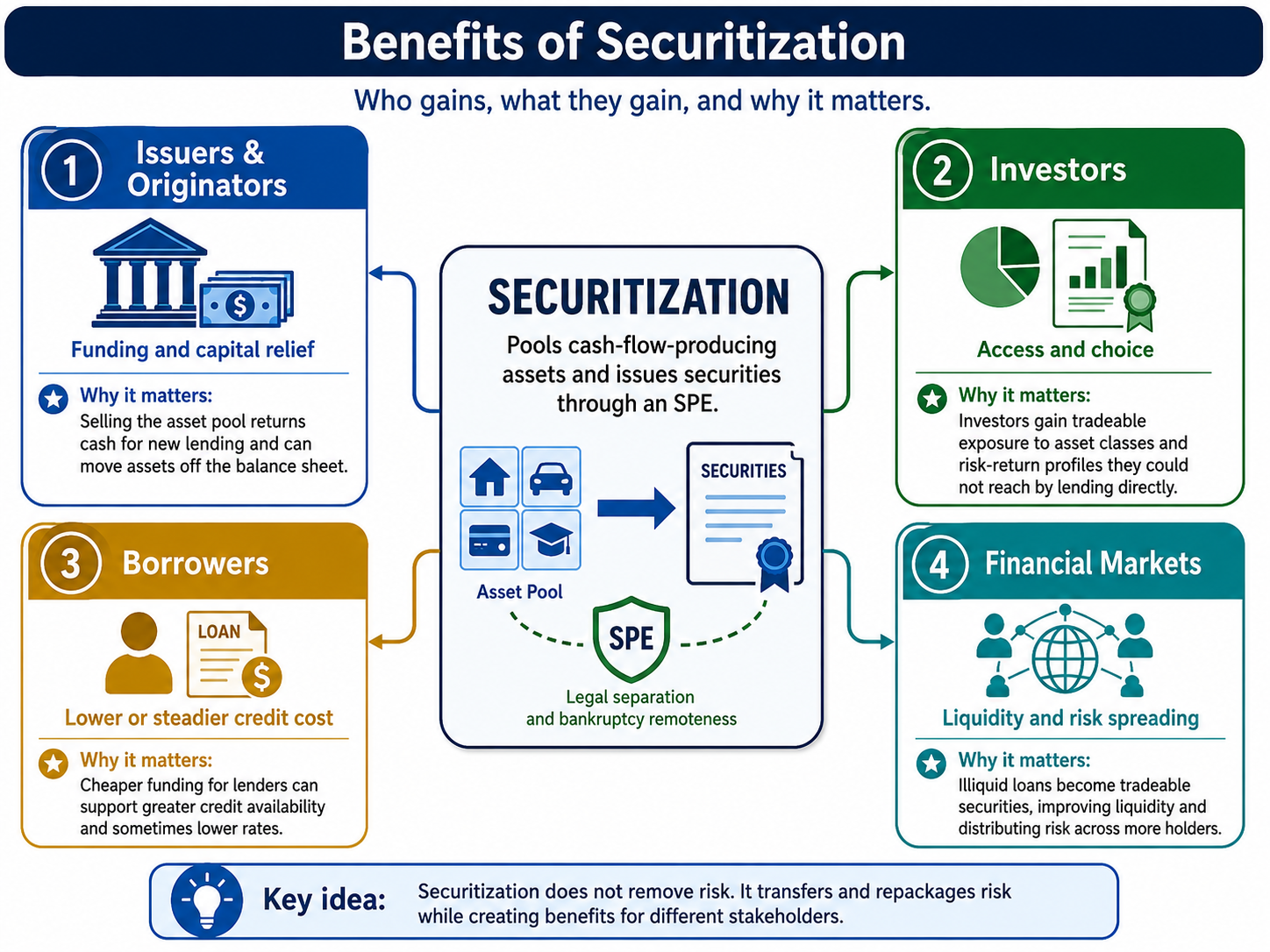
Who Benefits and Why
The clearest way to hold this for the exam is to group the benefits by party. Each group gains something different, and questions often ask you to match a benefit to the right stakeholder.
Stakeholder | Main benefit | Why it matters |
|---|---|---|
Issuers and originators | Funding and capital relief | Selling the pool returns cash for new lending and can move assets off the balance sheet, which frees up capital. |
Investors | Access and choice | Investors reach asset classes and risk-return profiles they could not get by lending directly, and they can match maturity and credit needs. |
Borrowers | Lower or steadier credit cost | Cheaper funding for lenders can pass through as more available credit and, at times, lower rates. |
Financial markets | Liquidity and risk spreading | Illiquid loans become tradeable securities, which improves liquidity and spreads risk across more holders. |
Read the table as four separate ideas. An issuer cares about funding and the balance sheet. An investor cares about access and fit. A borrower cares about credit availability. The market cares about liquidity and how widely risk is held.
How the Process Works
You do not need to model the cash flows at Level I, but you should know the order. Keep it to four steps.
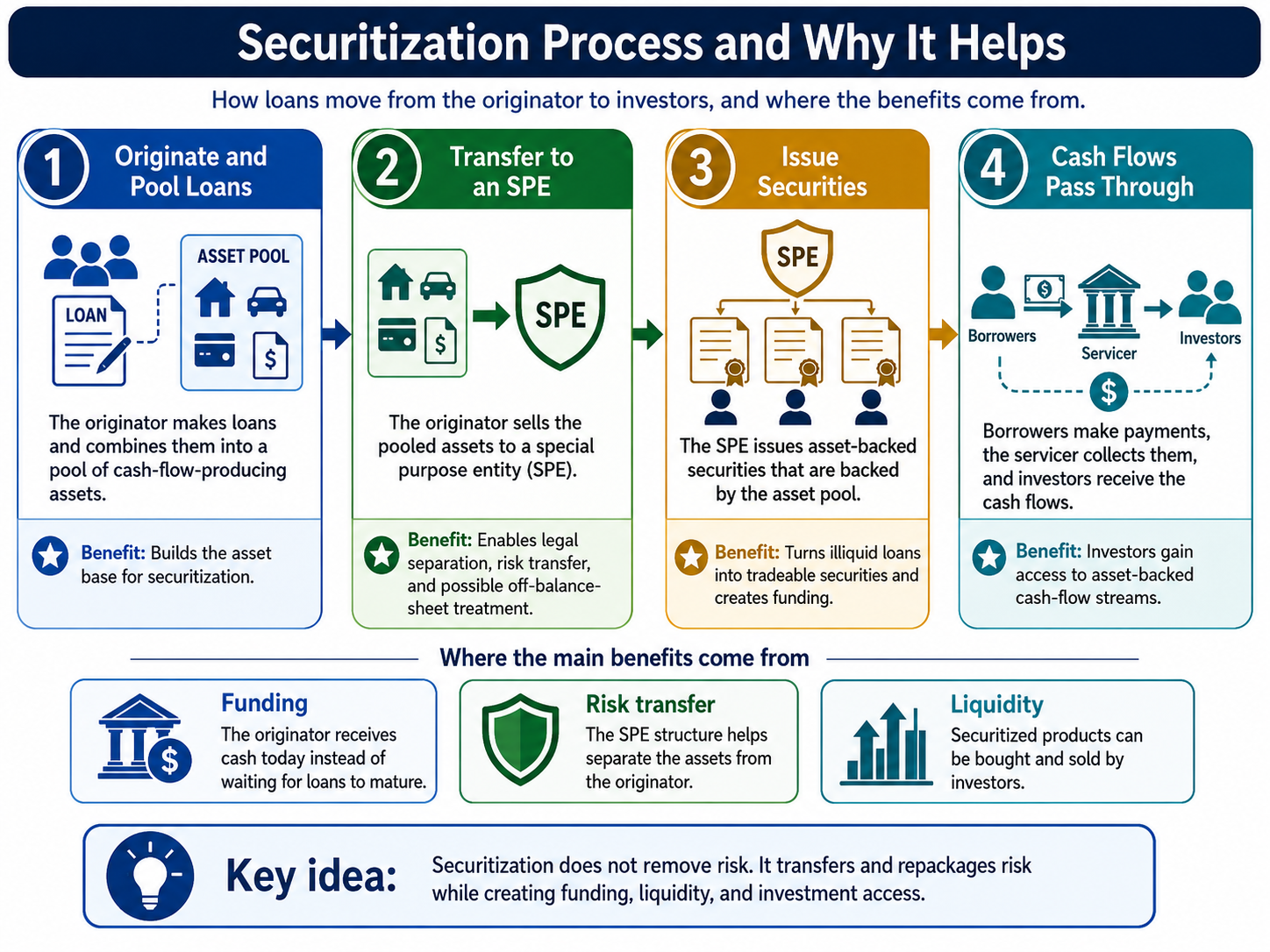
The originator makes loans to borrowers and builds a pool.
The originator transfers the pooled assets to an SPE.
The SPE issues securitized products backed by the pool.
Borrower payments flow through the servicer to the investors.
The process matters because it explains the benefits. The transfer to the SPE is what enables risk transfer and off-balance-sheet treatment. The issuance step is what creates the tradeable security that adds liquidity.
Worked Example
A regional lender holds a large pool of auto loans. The loans pay steady monthly cash flows, but they sit on the balance sheet and tie up capital, which limits new lending.
The lender sells the pool to an SPE. The SPE issues asset-backed securities and sells them to investors. The lender receives cash now instead of waiting years for borrowers to repay, and the loans no longer sit on its balance sheet in the same way.
The benefits line up by party. The lender gains funding and capital relief. Investors gain securities whose cash flows and maturity profile they can match to their needs. The market gains liquidity, because loans that were stuck on one balance sheet are now securities that can trade. Notice that the credit and prepayment risk did not vanish. It moved to the investors who chose to hold it.
Common Exam Traps
Confusing securitization with a plain bond issue. A bond is a direct promise from the issuer. Securitized products are backed by a pool of separated assets.
Forgetting the SPE. The SPE is what separates the assets from the originator and supports risk transfer.
Treating securitization as risk elimination. The risk is transferred and repackaged, not removed.
Ignoring prepayment and default risk. These still affect the cash flows investors receive.
Naming only banks. Investors and the wider market are part of the benefit story too.
Practice Question
A finance company sells a pool of receivables to a special purpose entity, which then issues securities to investors. From the finance company's point of view, the most direct benefit of this transaction is:
The elimination of all credit risk on the receivables
A new source of funding and relief from holding the assets on its balance sheet
The removal of prepayment risk from the securities
Correct Answer: B
Selling the pool gives the originator cash and capital relief, which is the originator's main benefit.
Option A is wrong because risk is transferred, not eliminated.
Option C is wrong because prepayment risk passes to investors rather than disappearing.
Continue Your CFA Level I Prep With KeyPoint Learning
Use structured lessons, practice questions, mock exams, and progress tracking to focus on the time you have left.
FAQs About Securitization
What is securitization?
Securitization is the process of pooling assets that produce cash flows, such as loans, and issuing securities backed by that pool. Investors buy the securities and receive the cash flows the assets generate.
What are the benefits of securitization?
The main benefits are added liquidity, lower funding costs, risk transfer off the originator's balance sheet, and a wider set of investment choices. Each benefit tends to favor a specific party in the structure.
What are securitized products?
Securitized products are the securities issued against a pool of assets, usually called asset-backed securities. Mortgage-backed securities are a common example.
Why do issuers use securitization?
Issuers use securitization to raise funding, free up capital, and move assets off the balance sheet so they can lend again. It turns long-dated loans into cash today.