
Investment grade and high yield are the two broad credit quality categories for corporate bonds. The split comes down to credit rating, and that rating shapes how much an issuer pays to borrow and how much risk a bondholder takes on. For CFA Level I, you need to place a bond on the right side of that boundary and explain what it means for the issuer.
Quick Answer
The difference between investment-grade vs high-yield bonds is credit quality. Investment grade bonds carry higher ratings and lower expected default risk, so they trade at narrower spreads. High-yield bonds sit below the rating boundary, carry higher default risk, and pay wider spreads to compensate investors for that risk.
Key Takeaways: Investment Grade vs High-Yield Bonds
Investment-grade bonds are higher rated and have lower expected default risk.
High-yield bonds are non-investment grade and pay wider spreads to compensate for that risk.
Investment grade issuers usually have more flexible access to long-term debt markets.
High-yield issuers often face tighter covenants, shorter maturities, and higher refinancing risk.
Credit ratings are useful, but they have limits and can lag market pricing.
What You Need to Know for CFA Level I
Identify whether a bond is investment grade or high yield from its rating.
Recall the rating boundary between the two categories across the major agencies.
Explain why high-yield issuers pay a wider credit spread.
Compare maturity flexibility, covenants, liquidity, and refinancing risk across the two groups.
Recognize a fallen angel as a special case rather than a separate category.
Investment Grade vs High-Yield Bonds: Main Difference
The main difference is credit quality, measured by rating. Investment grade issuers are judged to have a stronger capacity to meet their obligations, so investors accept a lower yield. High-yield issuers carry more uncertainty about repayment, so investors demand a higher yield, which shows up as a wider credit spread over comparable government bonds.
Everything else follows from that one distinction. The rating drives the spread, and the spread reflects the market's view of default risk.
What Are Investment-Grade Corporate Bonds?
Investment grade corporate bonds are bonds from issuers rated in the higher credit categories, where the expected probability of default is low. These issuers tend to have stable cash flows, established business lines, and a track record that lenders trust.
That trust gives them room to move. Investment grade issuers can usually borrow at longer maturities, accept fewer restrictive covenants, and return to the market when they need funding. Because the perceived risk is lower, the spread they pay over a government benchmark is narrower.
What Are High-Yield Corporate Bonds?
High-yield corporate bonds, also called non-investment-grade bonds, come from issuers rated below the investment-grade boundary. The market sees a higher chance of missed payments, so it requires a higher yield in return.
That higher risk shapes the terms. High-yield issuers often face tighter covenants that limit what they can do with cash, shorter maturities, and more refinancing risk when existing debt comes due. Their bonds can also be less liquid, which adds to the spread investors demand.
Investment-Grade (IG) vs High-Yield (HY) Ratings
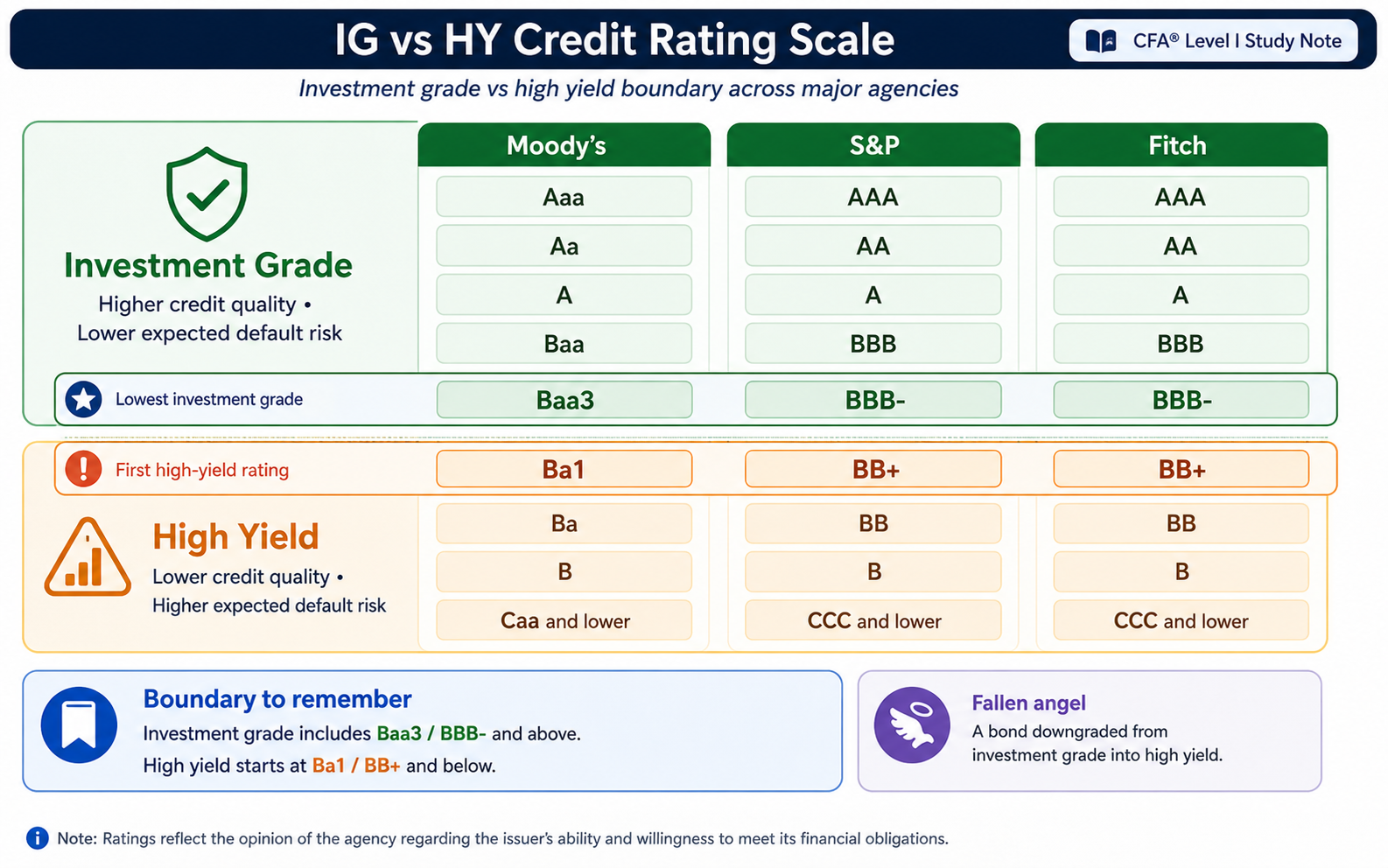
The rating boundary is the single fact candidates must hold onto. Bonds at the lowest investment grade rung and above are investment grade. Bonds one notch below and lower are high yield.
Agency | Lowest investment grade rating | First high-yield rating |
|---|---|---|
Moody's | Baa3 | Ba1 |
S&P | BBB- | BB+ |
Fitch | BBB- | BB+ |
Comparison Table: IG vs HY Corporate Bonds
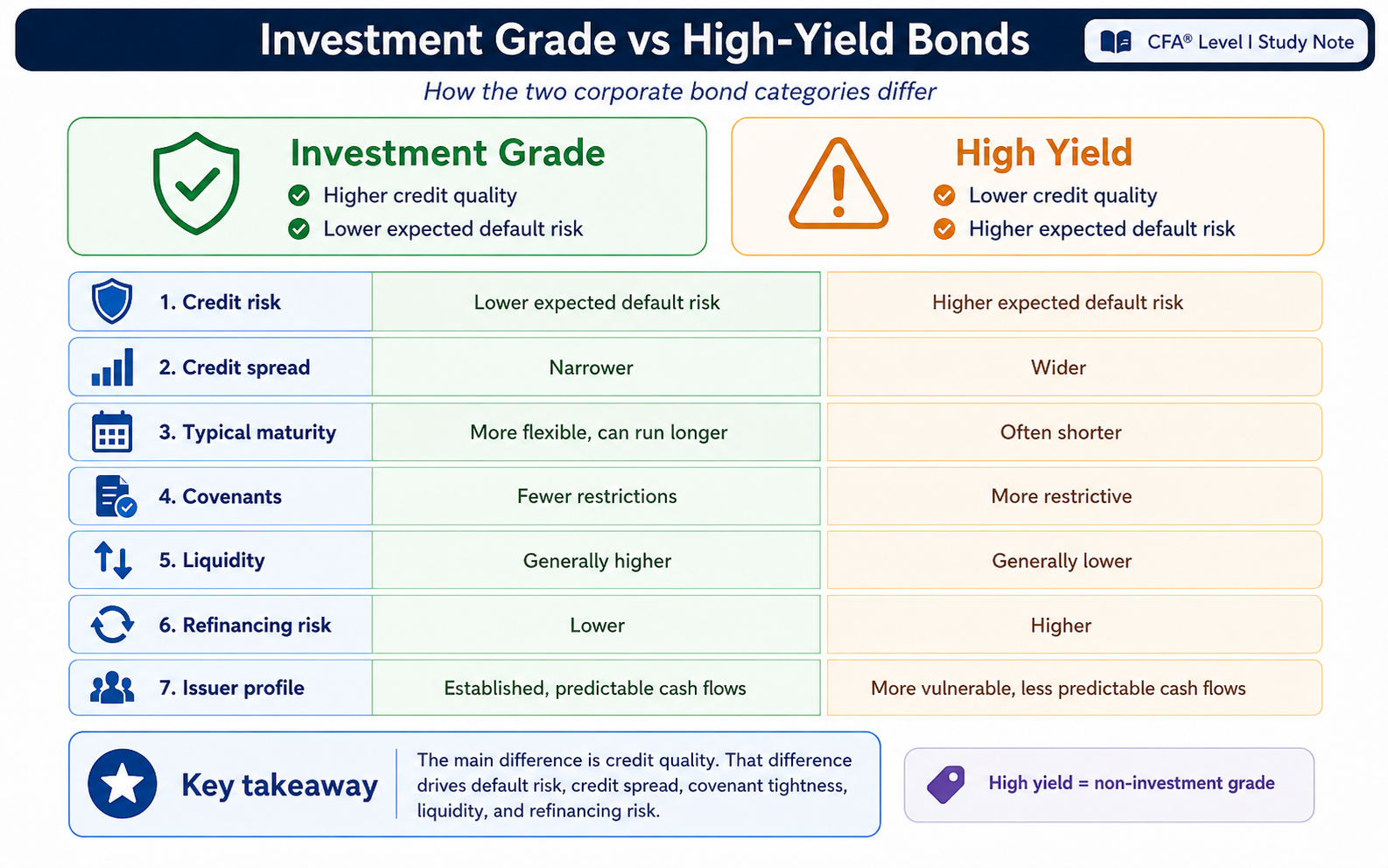
This table sums up how the two categories differ on the features Level I questions tend to test.
Feature | Investment Grade | High Yield |
|---|---|---|
Credit risk | Lower expected default risk | Higher expected default risk |
Credit spread | Narrower | Wider |
Typical maturity | More flexible, can run longer | Often shorter |
Covenants | Fewer restrictions | More restrictive |
Liquidity | Generally higher | Generally lower |
Refinancing risk | Lower | Higher |
Issuer profile | Established, predictable cash flows | More vulnerable, less predictable cash flows |
A bond that loses its investment grade rating and drops into high yield is called a fallen angel. It is the same issuer crossing the boundary, not a new type of bond, and it often keeps longer maturities and lighter covenants from when it was investment grade.
Common Exam Traps
Treating high yield as a maturity category. High yield is about credit quality, not time to maturity.
Forgetting the rating boundary. If you cannot place the split between the two categories, you cannot answer the question.
Assuming a higher coupon means a better bond. A higher coupon often signals higher credit risk, not a better deal.
Treating ratings as exact. Ratings are useful, but they can lag market pricing and do not promise repayment.
Practice Question
Issuer A has bonds rated BBB. Issuer B has bonds rated B. Both issue long-term corporate debt. Which statement is most accurate?
Issuer A is more likely to face restrictive covenants and pay a wider credit spread.
Issuer B is more likely to face restrictive covenants and pay a wider credit spread.
Both issuers pay the same spread because both issue corporate bonds.
Correct Answer: B
Issuer B is rated B, which is high yield, while Issuer A at BBB is investment grade. The lower-rated issuer carries higher credit risk, so the market demands a wider spread and usually imposes tighter covenants and shorter maturities.
Option A reverses the relationship.
Option C ignores the rating difference, which is the whole point of the comparison.
Continue Your CFA Level I Prep With KeyPoint
Use structured lessons, practice questions, mock exams, and progress tracking to focus on the time you have left
FAQs About Investment-Grade vs High-Yield Corporate Bonds
What is the difference between investment-grade and high-yield bonds?
The difference is credit quality. Investment-grade bonds are higher rated, have lower expected default risk, and pay narrower spreads. High-yield bonds are below the rating boundary, carry higher default risk, and pay wider spreads.
What ratings are investment grade?
Investment grade begins at Baa3 for Moody’s and BBB− for S&P Global Ratings and Fitch. Ratings below those thresholds fall into speculative-grade territory.
Are high-yield bonds the same as non-investment-grade bonds?
Yes, in the broad credit rating sense. Any bond rated below the investment grade boundary is non-investment grade, which is what high yield means.
Why do high-yield bonds usually have higher yields?
They compensate investors for higher credit risk and often for lower liquidity and greater refinancing risk as well. The wider yield is the market's price for taking on that uncertainty.