
Default risk is the chance that a borrower fails to make promised payments. On its own, that chance does not tell you how much you stand to lose. To estimate the loss, you need two separate pieces: how likely default is, and how much is lost if it happens. CFA Level I tests how those two combine into expected loss.
Quick Answer
Default risk, also called credit risk, is the risk that a borrower will miss or delay promised payments. It breaks into two parts: the probability of default, which is the likelihood of default, and loss severity, which is the loss given default after any recovery. Expected loss equals probability of default multiplied by loss severity and exposure. Keep the two drivers separate.
Key Takeaways: Default Risk and Expected Loss
Default risk is the risk of missed or delayed payments. Expected loss measures the size of the likely loss.
Probability of default is the chance default happens. Loss severity is how much is lost if it does.
Loss severity equals 1 minus the recovery rate, often stated as a percentage of exposure.
Expected loss = probability of default × loss severity × exposure.
Recovery rate and loss severity are opposites. A higher recovery means a lower loss severity.
What You Need to Know for CFA Level I
The difference between credit risk, probability of default, and loss severity.
That loss severity equals 1 minus the recovery rate.
The expected loss formula and how to apply it to a bond position.
How to express loss severity as both a dollar amount and a percentage of exposure.
The common confusion between recovery rate and loss severity.
Credit Risk Splits Into Two Questions
Credit risk is the risk that a borrower does not pay as promised. To measure the potential loss, you separate it into two questions. How likely is default? And if default occurs, how much is lost?
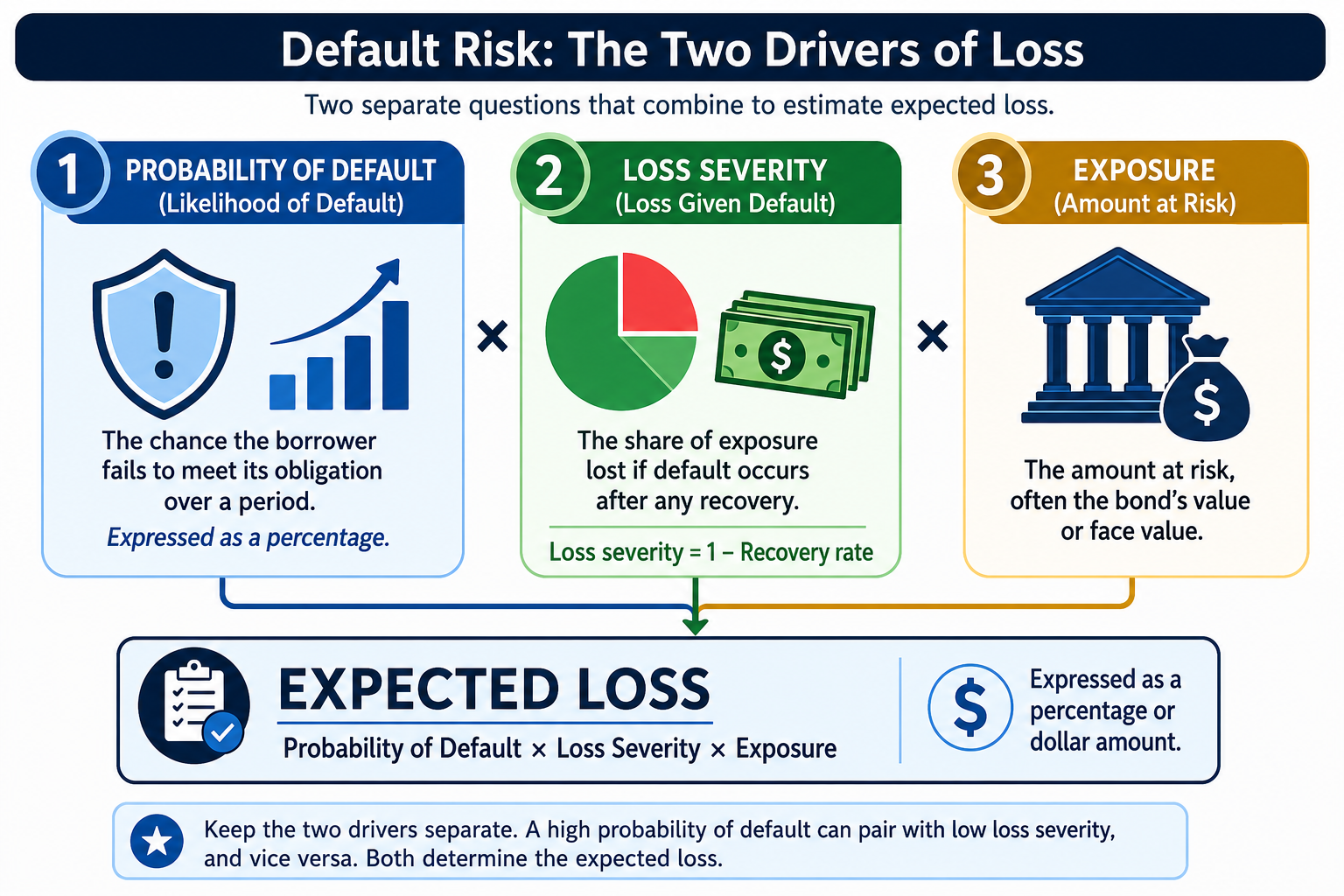
The first question is the probability of default, sometimes called the likelihood of default. It is the chance the borrower fails to meet the obligation over a period.
The second question is loss severity, also called loss given default. It is the share of the exposure you actually lose after recovering whatever you can. If a lender recovers part of the amount owed, the loss is only the unrecovered part.
These are different ideas, and questions often test whether you keep them apart. A bond can have a high probability of default but a low loss severity, or the reverse. Both feed the final estimate.
The Expected Loss Formula
Expected loss brings the two drivers together with the size of the position.
Term | Meaning |
|---|---|
Probability of default (PD) | The likelihood the borrower defaults over the period. |
Recovery rate | The share of exposure recovered if default occurs. |
Loss severity (LGD) | The share of exposure lost, equal to 1 − recovery rate. |
Exposure | The amount at risk, often the bond's value or face. |
Expected loss | The probability-weighted loss, in percent or dollars. |
Read loss severity and recovery rate as two sides of one coin. If recovery is 40%, loss severity is 60%. Mixing them up is the fastest way to lose a mark.
Worked Example
A bond position has an exposure of $8,000,000. The estimated probability of default over the year is 2.5%, and if default occurs the expected recovery rate is 45%. Find the loss severity, the expected loss percentage, and the dollar expected loss.
Step 1. Loss severity
Step 2. Expected loss percentage
Step 3. Dollar expected loss
The order matters. You find loss severity from the recovery rate first, then combine it with the probability of default, then scale by the exposure. Skipping the recovery step is a common error.
Common Exam Traps
Confusing recovery rate with loss severity. They are opposites: loss severity = 1 − recovery rate.
Ignoring exposure. Probability and loss severity give a percentage. You still need exposure for a dollar figure.
Treating the probability of default as the expected loss. The probability is only one of the three inputs.
Mixing dollar and percentage inputs in the same step.
Assuming a higher recovery rate raises expected loss. A higher recovery lowers loss severity, which lowers expected loss.
Practice Question
A bond has an exposure of $250,000, a probability of default of 4%, and an expected recovery rate of 35%. The expected loss on the position is closest to:
$10,000
$6,500
$3,500
$2,500
Correct Answer: B
Loss severity = 1 − 0.35 = 0.65.
Expected loss = 0.04 × 0.65 × $250,000 = $6,500.
Option A ignores recovery entirely.
Option C treats the recovery rate as the loss severity.
Option D applies the wrong combination of inputs.
Continue Your CFA Level I Prep With KeyPoint
Use structured lessons, practice questions, mock exams, and progress tracking to focus on the time you have left
FAQs About Credit Risk, Default Probability, and Loss Severity
What is default risk in fixed income?
Default risk is the risk that a borrower misses or delays promised payments on a bond or loan. It is also called credit risk and is one of the core risks in fixed income.
What is probability of default?
Probability of default is the likelihood that a borrower fails to meet its obligation over a period. It is one of the two drivers of expected loss, alongside loss severity.
What is loss severity?
Loss severity, also called loss given default, is the share of exposure lost when default occurs. It equals 1 minus the recovery rate and can be shown as a dollar amount or a percentage.
How do probability of default and loss severity affect expected loss?
Expected loss equals probability of default multiplied by loss severity and exposure. A higher probability or a higher loss severity raises expected loss, while a higher recovery rate lowers it.