
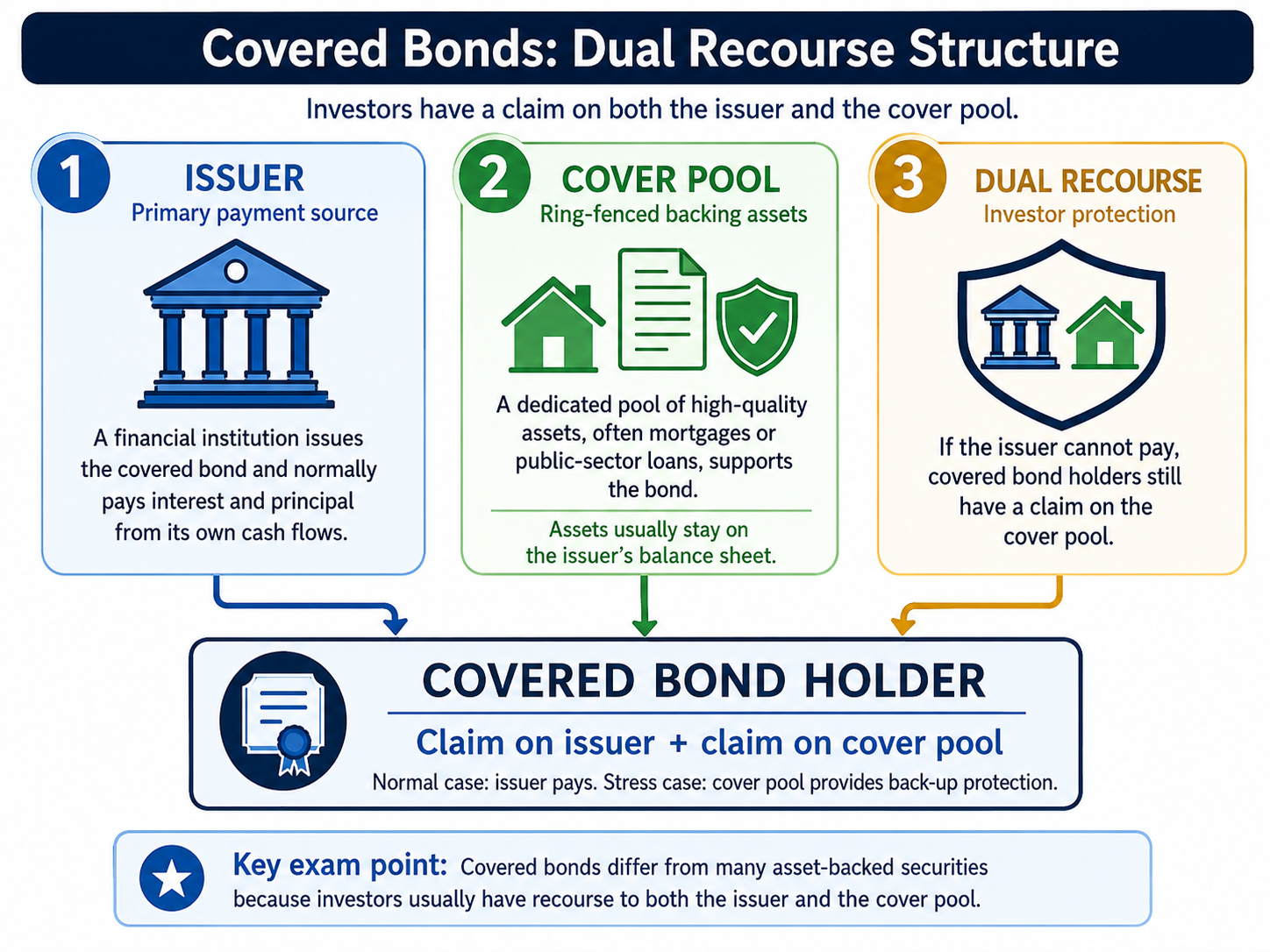
A covered bond is a debt security issued by a financial institution and backed by a separate pool of high-quality assets called the cover pool. The feature that defines it, and the one CFA Level I tests most, is dual recourse: if the issuer fails to pay, investors still hold a claim on the cover pool. That structure separates covered bonds from most securitized products, where the assets are moved off the issuer's books.
Quick Answer
A covered bond is a debt security issued by a financial institution and backed by a cover pool of assets. Investors usually have dual recourse, meaning a claim on the issuer and a claim on the cover pool. For CFA Level I, the main point is that covered bonds stay obligations of the issuer, unlike many securitized products where assets move to a separate vehicle.
Key Takeaways: Covered Bonds for CFA Level I
Covered bonds are backed by a dedicated cover pool of assets.
Dual recourse is the main investor protection feature.
The issuer stays responsible for payment.
The cover pool is commonly built from high-quality assets such as mortgages or public-sector loans, subject to rules that vary by jurisdiction.
Covered bonds differ from asset-backed securities because the assets usually stay on the issuer's balance sheet.
What You Need to Know for CFA Level I
You should be able to define a covered bond, explain the roles of the issuer, the cover pool, and the investor, describe dual recourse, compare covered bonds with asset-backed securities at a high level, and explain why the structure changes credit risk and investor protection.
What Are Covered Bonds?
A covered bond is senior debt issued by a financial institution. It is secured by a cover pool, a separate set of assets held to support repayment. The investor holds a claim on the issuing institution, and the pool reinforces that claim. The pool is usually strong collateral, often home mortgages or public-sector loans. The exact rules depend on the jurisdiction.
How Covered Bonds Work
Covered bonds work by giving investors two layers of protection at once. In normal conditions, the issuer pays interest and principal from its own cash flows. That is true of any senior bond it issues. The cover pool sits in the background as security. It is ring-fenced, so it stays available to covered bond holders rather than to general creditors.
The cover pool is also dynamic in many systems. If assets in the pool weaken or pay down, the issuer is generally required to replace them so the pool keeps supporting the outstanding bonds. That maintenance is part of why covered bonds are viewed as relatively secure.
What Is Dual Recourse?
Dual recourse means investors can look to two sources for repayment: the issuer first, and the cover pool if the issuer cannot pay. This is the heart of the instrument. With an ordinary unsecured bond, a default leaves investors as general creditors. With a covered bond, a default still leaves them with a direct claim on the cover pool of quality assets.
Covered Bonds vs Asset-Backed Securities
Covered bonds and asset-backed securities both rely on pools of assets, but they are built differently, and that difference is the common exam point. In a covered bond, the assets generally stay on the issuer's balance sheet and the issuer remains on the hook. In an asset-backed security, the assets are usually transferred to a separate legal entity, and investors mainly rely on the cash flows from that pool.
Area | Covered Bond | Asset-Backed Security |
|---|---|---|
Primary repayment source | Issuer cash flows | Cash flows from the asset pool |
Investor recourse | Issuer and cover pool (dual recourse) | Usually the asset pool or issuing vehicle |
Balance sheet treatment | Assets often stay on the issuer's books | Assets often transferred to a separate vehicle |
Key exam point | Dual recourse | Securitization structure |
Why Covered Bonds Matter in Fixed Income
Covered bonds matter because they offer secured exposure with an extra layer of protection. That appeals to investors who want a relatively safe holding without giving up the issuer's backing. For the exam, they are a clean test of whether you can separate an on-balance-sheet, dual-recourse instrument from a securitized, off-balance-sheet one.
Worked Example: Issuer Recourse and Cover Pool Recourse
A bank issues a covered bond and sets aside a cover pool of residential mortgages to support it. While the bank is healthy, it pays the covered bond's interest and principal from its own cash flows, and the mortgage pool simply sits behind the bond as security.
Now suppose the bank runs into severe financial trouble and cannot keep paying. The covered bond holders do not become ordinary unsecured creditors. They still hold a claim on the ring-fenced cover pool of mortgages, which can be used to support repayment. That second claim, on top of the claim on the issuer, is dual recourse in action.
Common Exam Traps
Treating a covered bond as the same thing as an asset-backed security.
Forgetting that covered bond investors usually have dual recourse.
Assuming the cover pool removes all credit risk. It strengthens protection, but risk remains.
Ignoring that covered bond rules vary by jurisdiction.
Confusing the issuer's ongoing obligation with a pass-through securitization, where the issuer steps aside.
Practice Question
Which feature most clearly distinguishes a covered bond from an asset-backed security?
A covered bond pays a fixed coupon, while an asset-backed security pays a floating coupon.
A covered bond gives investors recourse to both the issuer and a cover pool, while an asset-backed security usually relies on a separate asset pool.
A covered bond has no collateral, while an asset-backed security is fully collateralized.
Correct Answer: B
Dual recourse is the defining distinction. Covered bond investors can claim against both the issuer and the cover pool, whereas asset-backed security investors usually rely on cash flows from a pool transferred to a separate vehicle. The coupon type, the specific collateral, and the presence of collateral are not the defining differences.
Option A: Coupon type is not the defining difference. Covered bonds and asset-backed securities can have different payment structures. The key distinction is the investor’s claim on the issuer and the underlying assets.
Option C: Covered bonds do have collateral. Their defining feature is that investors have recourse to both the issuer and the dedicated cover pool.
Continue Your CFA Level I Prep With KeyPoint
Use structured lessons, practice questions, mock exams, and progress tracking to focus on the time you have left
FAQs About Covered Bonds
What is a covered bond?
It is a debt security issued by a financial institution and backed by a separate cover pool of assets. Investors usually hold a claim on both the issuer and the pool.
What is dual recourse in covered bonds?
Dual recourse means investors can look to the issuer for payment first, and to the cover pool if the issuer cannot pay. That second claim is the instrument's main protection feature.
How are covered bonds different from asset-backed securities?
Covered bonds generally keep the assets on the issuer's balance sheet and keep the issuer responsible for payment. Asset-backed securities usually transfer the assets to a separate vehicle, so investors rely mainly on that pool's cash flows.
Are covered bonds risk-free?
No. The cover pool and dual recourse strengthen protection, but the bond still carries credit risk, and the rules that govern the structure vary by jurisdiction.