
Some bonds react far more sharply to a change in yields than others. Three features explain most of that difference: maturity, coupon, and yield level. CFA® Level I uses these to ask which bond carries the most interest rate risk, so this note also covers the coupon rate vs yield to maturity distinction that sits underneath the comparison.
Quick Answers
The coupon rate is the fixed interest a bond promises. The yield to maturity is the market's required return implied by the bond's price. They are different, and that gap drives interest rate risk. All else equal, a bond is more sensitive to yield changes when it has a longer maturity, a lower coupon, or a lower yield level.
Key Takeaways: Coupon Rate vs Yield to Maturity and Interest Rate Risk
Longer maturity generally means higher duration and more interest rate risk, all else equal.
Lower coupon generally means higher duration, because more of the bond's value sits in the final principal payment.
Lower yield level generally means higher duration and greater price sensitivity.
Coupon rate and yield to maturity are different. The coupon is promised interest, while the yield is the market's required return implied by price.
The common trap is choosing on one feature while ignoring the all else equal condition.
What You Need to Know for CFA Level I
Tell the coupon rate apart from the yield to maturity, and connect both to the bond's price.
Rank option-free bonds by interest rate risk when one feature changes at a time.
Apply the all else equal rule so a single feature does not override the others by accident.
Identify which bond has the highest duration in a comparison question.
Link higher duration to a larger price move when yields shift.
Coupon Rate vs Yield to Maturity: Why the Difference Matters
The coupon rate and the yield to maturity answer two different questions. The coupon rate is what the issuer promised to pay. The yield to maturity is what the market currently demands to hold the bond, based on its price today.
When a bond trades at par, the two are equal. When it trades at a discount, the yield to maturity is above the coupon rate. When it trades at a premium, the yield is below the coupon. This matters for risk because the yield is the discount rate applied to every future cash flow, and a bond's price sensitivity depends on how those cash flows are spread over time.
How Maturity Affects Interest Rate Risk
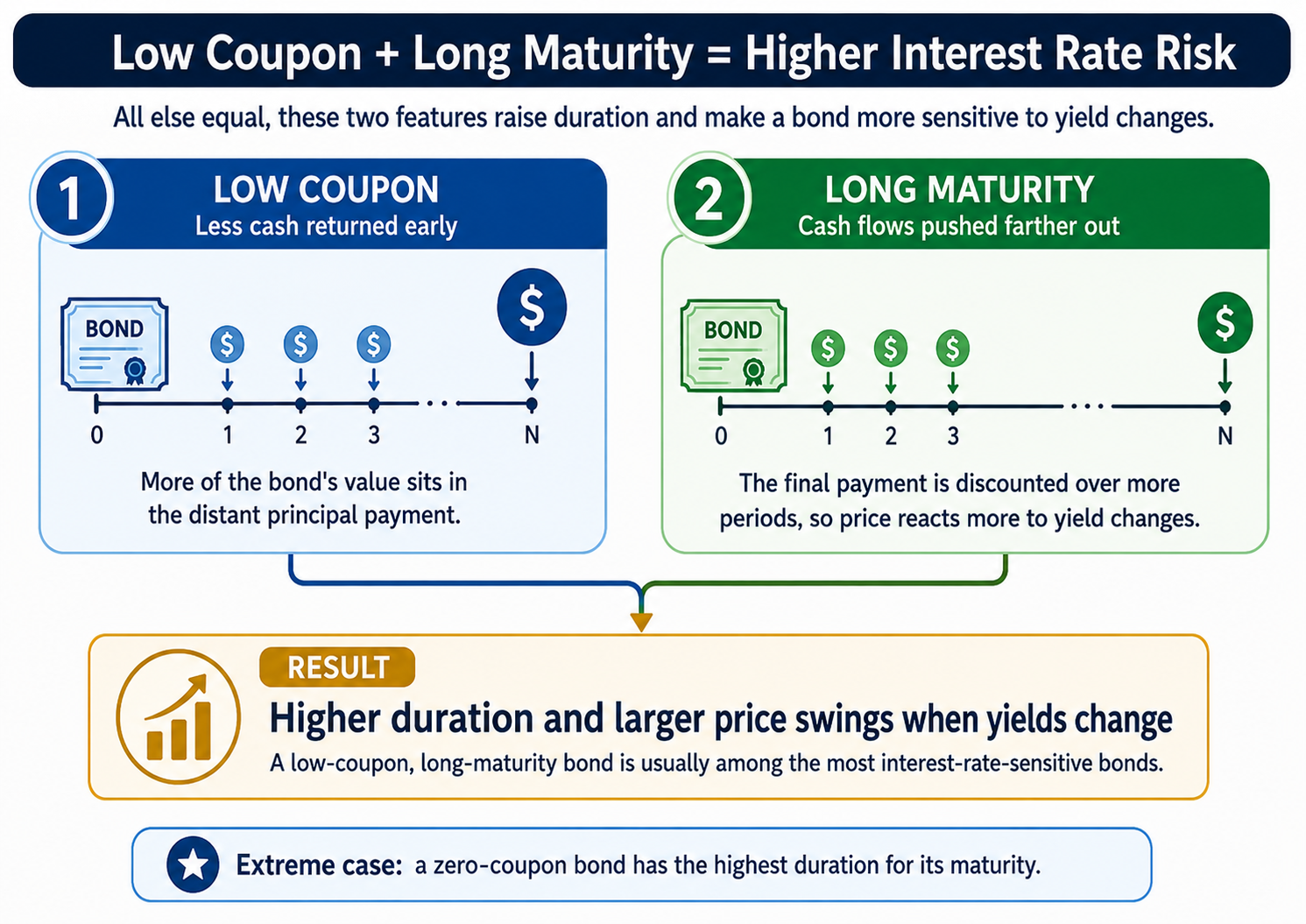
Longer maturity generally raises interest rate risk, all else equal. The reason is timing. A longer bond pushes its largest cash flow, the principal, further into the future.
Distant cash flows are discounted over more periods, so a change in the yield has a larger effect on their present value. That makes a 20-year bond respond far more to a yield move than an otherwise identical 5-year bond. Maturity is usually the single biggest driver of duration.
Why Low-Coupon Bonds Are More Volatile
Lower coupon bonds are more volatile because more of their value depends on the final principal payment. A high coupon returns cash to you steadily and early. A low coupon makes you wait.
When most of the value sits in one distant payment, the bond's average cash-flow timing stretches out, which raises duration. A zero-coupon bond is the extreme case, with all value in the maturity payment and the highest duration for its maturity. So between two bonds that match on everything else, the one with the lower coupon moves more when yields change.
How Yield Level Affects Duration
A lower yield level generally raises duration, all else equal. Duration is partly a present-value weighting of cash flows, and the discount rate sets those weights.
A useful way to see this is the link between Macaulay duration and modified duration, where r is the periodic yield.
Where:
ModDur = Modified duration (the price sensitivity of a bond to yield changes)
MacDur = Macaulay duration (the weighted average time to receive cash flows)
r = The periodic yield (the yield level expressed as a decimal for the period)
When the yield is lower, distant cash flows are discounted less heavily, so they carry more weight in the bond's value. That heavier weight on far-off payments lengthens duration. The effect is smaller than maturity or coupon, but it still matters in close comparisons.
Comparison Table: Which Bond Has Higher Interest Rate Risk?
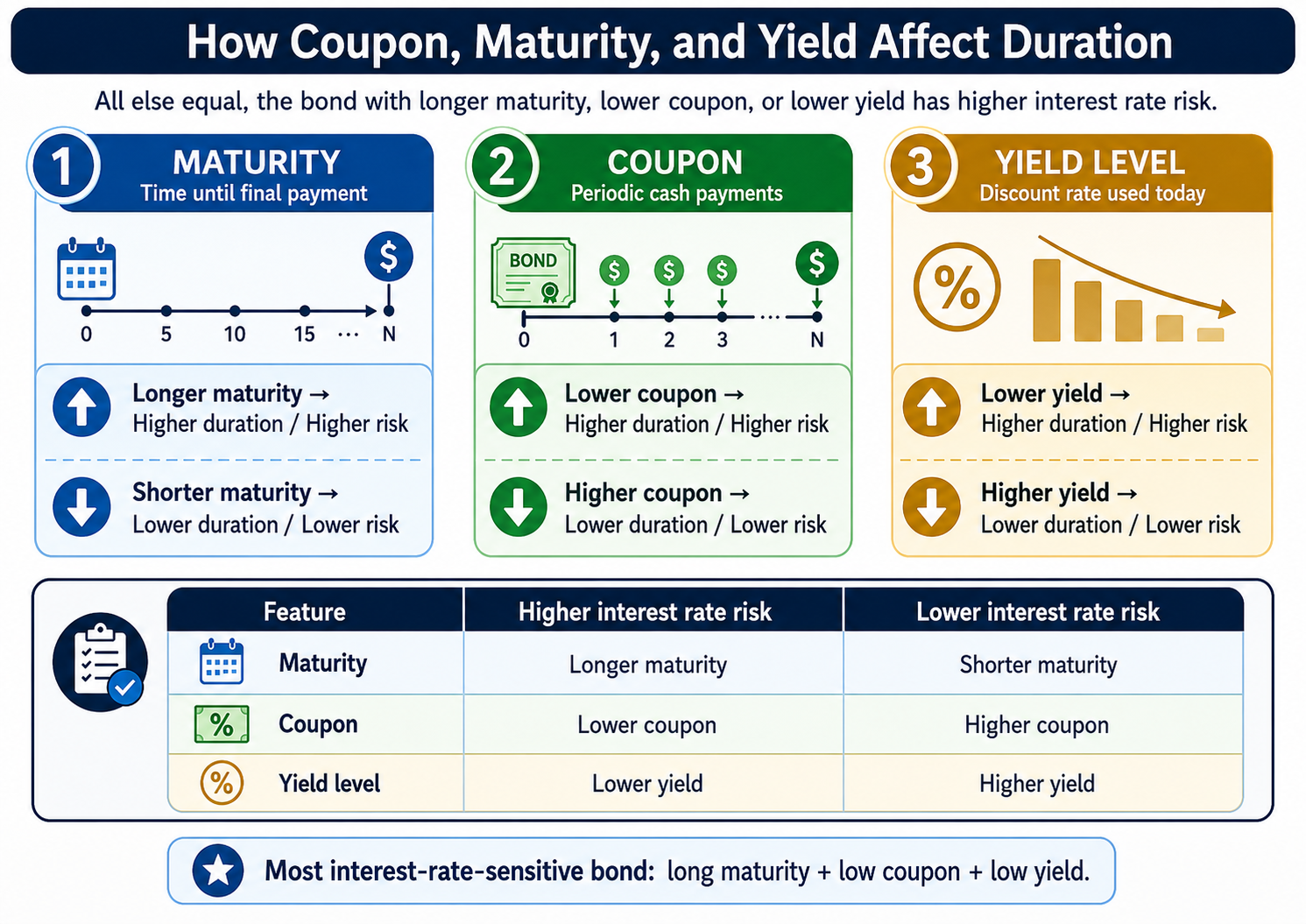
Each row holds everything constant except one feature, then shows which side carries more interest rate risk.
Feature compared | Higher interest rate risk | Lower interest rate risk |
|---|---|---|
Maturity | Longer maturity | Shorter maturity |
Coupon | Lower coupon | Higher coupon |
Yield level | Lower yield | Higher yield |
Example: Ranking Bonds by Interest Rate Risk
Start with a base bond, then change one feature at a time. All are option-free, annual-pay bonds priced per 100 of par. The modified duration shows the effect.
Bond | Coupon | Maturity | Yield | Modified duration |
|---|---|---|---|---|
A (base) | 4% | 10 years | 4% | 8.11 |
B (longer maturity) | 4% | 20 years | 4% | 13.59 |
C (lower coupon) | 2% | 10 years | 4% | 8.72 |
D (lower yield) | 4% | 10 years | 2% | 8.41 |
E (all three combined) | 2% | 20 years | 2% | 16.35 |
Each single change raises duration above the base bond, and maturity moves it the most. When all three line up in the riskier direction, bond E reaches the highest duration of the group. That is the pattern an exam ranking question is testing.
Common Exam Traps
Assuming the highest-coupon bond carries the most risk. All else equal, the high coupon usually carries the least.
Ignoring the all else equal wording. A question often changes only one feature, so read carefully.
Confusing the coupon rate with the yield to maturity. One is promised, the other is implied by price.
Forgetting that longer maturity and lower coupon both raise duration, which often makes a low-coupon long bond the riskiest.
Practice Question
Three option-free, annual-pay bonds are shown below. Which one most likely has the highest interest rate risk?
Bond | Coupon | Maturity | Yield to maturity |
|---|---|---|---|
Bond 1 | 6% | 5 years | 6% |
Bond 2 | 3% | 9 years | 6% |
Bond 3 | 6% | 9 years | 4% |
Bond 1
Bond 2
Bond 3
Correct Answer: B
Bonds 2 and 3 both have nine-year maturities, which is longer than Bond 1, so Bond 1 has the least risk. Between Bonds 2 and 3, maturity is tied. Bond 2's much lower coupon places more weight on the distant principal payment, which raises duration more than Bond 3's lower yield does. Bond 2 has the highest duration and the most interest rate risk.
Option A is wrong because Bond 1 has the shortest maturity.
Option C is close, but its higher coupon shortens its cash-flow timing enough that the lower-coupon Bond 2 wins.
Continue Your CFA Level I Prep With KeyPoint
Use structured lessons, practice questions, mock exams, and progress tracking to focus on the time you have left
FAQs About Bond Maturity, Coupon, and Yield Level
What is the difference between coupon rate and yield to maturity?
The coupon rate is the fixed interest the issuer promises. The yield to maturity is the market's required return implied by the bond's current price. They are equal only when the bond trades at par.
Why are low-coupon bonds more volatile?
A low coupon leaves more of the bond's value in the distant principal payment. That stretches the cash-flow timing, raises duration, and makes the price move more when yields change.
How does maturity affect bond duration?
Longer maturity generally increases duration, all else equal, because the principal payment is discounted over more periods and reacts more to yield changes.
When does yield equal the coupon rate?
For a standard fixed-rate bond, the yield to maturity equals the coupon rate when the bond trades at par, under normal conditions.