Bond pricing rests on one idea: a bond's price is the present value of its promised cash flows. Once that clicks, the relationships among price, coupon, maturity, and yield fall into place. For CFA Level I, you need the inverse price-yield rule first, then the feature-level effects.
Quick Answer
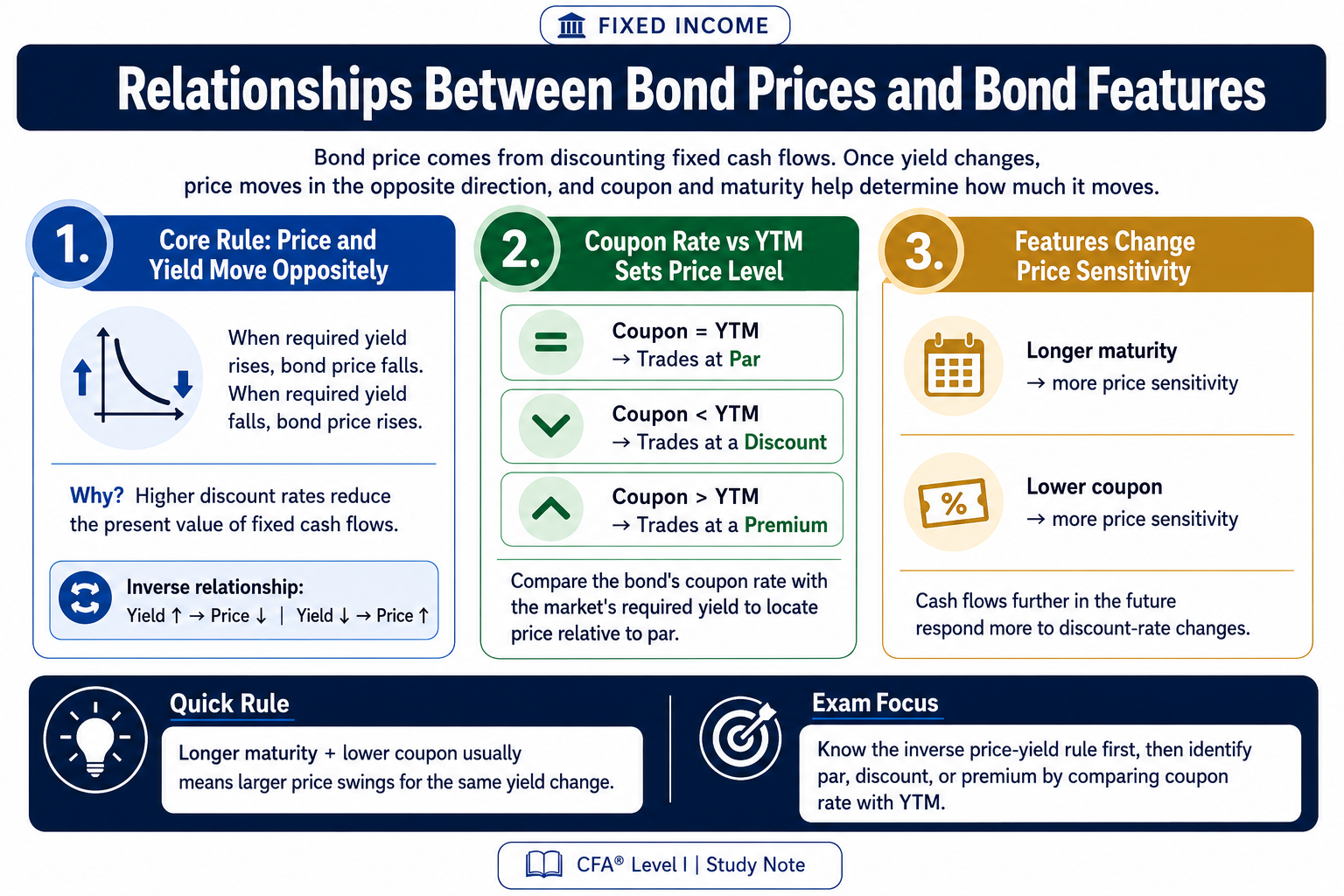
The bond price and yield relationship is inverse: when yields rise, prices fall, and when yields fall, prices rise. This happens because a bond's fixed cash flows are discounted at the required yield. Coupon rate relative to yield to maturity then sets the price: equal means par, lower means a discount, and higher means a premium.
Key Takeaways: Bond Price and Yield Relationship
Bond price and YTM move inversely because fixed cash flows are discounted at the required yield.
If the coupon rate equals the YTM, the bond trades at par, assuming a standard fixed-rate structure.
If the coupon rate is below the YTM, the bond trades at a discount.
If the coupon rate is above the YTM, the bond trades at a premium.
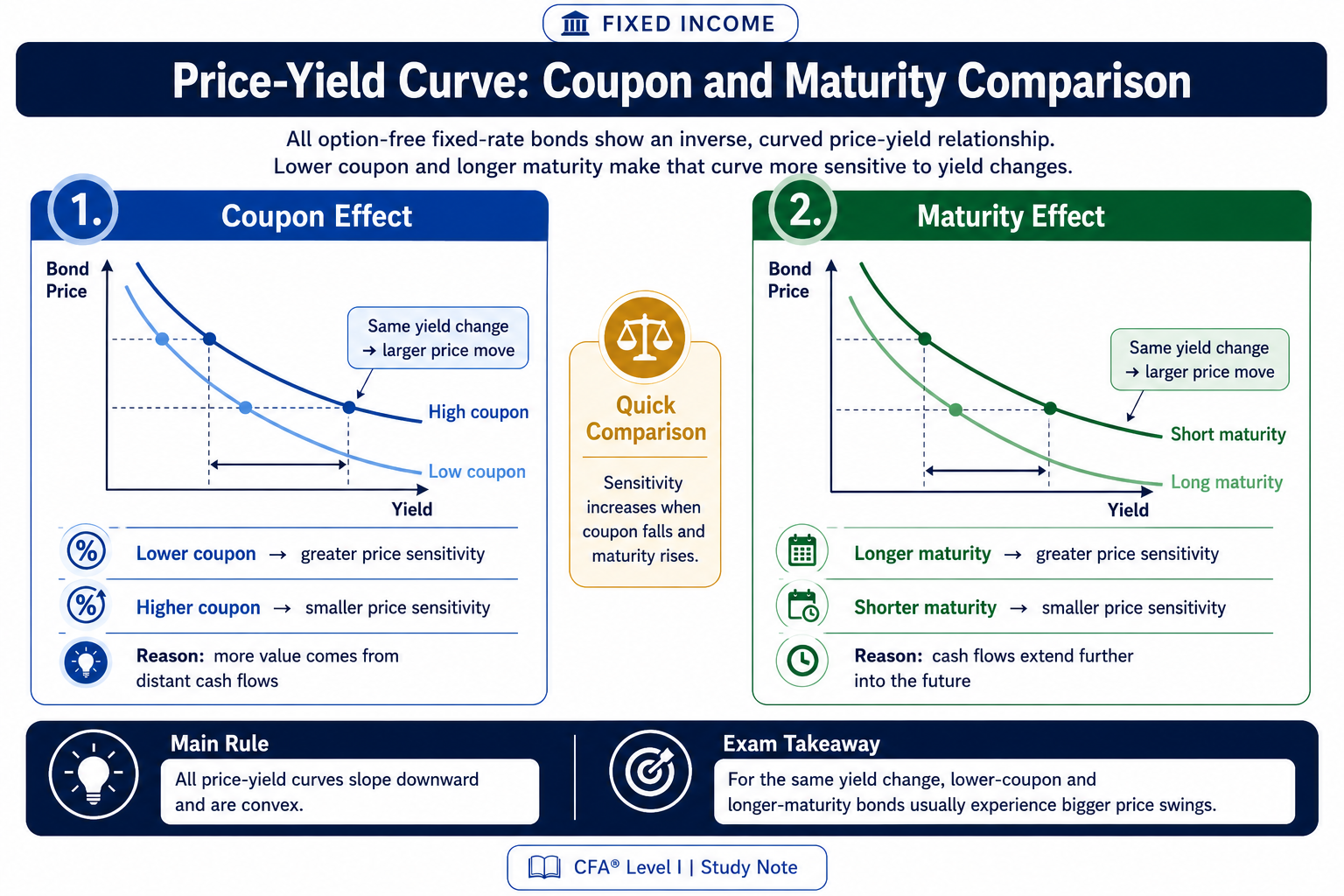
Longer maturity and a lower coupon generally increase price sensitivity to yield changes.
What You Need to Know for CFA Level I
State the inverse relationship between price and yield without hesitation.
Decide discount, par, or premium by comparing coupon rate to YTM.
Explain why longer maturity raises price sensitivity.
Recognize that a lower coupon raises price sensitivity.
Identify the direction a price moves after a yield change.
Bond Price and Yield Relationship: Main Rule
The main rule is direct: prices rise when yields fall and fall when yields rise. A bond promises a fixed set of cash flows, and its price is what those cash flows are worth today at the current required yield.
When the required yield goes up, each future cash flow is discounted more heavily, so the price drops. When the required yield goes down, the same cash flows are discounted less, so the price climbs.
Why Are Bond Prices and Yields Inversely Related?
Bond prices and yields are inversely related because price is the present value of fixed cash flows, and yield is the rate used to discount them. The cash flows do not change, so the only way the price can adjust to a new required yield is to move in the opposite direction.
Where:
= Present value of the bond (its price)
= Sum of all coupon payments from period 1 to N
= Time period (1, 2, 3, ... N)
= Coupon payment (periodic payment to bondholder)
= Yield per period (the discount rate; expressed as a decimal)
= Discount factor for period t
= Face value (principal amount repaid at maturity)
= Total number of periods until maturity
How Coupon Rate Affects Bond Price
The coupon rate sets the bond's cash flows, and comparing it to the YTM tells you where the price sits relative to par. The logic is simple: if the bond pays more than the market currently requires, it is worth more than par, and if it pays less, it is worth less.
Coupon rate equals YTM: the bond trades at par.
Coupon rate below YTM: the bond trades at a discount.
Coupon rate above YTM: the bond trades at a premium.
How Maturity Affects Bond Price Sensitivity
Longer maturity generally increases a bond's price sensitivity to yield changes. The reason is timing. A longer bond has cash flows stretching further into the future, and distant cash flows react more to a change in the discount rate than near ones do.
So two bonds can face the same yield change and move by different amounts. The one with the longer maturity, and especially the lower coupon, tends to swing more.
How Yield Level Affects Bond Price Sensitivity
The starting yield level also matters. At lower yield levels, a bond's price tends to be more sensitive to a given yield change than at higher levels. This is a property of the price-yield curve, which is steeper at lower yields.
Example: Discount, Par, and Premium Bonds
Consider three five-year bonds, each with annual coupons and a yield to maturity of 5 percent, priced per 100 of par.
Bond | Coupon rate | Price | Trades at |
|---|---|---|---|
A | 3% | 91.34 | Discount |
B | 5% | 100.00 | Par |
C | 7% | 108.66 | Premium |
Bond A pays less than the 5 percent the market requires, so it is worth less than par. Bond B pays exactly the required yield, so it sits at par. Bond C pays more, so it commands a premium. If the YTM then rose, all three prices would fall, because higher discounting lowers the present value of every bond's fixed cash flows.
Common Exam Traps
Thinking a higher yield means a higher bond price. The relationship is inverse.
Confusing coupon rate with yield to maturity. They are different rates and play different roles.
Forgetting that discount, par, and premium depend on coupon rate relative to YTM.
Assuming all bonds share the same price sensitivity to a yield change. Maturity and coupon change it.
Practice Question
A five-year, option-free, fixed-rate bond has a yield to maturity that rises from 4 percent to 5 percent. Its coupon payments do not change. What happens to the bond's price, and why?
The price rises, because a higher yield increases the value of the coupons.
The price falls, because the fixed cash flows are now discounted at a higher rate.
The price stays the same, because the coupon payments are unchanged.
Correct Answer: B
The cash flows are fixed, so when the required yield rises, each one is discounted more heavily and the present value drops.
Option A reverses the inverse relationship.
Option C confuses unchanged cash flows with an unchanged price, but the price reflects the discount rate, which has risen.
Continue Your CFA Level I Prep With KeyPoint
Use structured lessons, practice questions, mock exams, and progress tracking to focus on the time you have left
FAQs About Relationships Between Bond Prices and Bond Features
What is the relationship between bond price and yield?
It is inverse. When yields rise, bond prices fall, and when yields fall, bond prices rise.
Why are bond prices and yields inversely related
Because a bond's price is the present value of fixed cash flows. A higher required yield discounts those cash flows more heavily, which lowers the price, and a lower yield does the opposite.
When does a bond trade at a discount?
A bond trades at a discount when its coupon rate is below its yield to maturity, assuming a standard fixed-rate structure. It is paying less than the market currently requires, so it is worth less than par.
What makes a bond price more sensitive to yield changes?
Longer maturity, a lower coupon, and a lower starting yield level all tend to increase a bond's price sensitivity to a change in yield.