
Duration gives a quick estimate of how a bond's price moves when yields change, but that estimate is a straight line. The real price-yield relationship curves. Convexity measures that curve, and the bond convexity formula adds a correction that makes your price estimate more accurate, especially when the yield move is large.
Quick Answer
Convexity measures the curvature in the relationship between a bond's price and its yield. Duration alone gives a linear estimate, so it misses part of the price change when yields move a lot. The convexity adjustment corrects for that, using the formula 0.5 × annual convexity × (change in yield)². For Level I, you calculate the convexity effect and add it to the duration effect.
Key Takeaways: The Bond Convexity Formula
Convexity is the curvature in the price-yield relationship that duration's straight line cannot capture.
The convexity adjustment equals 0.5 × annual convexity × (change in yield)², with the yield change in decimal form.
For an option-free bond, positive convexity helps you. Gains are larger and losses are smaller than duration alone predicts.
The full price estimate combines the duration effect and the convexity effect.
The convexity effect is a correction, not the whole price change. Duration still does most of the work.
What You Need to Know for CFA Level I
That duration is a first-order, linear estimate of price change.
That convexity is the second-order correction for curvature.
How to compute the convexity adjustment from annual convexity and a yield change.
How to combine the duration effect and the convexity effect into one estimate.
How to interpret positive convexity for an option-free, fixed-rate bond.
Why Duration Is Not Enough
A bond's price and its yield move in opposite directions, but not in a straight line. The true relationship is a curve. Duration draws a straight line tangent to that curve, which works well for small yield changes. As the yield change grows, the straight line drifts away from the curve, and the duration estimate becomes less accurate.
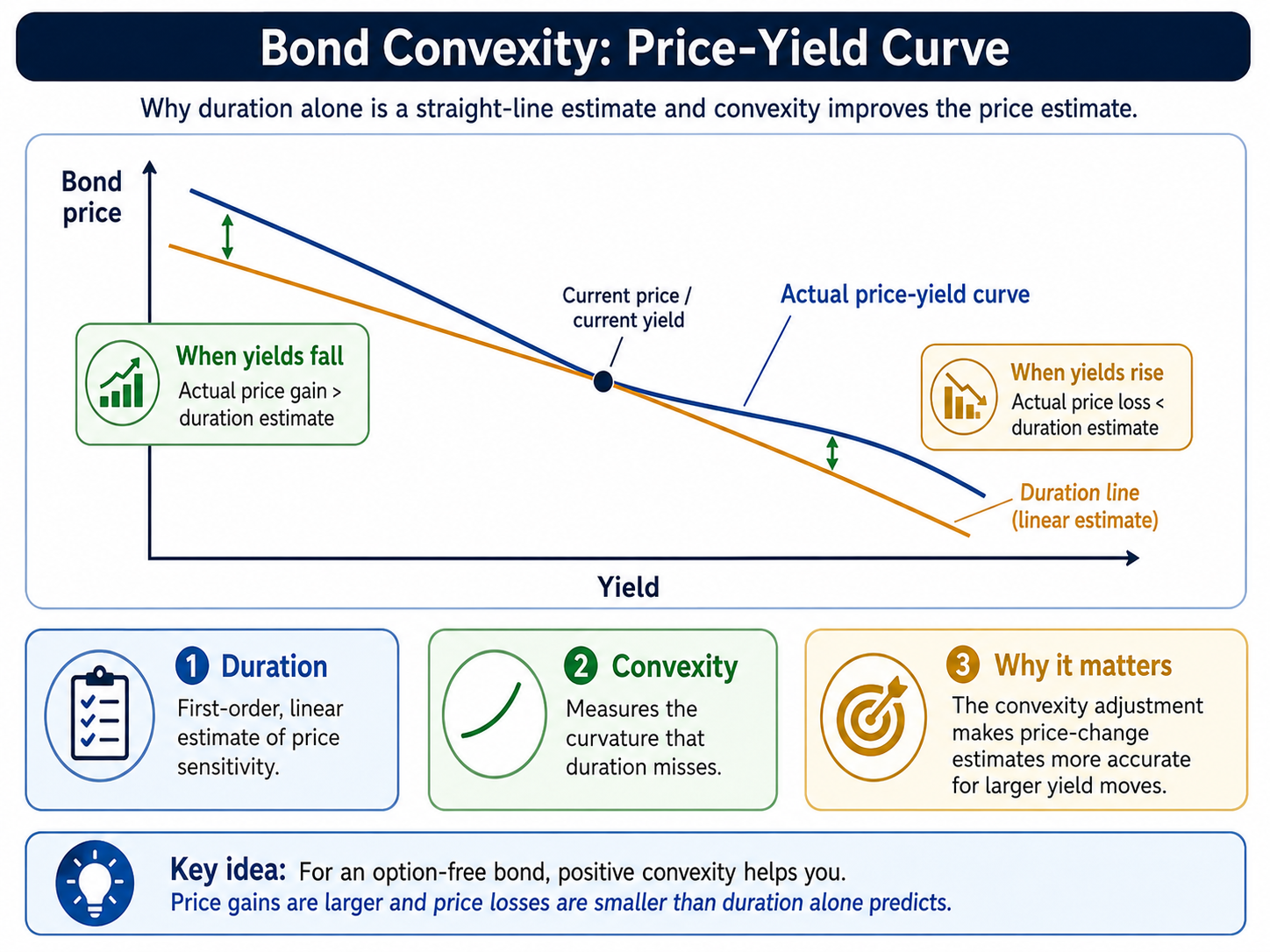
Convexity measures how much the price-yield line curves. Because the curve bends in the bondholder's favor for an option-free bond, the duration estimate understates price gains when yields fall and overstates price losses when yields rise. The convexity adjustment fixes both.
The Convexity Adjustment Formula
The convexity effect you add to a price estimate uses annual convexity and the yield change.
Convexity adjustment = 0.5 × annual convexity × (Δy)²
Annual convexity is given in the question for Level I.
Δy is the change in yield, written as a decimal. A 150 basis point move is 0.0150, not 150.
The result is a percentage price change, expressed as a decimal you can convert to a percent.
Two points decide most questions. First, you must square the yield change. Second, you must keep the 0.5 factor. The full estimate of the price change then combines duration and convexity:
How to Interpret Positive Convexity
For an option-free, fixed-rate bond, convexity is positive, and positive convexity works for you. When yields fall, the price rises by more than duration alone suggests. When yields rise, the price falls by less than duration alone suggests. The convexity term is always added, so it improves the estimate in both directions.
This is why two bonds with the same duration are not identical. The bond with greater convexity gains a little more when rates drop and loses a little less when rates climb.
Worked Example
A bond has a modified duration of 6.2 and an annual convexity of 78. Its yield rises by 150 basis points. Estimate the percentage price change.
First, convert the yield change to decimal:
then, calculate the Duration Effect:
then, the Convexity Effect:
lastly, the Estimated Price Change:
The duration line on its own predicts a 9.30% loss. The convexity correction reduces that predicted loss to about 8.42%, which matches the idea that positive convexity softens price losses when yields rise.
Common Exam Traps
Using basis points as whole numbers. A 150 basis point change is 0.0150 in the formula.
Forgetting to square the yield change.
Dropping the 0.5 factor.
Treating the convexity effect as the total price change. It is only the correction you add to the duration effect.
Assuming convexity can replace duration. It refines the duration estimate, it does not stand alone.
Practice Question
A bond has an annual convexity of 110. Its yield falls by 80 basis points. The convexity effect on the bond's price is closest to:
+0.35%
+0.70%
+0.44%
+8.80%
Correct Answer: A
Convexity effect = 0.5 × 110 × (0.0080)² = 0.5 × 110 × 0.000064 = 0.003520, or +0.352%, which rounds to +0.35%.
Option B drops the 0.5 factor.
Option C fails to square the yield change. Option D misreads the basis point input.
Continue Your CFA Level I Prep With KeyPoint
Use structured lessons, practice questions, mock exams, and progress tracking to focus on the time you have left
FAQs About Calculating and Interpreting Convexity
What is convexity in bonds?
Convexity is the curvature in the relationship between a bond's price and its yield. It measures how the price-yield line bends, which duration's straight-line estimate cannot capture.
What is the bond convexity formula?
The convexity adjustment is 0.5 × annual convexity × (change in yield)², with the yield change in decimal form. You add this convexity effect to the duration effect to estimate the price change.
How do you calculate the convexity adjustment?
Square the yield change in decimal form, multiply by annual convexity, then multiply by 0.5. The result is the percentage price change from convexity.
How is convexity different from duration?
Duration is a first-order, linear estimate of price sensitivity. Convexity is the second-order correction for curvature, and it improves accuracy when yield changes are large.