
Two bonds from the same company can carry different credit quality. Bond ratings give you a starting label, but the label is not the whole story. To evaluate a corporate bond's credit quality, you weigh the issuer's ability to pay against the specific terms of that bond, including where it sits in the repayment line.
Quick Answer
Evaluating a corporate bond's credit quality means judging the likelihood of timely payment and the loss if default occurs. Bond ratings summarize this into categories, from investment grade to high yield to default. Credit quality depends on both the issuer and the specific bond issue, because seniority and covenants change the risk. Ratings are an input, not the full analysis.
Key Takeaways: Bond Ratings and Credit Quality
Credit quality reflects both the chance of timely payment and the potential loss if default happens.
Credit ratings sort bonds into investment grade, non-investment grade (high yield), and default.
Issuer ratings and issue ratings can differ, because seniority and collateral change the risk of a specific bond.
Business risk, financial risk, and bond protections all feed the credit view.
Ratings are inputs. Trend direction and bond-specific terms can move credit quality away from the headline label.
What You Need to Know for CFA Level I
The meaning of credit quality and how it differs from a single rating label.
The broad rating categories: investment grade, high yield, and default.
The difference between an issuer rating and an issue rating.
How seniority, collateral, and covenants change a bond's credit quality.
Why a rating should be interpreted, not memorized.
What Credit Quality Means
Credit quality is a judgment about two things: how likely the borrower is to pay on time, and how much you lose if it defaults. A bond with strong credit quality has a low chance of default and good protections if default occurs. A weaker bond has a higher default chance, weaker protections, or both.
The point candidates miss is that credit quality is not only about the company. It is also about the specific bond. The same issuer can sell a senior secured bond and a subordinated bond at the same time. The senior bond stands closer to the front of the repayment line, so its credit quality is higher even though the company behind both is identical.
A Framework for Evaluating Credit Quality
Build the evaluation in three layers. Each layer narrows from the company down to the bond itself.
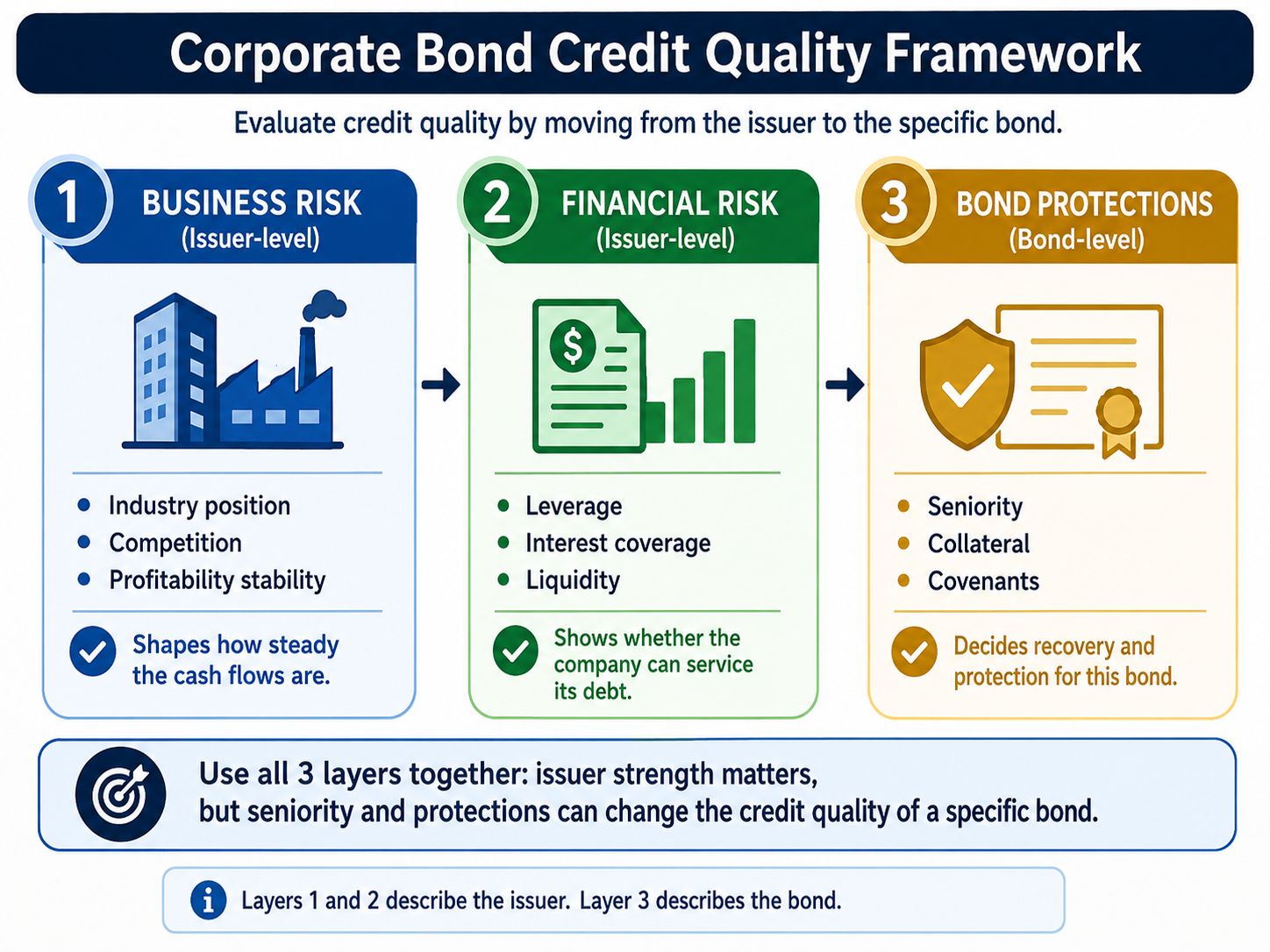
Layer | What to look at | Why it matters |
|---|---|---|
Business risk | Industry position, competition, profitability stability | Shapes how steady the cash flows are |
Financial risk | Leverage, coverage, liquidity | Shows whether the company can service its debt |
Bond protections | Seniority, collateral, covenants | Decides how much a specific bondholder recovers and how protected they are |
The first two layers describe the issuer. The third describes the bond. You need all three, because a strong company can still issue a weakly protected bond, and a weaker company can issue a well-secured one.
Reading the Rating Scale
Ratings compress this analysis into a label. You should know the broad bands without memorizing every notch from every agency.
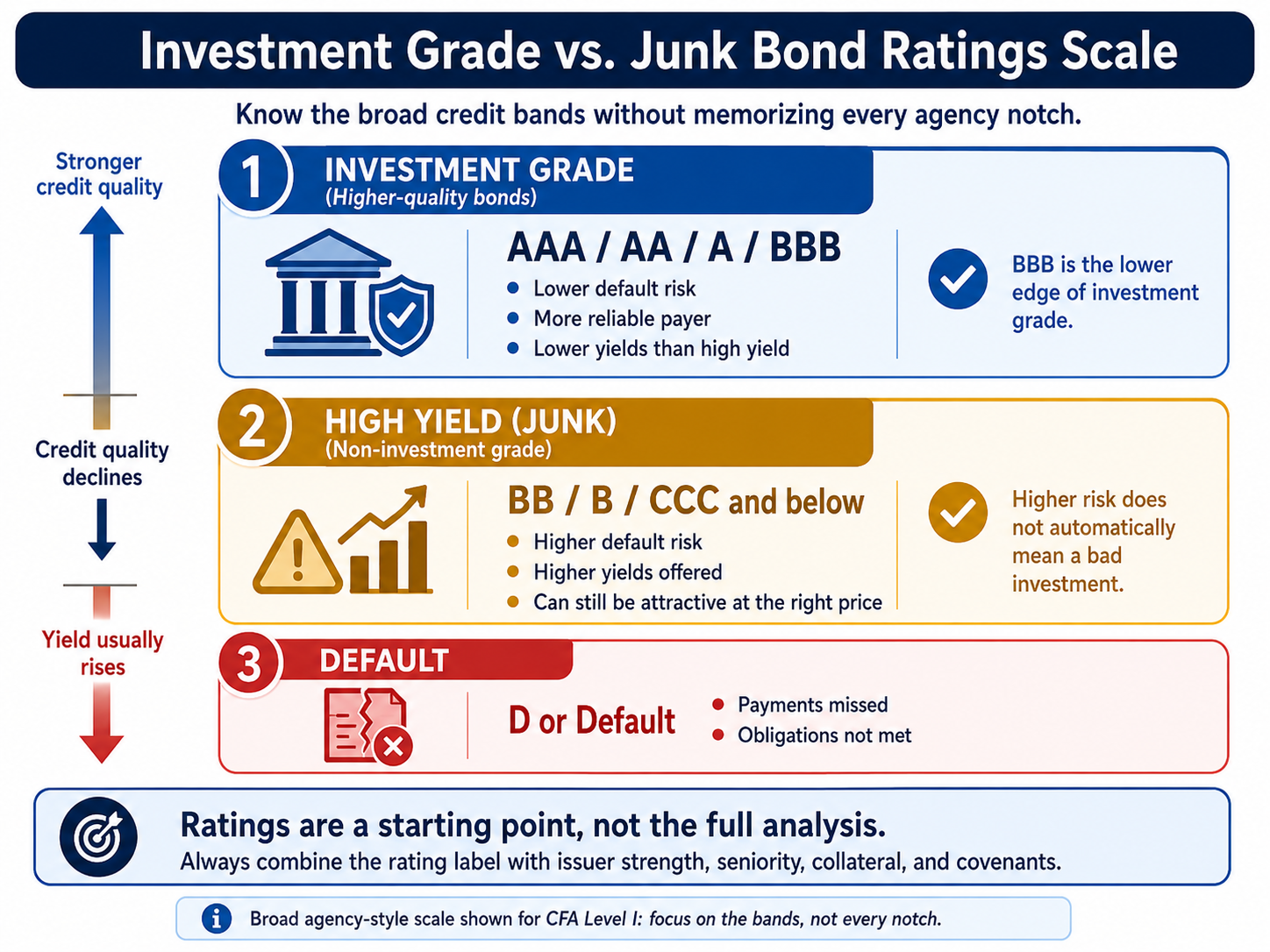
Band | Common meaning | Plain reading |
|---|---|---|
Investment grade | Higher-quality bonds with lower default risk | The issuer is seen as a reliable payer |
Non-investment grade (high yield, or junk bond) | Higher default risk, higher yield offered | More risk, paid for with a higher coupon |
Default | The issuer has failed to meet obligations | Payments have already been missed |
Investment grade bonds are not risk-free, and high yield bonds are not automatically bad. A high yield bond with improving finances and strong covenants can be a sound holding at the right price. The label is a summary, not a verdict.
Worked Example
Two corporate bonds are on the table. Both pay similar coupons, so you compare credit quality.
Factor | Bond A | Bond B |
|---|---|---|
Debt to EBITDA | 2.1 | 4.6 |
EBIT interest coverage | 6.5 | 2.4 |
Position in capital structure | Senior secured | Subordinated |
Bond A's issuer carries less debt against earnings and covers its interest 6.5 times over. Bond B's issuer carries more than twice the leverage and covers interest only 2.4 times. On financial risk alone, Bond A looks stronger.
The bond terms widen the gap. Bond A is senior secured, so it sits near the front of the repayment line with collateral behind it. Bond B is subordinated, so it recovers less if default occurs. Bond A has the higher credit quality on both the issuer layer and the bond-protection layer.
Common Exam Traps
Relying only on the rating label and skipping the analysis behind it.
Ignoring issue seniority. A subordinated bond is weaker than a senior bond from the same issuer.
Treating high yield as automatically bad. The yield compensates for the added risk.
Ignoring the trend. A weakening investment grade issuer can be riskier than a stable high yield one.
Confusing issuer ratings with issue ratings.
Practice Question
An analyst compares two bonds from the same issuer. Which factor most directly weakens the credit quality of one bond relative to the other, holding the issuer constant?
A higher coupon rate.
A subordinated position in the capital structure.
A longer time since the bonds were issued.
A higher credit rating on the issuer overall.
Correct Answer: B
With the issuer held constant, a subordinated position lowers recovery if default occurs, which weakens that bond's credit quality.
Option A reflects pricing, not credit quality directly.
Option C is not a credit driver here.
Option D would not differ between two bonds of the same issuer.
Continue Your CFA Level I Prep With KeyPoint
Use structured lessons, practice questions, mock exams, and progress tracking to focus on the time you have left
FAQs About Evaluating the Credit Quality of a Corporate Bond
What is a bond rating?
A bond rating is a credit agency's summary of a bond's credit quality. It sorts the bond into broad bands, from investment grade to high yield to default, based on default risk and expected loss.
What are investment grade bonds?
Investment grade bonds are higher-quality bonds judged to have lower default risk. They are seen as more reliable payers, though they are not risk-free.
Is BBB investment grade?
In the common agency scales, BBB sits at the lower edge of investment grade, just above the high yield band. Confirm the exact notch wording against the current agency scales before publishing.
What is the difference between investment grade and high yield?
Investment grade bonds carry lower default risk and lower yields. High yield bonds, also called junk bonds, carry higher default risk and offer higher yields to compensate.