
Ratios are part of corporate credit analysis, but they are not the whole of it. Strong credit analysis runs a process. You understand the business, read the statements, calculate ratios, compare against trends and peers, then form a view on repayment. This note focuses on that workflow and where ratios fit inside it.
Quick Answer
Corporate credit analysis is the process of judging whether a company can service and repay its debt. It combines business risk, financial ratios, debt structure, and market signals into one credit view. Financial ratios are central, but they are one input among several. For the ratio formulas themselves, see the Financial Ratios in Credit Analysis note. Here the focus is how ratios feed the decision.
Key Takeaways: Corporate Credit Analysis
Corporate credit analysis is a process, not a single ratio calculation.
The workflow runs from business risk to financial profile to debt structure to a final credit view.
Financial ratios for credit analysis show repayment capacity, but they need context to be useful.
Qualitative factors and capital structure can change a conclusion the ratios alone would suggest.
Trends and peer comparison matter as much as the raw credit metrics.
What You Need to Know for CFA Level I
The steps in a corporate credit analysis workflow.
How profitability, leverage, coverage, liquidity, and cash flow metrics support the credit view.
Why qualitative business risk sits alongside the ratios.
How debt seniority affects what a bondholder actually faces.
The difference between a full credit workflow and a ratio-only calculation.
Corporate Credit Analysis Is a Process
Corporate credit analysis answers whether a company can meet its debt obligations through the cycle. The numbers matter, but a credit view that rests on one ratio is fragile. A complete analysis works through several steps so the ratios are read in context rather than in isolation.
That process is what separates this note from a ratio reference. The formulas live on the [Financial Ratios in Credit Analysis] page. Here, the question is how those ratios combine with business judgment to reach a conclusion.
The Credit Analysis Workflow
Work through the company in order. Each step builds on the one before it.
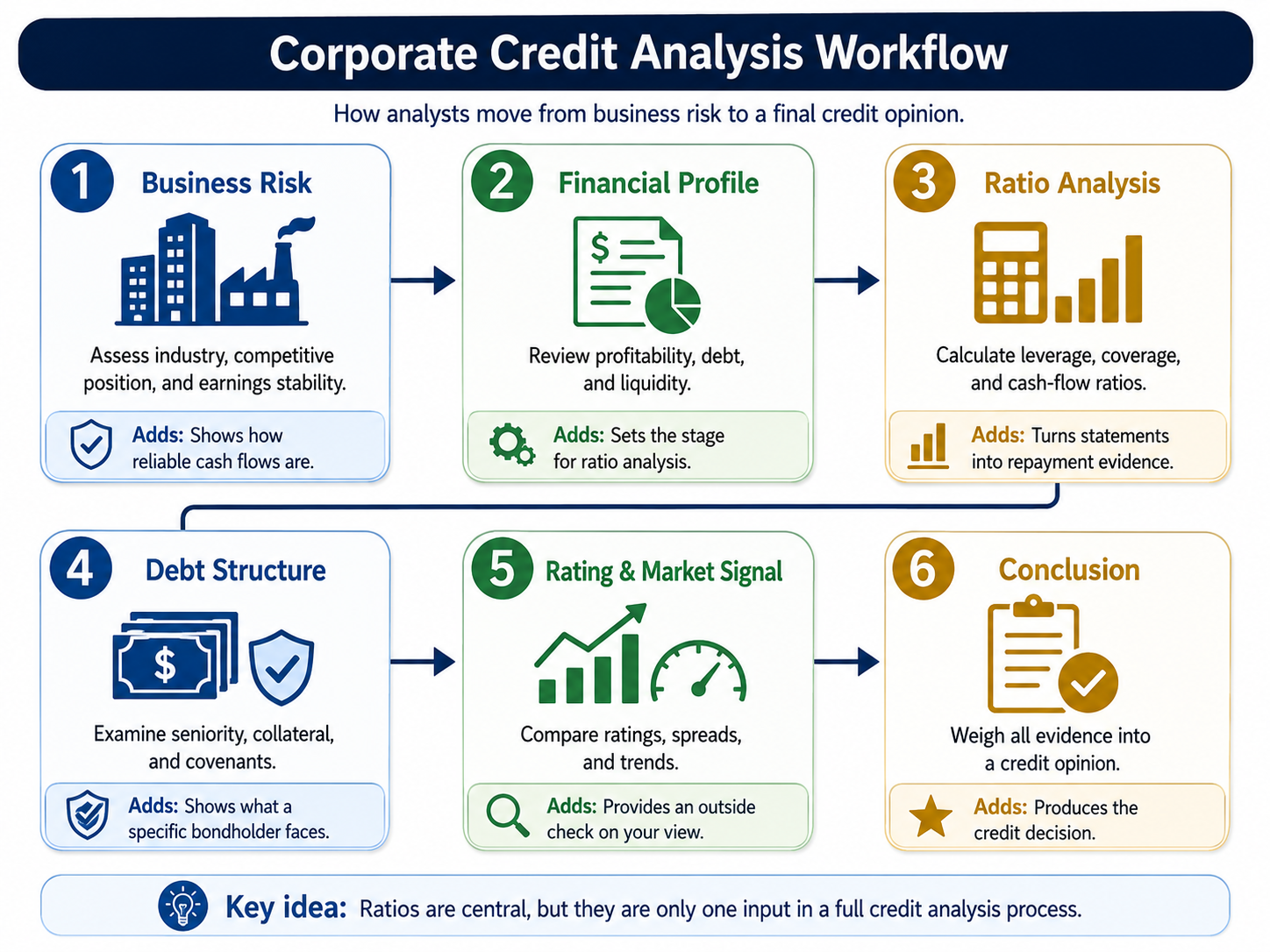
Step | What you do | What it adds |
|---|---|---|
Business risk | Assess the industry, competitive position, and earnings stability | Tells you how reliable the cash flows are |
Financial profile | Review the statements for profitability, debt, and liquidity | Sets the stage for the ratio work |
Ratio analysis | Calculate leverage, coverage, and cash flow ratios | Turns the statements into repayment evidence |
Debt structure | Examine seniority, collateral, and covenants | Shows what a specific bondholder faces |
Rating and market signal | Compare ratings, spreads, and trends | Adds an outside check on your view |
Conclusion | Weigh the evidence into a credit opinion | Produces the credit decision |
The middle of this workflow is the ratio work, but notice that it sits between business judgment and bond structure. A credit view that skips the first and last steps can be wrong even when the ratios are calculated perfectly.
How Ratios Feed the Credit View
Financial ratios for credit analysis fall into familiar categories: profitability, leverage, coverage, liquidity, and cash flow. Rather than repeat the formulas, focus on what each one contributes to the credit picture.
Leverage tells you how heavy the debt load is relative to earnings.
Coverage tells you whether current earnings can pay current interest.
Cash flow tells you whether real cash, not just earnings, can service the debt.
Profitability and liquidity add cushion and near-term safety.
The credit metrics only mean something against a benchmark. The same leverage ratio can be comfortable for a stable utility and alarming for a cyclical manufacturer. Trend direction and peer comparison decide the reading. For the exact formulas, work from the canonical ratio note.
Worked Example
A mid-size manufacturer is up for a credit review. The clues are mixed, so you work the process rather than a single number.
The qualitative picture is cautious. The company sells into a cyclical end market, and its operating margins have slipped for two years running. That is a business-risk warning before any ratio is run.
The quantitative picture confirms the concern. Debt to EBITDA sits near 4.8, which is high. EBIT covers interest only about 1.9 times, which is thin. On the bond side, the issue under review is subordinated, so a bondholder recovers less in a default.
Put together, the workflow points to a weaker borrower. The business risk, the leverage, the thin coverage, and the subordinated position all push the same way. A single ratio might have looked survivable. The process makes the weakness clear.
Common Exam Traps
Treating the ratio calculation as the whole analysis.
Ignoring qualitative business risk that the numbers do not capture.
Skipping the capital structure and the bond's seniority.
Comparing companies across different industries without adjusting for context.
Forgetting that debt seniority changes what a bondholder actually faces.
Practice Question
An analyst reviews a corporate borrower with the following details: a cyclical industry, debt to EBITDA of 4.8, interest coverage of 1.9, and a subordinated bond issue. Which factor most directly affects what a bondholder in this specific issue would recover in a default?
The cyclical nature of the industry.
The debt to EBITDA ratio of 4.8.
The subordinated position of the bond issue.
The interest coverage ratio of 1.9.
Correct Answer: C
Recovery in a default depends on where the bond sits in the repayment line, so the subordinated position is the most direct driver. The other factors weaken the overall credit view, but seniority is what governs recovery for this specific issue.
Continue Your CFA Level I Prep With KeyPoint
Use structured lessons, practice questions, mock exams, and progress tracking to focus on the time you have left
FAQs About Financial Ratios in Corporate Credit Analysis
What is corporate credit analysis?
Corporate credit analysis is the process of judging whether a company can service and repay its debt. It combines business risk, financial ratios, debt structure, and market signals into one credit view.
How do financial ratios help determine creditworthiness?
Financial ratios turn the statements into evidence about repayment capacity. Leverage, coverage, and cash flow ratios show whether a company can carry and service its debt, read against trends and peers.
What credit metrics matter in corporate credit risk analysis?
Leverage ratios such as debt to EBITDA, coverage ratios such as interest coverage, and cash flow measures such as FFO to debt are central. Profitability and liquidity metrics add context.
How do you evaluate the creditworthiness of a company?
Work a process: assess business risk, review the financial profile, run the ratios, examine the debt structure, check ratings and market signals, then weigh it all into a credit opinion.