
Macaulay duration is more than a formula. For a standard fixed-rate bond, it also marks the investment horizon where price risk and reinvestment risk tend to offset each other, assuming small yield changes and the usual simplifying assumptions. That is why CFA® Level I asks you to compare an investor's horizon with the bond's Macaulay duration, then say which risk dominates.
Quick Answer
Macaulay duration is the present-value-weighted average time to receive a bond's cash flows. When an investor's horizon equals Macaulay duration, price risk and reinvestment risk tend to offset, so the realized return is more stable. A shorter horizon leans toward price risk, and a longer horizon leans toward reinvestment risk.
Key Takeaways: Macaulay Duration and Investment Horizon
A bond investor faces both price risk and reinvestment risk.
A shorter horizon is usually more sensitive to price changes.
A longer horizon is usually more sensitive to reinvestment rates.
Matching the horizon to Macaulay duration helps balance the two risks.
The relationship is a tendency, not a guarantee, because it rests on simplifying assumptions.
What You Need to Know for CFA® Level I
You should be able to define holding period and investment horizon, treat Macaulay duration as a timing measure rather than just a calculation output, explain price risk and reinvestment risk, and identify which risk dominates when the horizon is shorter than, equal to, or longer than duration.
What Is the Relationship Between Holding Period, Macaulay Duration, and Investment Horizon?
The relationship ties an investor's time frame to the bond's weighted cash-flow timing. The holding period, or investment horizon, is how long the investor plans to hold the bond before needing the money. Macaulay duration is the bond's present-value-weighted average cash-flow timing. When those two line up, the bond is roughly immunized against small parallel yield changes, because the two interest-rate risks move in opposite directions and tend to cancel.
How Price Risk and Reinvestment Risk Work Against Each Other
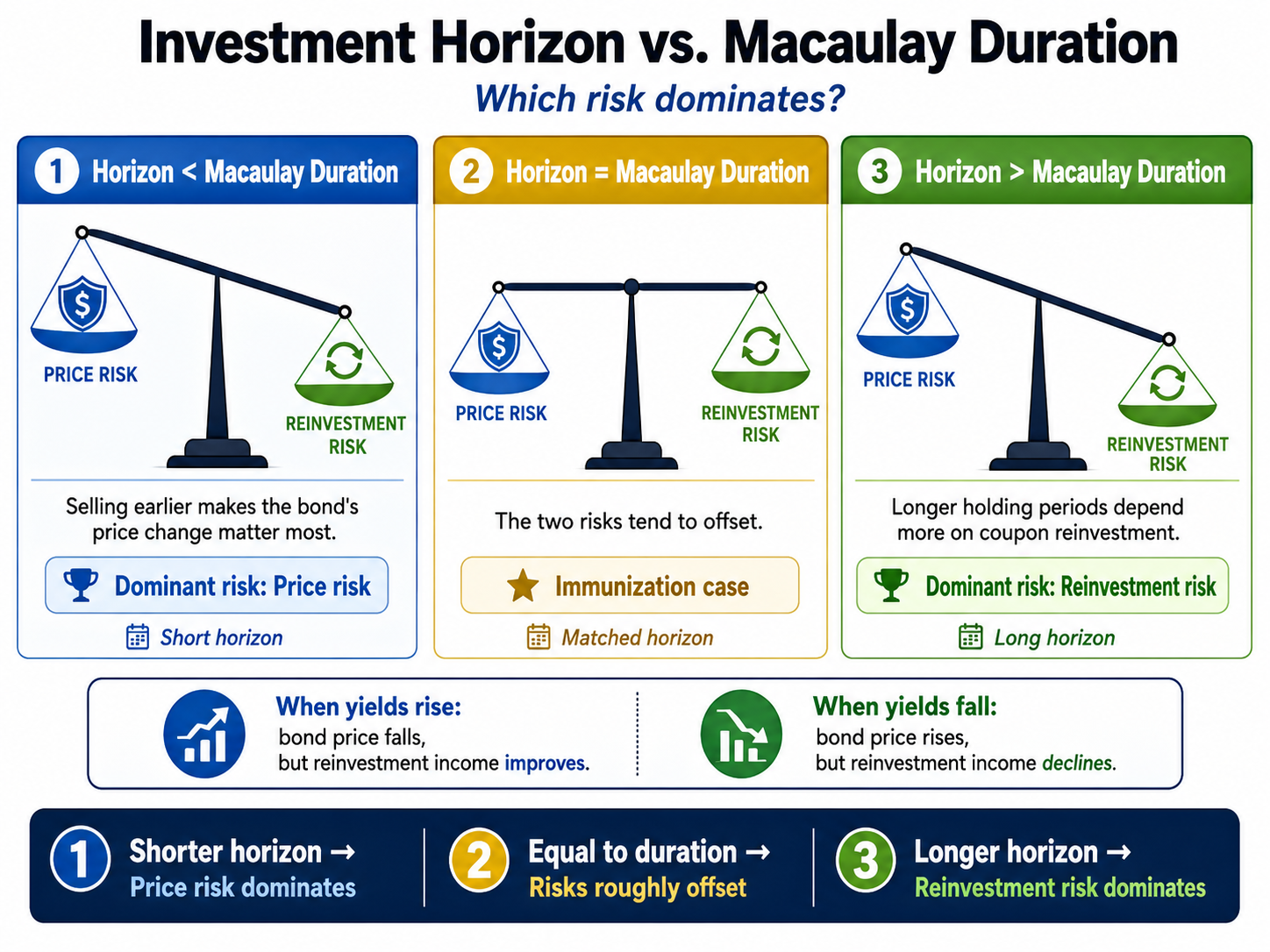
Price risk and reinvestment risk pull in opposite directions after a rate change. When yields rise, a bond's price falls, which hurts an investor who needs to sell, but the same higher yields let coupons be reinvested at better rates. When yields fall, the bond's price rises, which helps a seller, but coupons now reinvest at lower rates. Because one effect helps while the other hurts, their net impact depends on how long the investor holds the bond.
What Happens When the Investment Horizon Is Shorter Than Macaulay Duration?
When the horizon is shorter than Macaulay duration, price risk dominates. The investor sells before enough coupons have been reinvested to offset a price move, so the sale price drives the outcome. If rates rise during that short window, the realized return suffers because the bond is sold at a lower price.
What Happens When the Investment Horizon Equals Macaulay Duration?
When the horizon equals Macaulay duration, price risk and reinvestment risk tend to offset, which is the immunization case. A rate change that lowers the sale price is roughly balanced by the higher reinvestment income earned along the way, and the reverse holds if rates fall. The realized return over the horizon is therefore more stable, though the balance is approximate and relies on small, parallel yield changes.
What Happens When the Investment Horizon Is Longer Than Macaulay Duration?
When the horizon is longer than Macaulay duration, reinvestment risk dominates. The investor holds long enough that the return depends heavily on the rates at which coupons are reinvested. If rates fall over that longer window, the reinvested coupons earn less, and the realized return drops even though the bond's price may have risen.
Framework: Horizon Versus Macaulay Duration
Investment Horizon | Main Risk Exposure | Plain-English Reading | Common Exam Trap |
|---|---|---|---|
Shorter than Macaulay duration | Price risk | Selling early makes the price change matter most | Ignoring the effect of the sale price |
Equal to Macaulay duration | Price and reinvestment risk roughly offset | The horizon balances the two effects | Treating it as a guaranteed return |
Longer than Macaulay duration | Reinvestment risk | Coupons must be reinvested over a longer span | Forgetting coupon reinvestment |
Worked Example: Three Horizons, One Bond
Suppose a fixed-rate coupon bond has a Macaulay duration of about five years. Three investors hold it: one with a two-year horizon, one with a five-year horizon, and one with an eight-year horizon. Soon after they buy, market yields rise.
The two-year investor is hurt mainly by price risk. With only two years to go, there is little time to recover through higher reinvestment income, and the bond must be sold at a lower price. The five-year investor sits near the matched, immunized point, so the lower sale value and the higher reinvestment income roughly offset, and the realized return stays close to plan. The eight-year investor leans toward reinvestment exposure over the long run, though the early price drop matters less the longer the bond is held. The point is not exact numbers but the direction: the shorter the horizon relative to duration, the more price risk drives the result, and the longer the horizon, the more reinvestment risk does.
Common Exam Traps
Treating Macaulay duration as a promised holding-period return.
Confusing the holding period with the bond's maturity.
Forgetting that price risk and reinvestment risk move in opposite directions after a rate change.
Assuming the relationship holds perfectly for large yield changes or non-parallel curve shifts.
Using modified duration when the question asks for the horizon interpretation of Macaulay duration.
Practice Question
An investor buys a fixed-rate bond with a Macaulay duration of six years and plans to sell it in three years. Shortly after purchase, market yields rise and stay higher. Which risk most affects this investor's realized return?
Reinvestment risk, because higher yields raise reinvestment income.
Price risk, because the horizon is shorter than Macaulay duration and the bond must be sold at a lower price.
Neither risk, because the horizon and duration are unrelated.
Credit risk, because yields rose.
Correct Answer: B
Because the three-year horizon is shorter than the six-year Macaulay duration, the investor is more exposed to price risk when yields rise.
Option A: Higher yields increase reinvestment income, but the investor’s three-year horizon is shorter than the bond’s six-year Macaulay duration, so price risk dominates.
Option C: Investment horizon and Macaulay duration are directly related when assessing interest rate risk.
Option D: A rise in market yields creates interest rate risk, not credit risk.
Continue Your CFA Level I Prep With KeyPoint
Use structured lessons, practice questions, mock exams, and progress tracking to focus on the time you have left
FAQs About Relationship Among a Bond's Holding Period, Macaulay Duration, and Investment Horizon
What happens when the investment horizon equals Macaulay duration?
Price risk and reinvestment risk tend to offset, which is the immunization case. The realized return over the horizon is more stable, though the balance is approximate and assumes small, parallel yield changes.
Is Macaulay duration the same as the holding period?
No. The holding period is how long the investor plans to hold the bond. Macaulay duration is the bond's present-value-weighted cash-flow timing. The two only line up when the investor chooses a horizon equal to the bond's duration.
Why does reinvestment risk matter for bond investors?
Coupons received before the horizon date must be reinvested, and the rate available at that time is uncertain. Over a longer horizon, that reinvestment income becomes a larger part of the total return.
Is the Macaulay duration relationship exact for all bonds?
No. It is a tendency that holds most closely for small, parallel yield changes on standard fixed-rate bonds. Large yield moves or non-parallel curve shifts weaken it.