
The CFA® Professional Conduct Program is how CFA Institute enforces the Code and Standards and its related rules. When a possible case of professional misconduct comes to light, the program reviews it through a structured process before reaching any conclusion. An allegation is not a finding, and a finding is not the same as a sanction. This note is an educational overview of how the process works, not legal advice.
Quick Answer
The CFA Professional Conduct Program may receive or identify a possible violation, then review and investigate it. The covered person is given notice and a chance to respond under the applicable procedures. After that, the program may close the matter, or it may proceed to disciplinary review and possible sanctions. The process is governed by CFA Institute bylaws and the Rules of Procedure.
Key Takeaways About the CFA Professional Conduct Program
The program enforces the Code and Standards and the related CFA Institute rules.
The process is governed by CFA Institute bylaws and the Rules of Procedure for Professional Conduct.
Investigation and disciplinary review are separate stages, not one step.
The Disciplinary Review Committee is a volunteer body that carries out peer review.
Sanctions depend on the facts and the procedures that apply.
The Professional Conduct Statement is an annual member requirement, not a sanction.
What You Need to Know for CFA Level I
You should understand the purpose and scope of the program and the high-level stages it moves through. You should also be able to separate three ideas that students often blur together: an allegation, a finding, and a sanction.
Peer review is part of the design, which is why CFA charterholder volunteers sit on the committee that reviews disciplinary matters. Outcomes can affect members and candidates differently. Most of all, keep CFA Institute discipline distinct from legal proceedings. They can run side by side, but they are not the same thing.
What Is the CFA Professional Conduct Program?
The CFA Professional Conduct Program is the function that enforces the Code and Standards and the rules connected with CFA Institute programs and membership. Its role goes beyond punishment.
The program enforces the Code and Standards. It enforces rules tied to membership, the designation, and the exam programs. It educates members and candidates and deters misconduct. It protects the integrity of the designation, the programs, the markets, and investors. And it supports fair, consistent enforcement so that similar conduct is treated in a similar way.
What Can Lead to a Professional Conduct Review?
A review can begin from several high-level sources. These include complaints or reports from clients, employers, or colleagues, and publicly available information. They also include regulatory, judicial, or self-regulatory actions, possible exam-rule violations, and a failure to meet applicable CFA Institute conduct or disclosure requirements. Information identified through CFA Institute's own processes can also trigger a review.
This is a general picture rather than a complete list. The exact triggers depend on the current official procedures, so treat the categories above as orientation, not as an exhaustive legal inventory.
How Does the Enforcement Process Work?
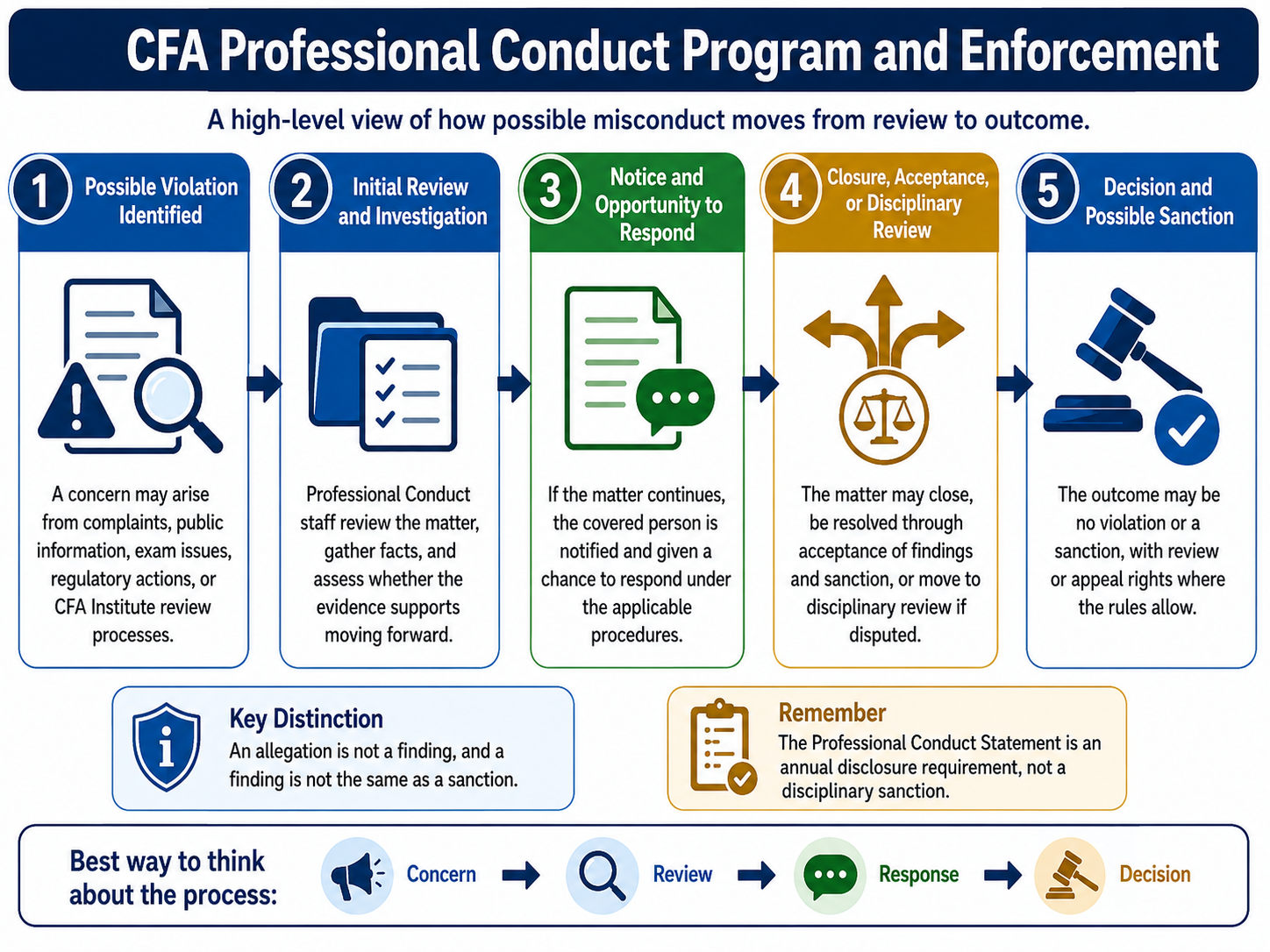
Stage 1: A Possible Violation Is Identified
The process starts when information about possible misconduct reaches the program. That information may come from reports, public records, exam administration, or other permitted sources.
Stage 2: Initial Review and Investigation
Professional Conduct staff may gather documents, contact relevant parties, and assess whether the evidence supports going further. Not every report becomes a disciplinary case. Many matters close at this stage because the evidence does not support one.
Stage 3: Notice and Opportunity to Respond
If the matter continues, the covered person receives notice under the applicable process and is given a chance to respond. The procedure builds in a response opportunity rather than reaching a conclusion in the person's absence.
Stage 4: Closure, Acceptance, or Disciplinary Review
From here, the matter can move in a few directions. It may close if the evidence is insufficient. The covered person may accept the findings and a proposed sanction. Or, if the findings are disputed, the matter may proceed to a review or hearing under the applicable rules.
Stage 5: Decision, Sanction, and Any Available Review
The outcome may be no violation, or it may be a sanction. Where the rules allow, the covered person may have access to a review or appeal. The path depends on the specific facts and the current procedures.
What Is the Role of the Disciplinary Review Committee?
The Disciplinary Review Committee, often shortened to DRC, is a volunteer body of CFA charterholders that supports peer review and disciplinary decision-making under CFA Institute procedures. Members of the committee sit on panels that assess conduct cases.
It helps to know what the committee is not. It is not the Standards of Practice Council, which maintains and updates the Code and Standards. It is not a government regulator, a court, or an employer's internal disciplinary team. Mixing these up is a common exam error.
What Disciplinary Sanctions May Be Imposed?
The table below summarizes the broad categories of disciplinary sanctions. Verify the current categories and labels against the Rules of Procedure before publication, since exact terms can change.
Sanction Category | High-Level Meaning |
|---|---|
Private reprimand | Written admonishment that is not published or disclosed |
Censure | Public written admonishment that includes the person's name |
Suspension of membership or designation | Temporary loss of specified rights for a set period |
Revocation of membership or designation | Permanent or indefinite loss of specified rights |
Summary suspension | Automatic suspension in defined circumstances under current rules |
Candidate suspension or prohibition | Temporary or permanent restriction from CFA Institute exam programs |
CFA Institute sanctions affect membership, the designation, and program participation. They are serious, but they are not criminal penalties, and it is worth not overstating their legal effect.
What Is the Professional Conduct Statement?
The Professional Conduct Statement is an annual disclosure and affirmation that members complete. It is a routine requirement, not a sign that anything is wrong.
A few points clarify its role. It is separate from a disciplinary finding, so completing it is part of normal membership rather than a response to misconduct. Members use it to affirm and disclose certain matters, such as whether they have become involved in conduct that should be reported.
Failing to complete required conduct documentation may have consequences under current membership rules. Candidates may be subject to separate candidate agreements, pledges, and exam rules rather than the member statement.
CFA Institute Enforcement vs Legal or Regulatory Action
Area | CFA Institute Process | Government or Regulatory Process |
|---|---|---|
Authority | Membership, designation, candidate, and program rules | Law and regulatory authority |
Main focus | Code, Standards, membership, designation, and program conduct | Legal or regulatory compliance |
Possible outcomes | CFA Institute sanctions | Civil, regulatory, criminal, licensing, or other legal outcomes |
Relationship | May consider external actions but remains separate | May proceed independently |
One event can lead to more than one process at the same time. A regulator and CFA Institute can each look at the same conduct under their own authority, with their own possible outcomes.
Professional Misconduct Examples
These three short examples are illustrative. In each, the final outcome would depend on the facts and the applicable process.
False information in a professional application. A member knowingly overstates prior experience on a registration form. The potential issue is dishonesty in a professional context. A review may be triggered because the conduct bears on professional integrity. Whether it leads to a sanction depends on the facts and the process.
Sharing prohibited exam content. A candidate posts questions recalled from an exam in a private study chat. The potential issue is conduct that compromises the integrity of the exam program. A review may be triggered through exam administration. The outcome again depends on the facts and the applicable procedures.
Dishonest professional conduct. A charterholder is found to have deceived a client about how fees were calculated. The potential issue is professional conduct that reflects adversely on integrity. A review may be triggered by a complaint or public information. The result would turn on the facts and the process that follows.
These are constructed examples, not summaries of real cases.
Common Exam Traps
Assuming an allegation proves a violation, when an allegation is only a starting point.
Treating CFA Institute as a government regulator with legal authority over the public.
Confusing the Disciplinary Review Committee with the Standards of Practice Council.
Assuming the Professional Conduct Statement is used only after misconduct, when it is an annual requirement.
Relying on outdated committee names or process descriptions.
Assuming every matter follows one identical detailed path.
Practice Question
A CFA charterholder receives notice that the Professional Conduct Program has opened an investigation into a complaint about his conduct. He tells a colleague that he has therefore been found to have violated the Code and Standards. Which statement best describes the situation?
An open investigation means a violation has been found, so he is correct.
An investigation is part of the review process, and no violation has been determined until the process concludes.
The Professional Conduct Statement he files each year is itself the finding of violation.
Correct Answer: B
An investigation is a stage in the process, not a conclusion. A finding of violation, and any sanction, come later and only after the covered person has had an opportunity to respond under the applicable procedures.
Option A is incorrect because an allegation or open investigation does not establish a violation.
Option C is incorrect because the Professional Conduct Statement is an annual disclosure requirement, not a disciplinary finding.
Continue Your CFA Level I Prep With KeyPoint
Use structured lessons, practice questions, mock exams, and progress tracking to focus on the time you have left
FAQs About CFA Institute Professional Conduct Program and Enforcement
What is the CFA Professional Conduct Program?
The CFA Professional Conduct Program is how CFA Institute enforces the Code and Standards and its related rules. It reviews possible misconduct through a structured process governed by CFA Institute bylaws and the Rules of Procedure.
Who investigates possible CFA Code violations?
Professional Conduct staff handle investigations, gathering information and assessing the evidence. Disputed matters can move to panels of the Disciplinary Review Committee, a volunteer body of CFA charterholders who carry out peer review.
What disciplinary sanctions can CFA Institute impose?
Disciplinary sanctions range from a private reprimand to public censure, suspension or revocation of membership and the designation, and suspension or prohibition for candidates. The sanction depends on the facts and the applicable procedures.
What is the Professional Conduct Statement?
The Professional Conduct Statement is an annual disclosure and affirmation completed by members. It is a normal membership requirement and is separate from any disciplinary finding.
Can CFA Institute discipline be separate from legal action?
Yes. CFA Institute enforcement is based on membership, designation, and program rules, while legal or regulatory processes are based on law. One event can lead to both, each with its own outcomes.