
CFA® Standard V governs the quality of your research, the way you communicate it, and the records you keep behind it. Read investment analysis, recommendations, and actions as one connected workflow rather than three separate definitions. The work starts with a diligent and reasonable basis, moves to clear communication with the client, and ends with records that can support what you did. When a scenario fails, it usually fails at one identifiable point in that chain.
Quick Answer
CFA Standard V has three parts that follow the research process.
V(A) Diligence and Reasonable Basis requires diligence and a reasonable, adequately supported basis for your work.
V(B) Communication with Clients and Prospective Clients requires clear disclosure of services, costs, process, risks, limitations, and the difference between fact and opinion.
V(C) Record Retention requires records that support your analyses, recommendations, actions, and client communications.
Key Takeaways About CFA Standard V
A profitable outcome does not cure weak research.
A reasonable basis depends on the circumstances, not a single universal checklist.
Using third-party research does not transfer away your professional responsibility.
Clients need enough information to understand the service, the process, the risks, and the conclusion.
Facts and opinions must be clearly separated.
Supporting records must be kept in appropriate formats, including digital ones.
What You Need to Know for CFA Level I
Learn the names and order of V(A) through V(C). Understand diligence, independence, and thoroughness, and what makes a basis reasonable and adequate. Know what must be communicated: services and costs, the basic process and any material change, significant risks and limitations, the important factors behind the analysis, and the line between fact and opinion. Know what records to create, who owns them, and that the duty to maintain them is separate from ownership. Standard V overlaps with Standards I, III, and VI, so keep those in view.
The Standard V Research-to-Record Workflow
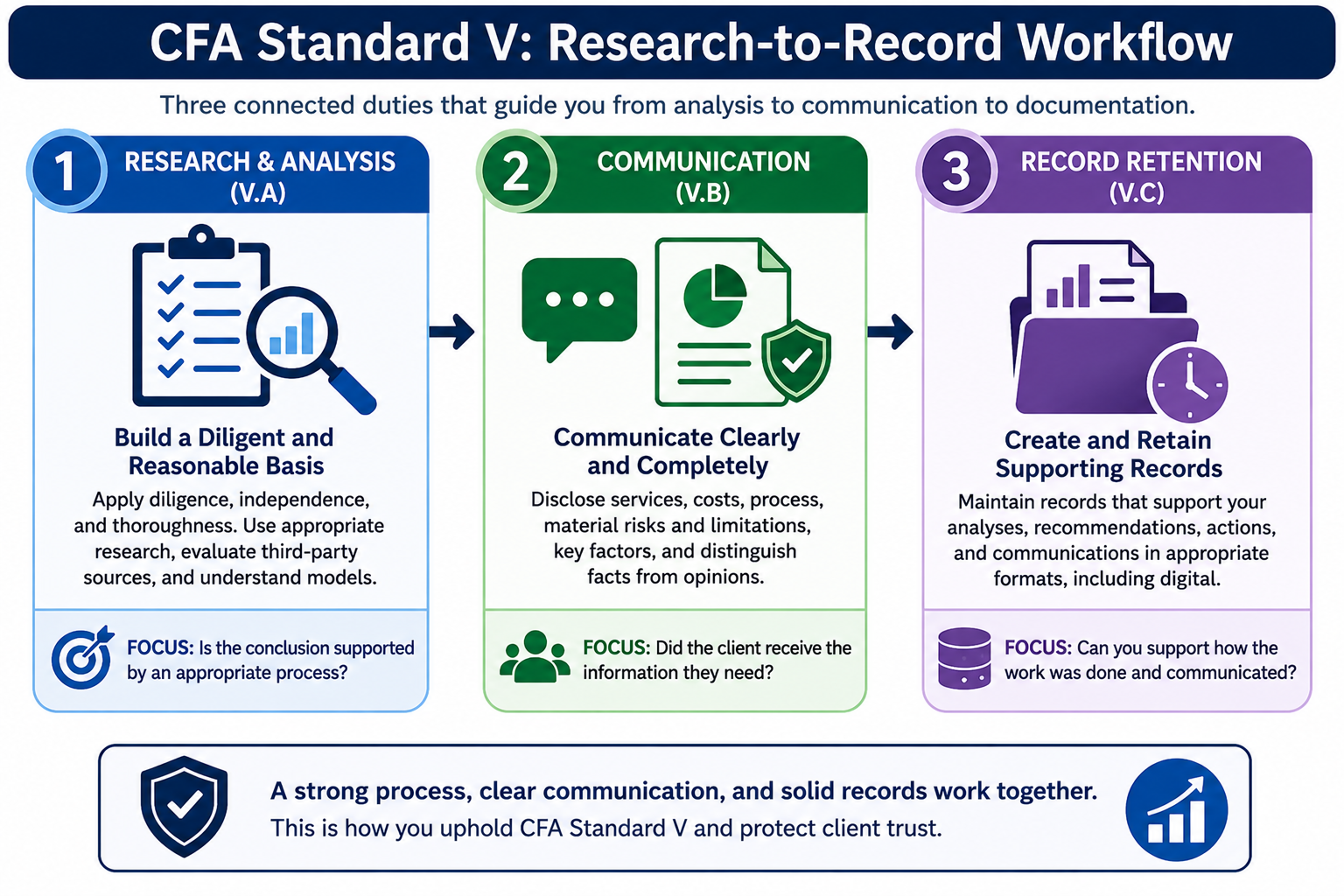
Standard V moves in one direction: build the basis, communicate it, then retain the support. The image below traces that path.
Standard V(A): Diligence and Reasonable Basis
Standard V(A) asks for reasonable diligence, independence, and thoroughness, plus a reasonable and adequate basis supported by appropriate research and investigation. If you lean on third-party research, you still evaluate whether it is reliable. If you use a model, you understand its assumptions, inputs, outputs, and limits.
The depth of work that counts as adequate depends on your role and on the nature of the product or service. One more point that the exam likes: an unexpected loss does not automatically prove a violation. The question is whether the process behind the decision was sound.
Standard V(B): Communication with Clients and Prospective Clients
Standard V(B) is about giving clients what they need to understand your work. Disclose the nature of your services and the costs the client will bear. Describe the basic investment process and tell clients when it changes in a material way. Disclose significant risks and limitations. Include the important factors behind your analysis, and clearly distinguish your facts from your opinions.
This duty applies across every channel, whether the message is spoken, written, posted on social media, or broadcast. Detailed communication examples sit on the child note.
Standard V(C): Record Retention
Standard V(C) asks you to develop and keep records that support your analyses, recommendations, actions, and client communications. That includes support for a decision to make no change, not just buy and sell actions. Relevant model inputs, notes, reports, correspondence, and digital messages can all be part of the record. Records you produce for your employer are generally firm property.
Avoid memorizing one fixed retention period as if it were universal, because the governing period comes from current law, regulation, or firm policy.
Standard V Comparison Table
Substandard | Main Question | Common Evidence | Typical Failure |
|---|---|---|---|
V(A) Diligence and Reasonable Basis | Is the conclusion supported by an appropriate process? | Research, models, due diligence, provider review | Recommending without adequate investigation |
V(B) Communication | Did the client receive the information needed to understand the service and recommendation? | Reports, disclosures, presentations, updates | Omitting material risks, costs, limits, or process changes |
V(C) Record Retention | Can the professional support how the conclusion and communication were developed? | Notes, inputs, outputs, emails, reports | Failing to preserve supporting records |
A Practical Reasonable Basis Test
A reasonable basis test is not a single official checklist, so treat the following as a KeyPoint study framework that helps you think through V(A). Ask whether the work was:
Relevant: Did the analysis consider the factors that actually matter?
Reliable: Were sources and third-party materials evaluated, not just trusted?
Independent: Was judgment protected from improper influence?
Appropriate: Was the depth of work suitable for the product, the role, and the circumstances?
Documented: Can you show what information and process supported the conclusion?
Current: Were material changes considered before the action or communication?
How Standard V Connects Across the Investment Process
The three parts reinforce each other. Weak research can create both a V(A) and a V(B) problem, since you cannot communicate a sound basis you never built. Poor communication remains a violation even when the underlying analysis is strong. Good analysis and good communication still need records, so V(C) does not disappear because the first two went well. Records help demonstrate process, but they do not automatically prove the conclusion was reasonable. And a recommendation can be well researched yet still unsuitable for a particular client under III(C).
Mixed Standard V Example
An analyst builds a buy case on a mid-cap company. She runs a third-party valuation model but never reviews its assumptions. She publishes her investment recommendation as a short social media post that omits the company's heavy leverage and presents her price forecast as if it were established fact rather than her opinion. After the post goes out, she deletes the spreadsheet that held her supporting work.
Identify the concerns by stage. Relying on the model without checking its assumptions is a V(A) diligence gap. Omitting the leverage risk and blurring opinion into fact is a V(B) communication failure. Deleting the supporting spreadsheet is a V(C) record-retention failure. The same recommendation breaks down at all three points in the workflow.
Common Exam Traps
Judging diligence only by whether the investment made money.
Assuming reputable third-party research needs no review.
Treating a model's output as a fact.
Leaving significant limitations out of a short communication.
Assuming texts and other digital messages do not count as records.
Memorizing a fixed retention period without checking the governing requirement.
Practice Question
An analyst is preparing a buy recommendation that relies heavily on a third-party provider's valuation model. Which step best supports a reasonable basis under Standard V(A)?
Confirming the third-party firm has a strong brand reputation.
Reviewing the model's key assumptions, inputs, and limitations before relying on it.
Checking that the recommended stock rose in price last quarter.
Correct Answer: B
A reasonable basis requires understanding the model you depend on, including its assumptions, inputs, and limits.
Option A. Reputation alone, option A, does not establish that the model is sound for this use.
Option C. Recent price movement, option C, is an outcome, not evidence that the underlying analysis was adequate.
Continue Your CFA Level I Prep With KeyPoint
Use structured lessons, practice questions, mock exams, and progress tracking to focus on the time you have left
FAQs About Guidance for Standard V: Investment Analysis, Recommendations, and Actions
What is CFA Standard V?
CFA Standard V, Investment Analysis, Recommendations, and Actions, governs research quality, client communication, and record keeping. Its three parts are V(A) Diligence and Reasonable Basis, V(B) Communication, and V(C) Record Retention.
What is the reasonable basis test?
It is a way of checking whether your conclusion rests on an appropriate process. A reasonable basis depends on the circumstances, including your role and the product, rather than a single fixed checklist.
Can analysts rely on third-party research?
Yes, but reliance does not remove responsibility. You should evaluate whether the third-party research or model is reliable and understand its assumptions and limits before you depend on it.
What must be included in an investment recommendation?
Communications should disclose the nature and cost of services, the basic process and material changes, significant risks and limitations, and the important factors behind the analysis. They should also separate fact from opinion.
What is the difference between fact and opinion?
A fact can be verified, while an opinion is a judgment or forecast. Standard V(B) asks you to label the two clearly so a client is not led to treat your projection as a certainty.
How long should investment records be retained?
There is no single universal period. The required retention period comes from current law, regulation, or firm policy, so confirm the governing rule rather than memorizing a fixed number.