
Standard IV(C) sets the duty of anyone with authority over others to make reasonable efforts to prevent and detect violations. The responsibilities of supervisors run beyond reacting once something goes wrong. They include building a system that catches problems early. CFA® Level I exam questions usually test whether a supervisor did enough, especially when warning an employee or reporting upward felt like the end of the job but was only the start.
Quick Answer
Standard IV(C) requires you to make reasonable efforts to ensure that anyone under your supervision or authority complies with the law, firm policy, and the Code and Standards. You must establish or promote effective systems to prevent and detect violations, not just react after misconduct. You may delegate duties, but accountability for instruction, monitoring, escalation, and enforcement stays with you.
Key Takeaways
The duty is reasonable effort to prevent and detect violations by those under your authority.
A written code of ethics is not enough on its own. It needs procedures, training, monitoring, and enforcement behind it.
Supervisory responsibility comes from control or influence, so it can cover people who are not your direct reports or CFA members.
You can delegate the work, but you keep responsibility for instruction, monitoring, and enforcement.
After suspected misconduct, warning or reporting alone is not enough. You have to investigate and contain.
A subordinate's violation does not automatically mean you violated the Standard, if your controls were reasonable and enforced.
What You Need to Know for CFA Level I
Supervisory responsibility can arise through control or influence and is not limited to direct reports or CFA members.
What counts as reasonable depends on the number of employees, the work they do, the risk involved, and the firm's size and structure.
An effective system has written procedures, clear authority, training, monitoring, testing, reporting channels, sanctions, and periodic updates.
If procedures are inadequate, raise the issue and recommend a fix. If effective supervision is impossible, decline the responsibility.
After learning of a possible violation, investigate and take interim steps to prevent it from continuing.
A subordinate's violation does not by itself prove a supervisory violation when reasonable controls were set and followed.
Who Has Supervisory Responsibility?
The duty follows authority, not job titles. It covers direct reports, delegated reporting structures, and teams you control or influence, including employees who are not CFA members or candidates. The question is whether you have the authority or influence to direct someone's conduct, not whether an organizational chart formally names you as their boss. A senior professional who effectively steers a team carries supervisory responsibility even without the title.
What Are the Core Supervisory Duties?
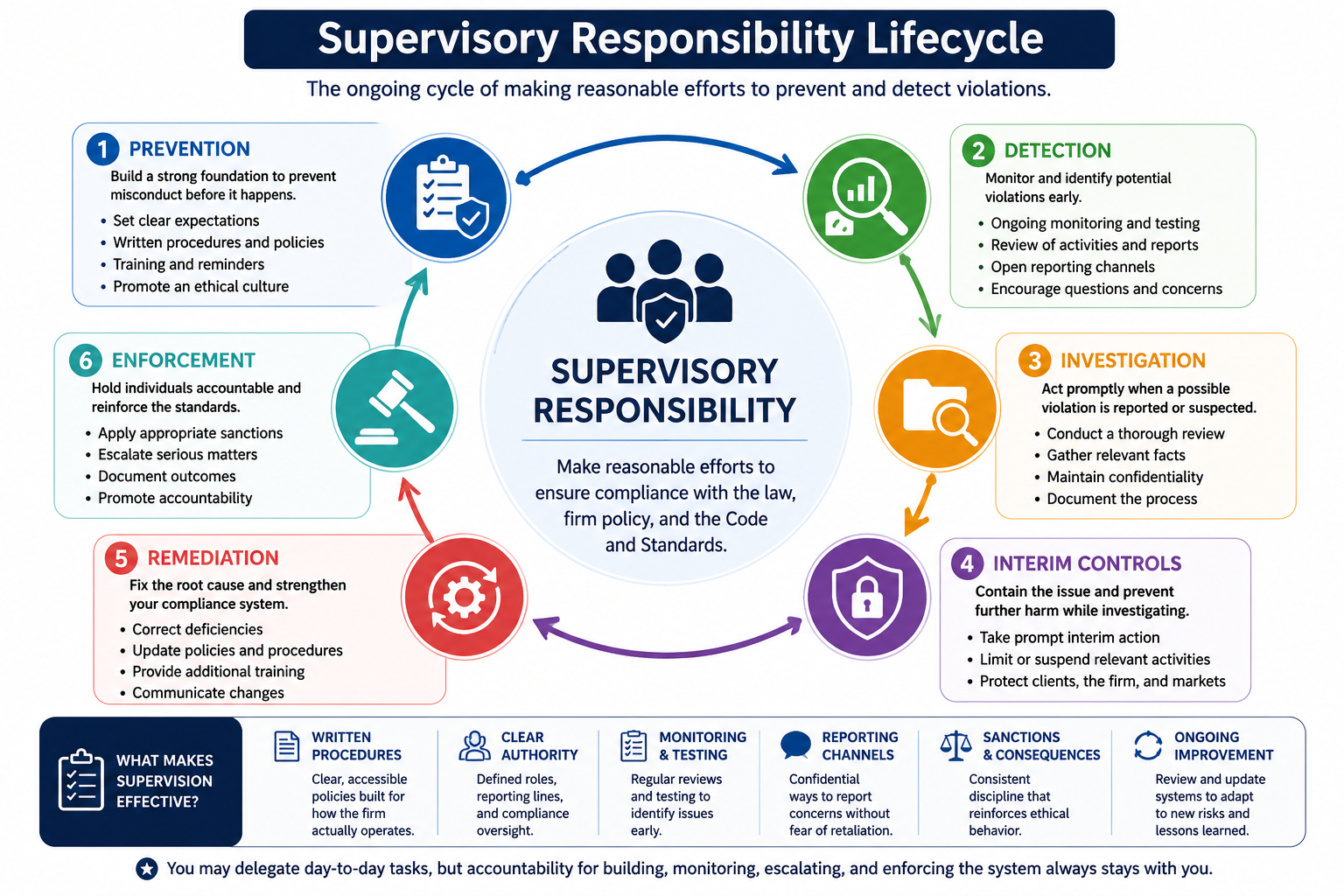
Think of the duties as a lifecycle rather than a single reaction. They run across prevention, detection, investigation, containment, remediation, and enforcement. Across that cycle, you promote compliance with the law, firm policy, and the Code and Standards. The depth of supervision should match the risk. A small low-risk team and a large trading desk do not need identical systems, so reasonable supervision is risk-based rather than one fixed template applied everywhere.
What Makes a Compliance System Adequate?
An adequate system starts with accessible written procedures built for how the firm actually operates. It defines responsibilities, reporting lines, and compliance authority, and it builds in checks and balances, monitoring, testing, reporting channels, and sanctions. It is kept alive through recurring training, reminders, performance evaluation, incentives that reward ethical behavior, and periodic updates. The point worth remembering for the exam: adopting a code of ethics without implementing and reviewing it does not create an adequate system.
Can Supervisory Duties Be Delegated?
Yes, and large teams often require it. A supervisor overseeing many people can delegate day-to-day oversight to others. What delegation does not do is hand off the original supervisor's responsibility. You still have to instruct the people you delegate to on prevention, detection, escalation, and documentation, and you remain responsible for making sure the system actually works. The senior supervisor does not have to personally review every action, but cannot simply assume the delegate has it handled.
What If the Firm's Compliance Procedures Are Inadequate?
When procedures are weak or missing, you cannot quietly accept it. Notify senior management and recommend corrective action. Limited authority is not an excuse for silence, because raising the concern is still within your reach. If the absence or inadequacy of procedures clearly makes effective supervision impossible, you should decline the supervisory role rather than accept it and hope for the best. There is a real difference between asking for improvements and accepting the role, then disclaiming responsibility after the fact.
What Must a Supervisor Do After Suspected Misconduct?
This is the part candidates most often get wrong. Once you learn of a possible violation, start a prompt assessment to find out how far it goes. Do not stop at the employee's explanation, an assurance that it will not happen again, a warning, or a referral to compliance. Temporarily restrict the relevant activities or increase monitoring while you investigate, so the conduct cannot continue under your nose. Then make sure the investigation is thorough, enforce appropriate consequences, fix the weakness that allowed the conduct, and document the facts, the response, and the outcome.
When Is a Supervisor Not Automatically in Violation?
No system catches everything, and the Standard does not pretend otherwise. A supervisor can be compliant when reasonable procedures were established, communicated, monitored, and enforced, yet a violation still slipped through. What turns that into a supervisory failure is the surrounding pattern: repeated violations, ignored red flags, or knowing that procedures were not being followed and doing nothing. In other words, reasonable effort that genuinely operated is the defense. Paper procedures that no one enforced are not.
Recommended Supervisory Guidelines
These are recommended practices that support the Standard.
Map the firm's risks to specific controls and name an owner for each.
Provide recurring, role-specific training rather than a single onboarding session.
Test procedures and document the exceptions you find.
Align incentives with ethical conduct, not results alone.
Create anonymous or protected reporting channels.
Review each incident for both the individual misconduct and the system failure behind it.
Compliant Scenario
Situation. A desk manager receives evidence that an employee may be favoring certain accounts when allocating trades.
Relevant issue. The manager has to respond in a way that both addresses this employee and protects clients while the facts are unclear.
Correct action. She restricts the employee's allocation authority, preserves the records, escalates the matter, launches a broader review of past allocations, and updates the controls once the investigation concludes.
Why it complies. Reporting is paired with active containment and a real investigation. By restricting authority and reviewing the wider pattern, she prevents recurrence and strengthens the system, which is what the Standard asks.
Violation Scenario
Situation. A supervisor learns that a salesperson may be sending clients unapproved performance claims. He accepts the salesperson's promise to stop and sends a short reminder about the rules. He does not review the prior communications, restrict the activity, or investigate how many clients received the claims.
Violation. A warning and a promise are not reasonable supervision after suspected misconduct. He never determined the scope, never contained the activity, and never investigated.
Required alternative. Restrict or monitor the salesperson's client communications, review what was already sent and to whom, investigate the full scope, enforce consequences, and correct the gap that let it happen.
Why the original action fails. The duty does not end at a warning. Without assessment, containment, and investigation, the supervisor failed to make reasonable efforts to detect and stop the violation.
Common Exam Traps
Limiting the duty to direct reports or CFA members. Supervisory responsibility follows control or influence, so it can reach anyone under your authority.
Treating a written code as a complete system. A code without procedures, training, monitoring, and enforcement is not adequate.
Reading delegation as a full transfer. You can delegate the work but not your responsibility for the system.
Assuming a report to compliance ends your duty. Reporting is one step. Investigation and containment still belong to you.
Relying on the employee's assurance. A promise to stop is not a substitute for determining how far the misconduct went.
Assuming every subordinate violation is a supervisory violation. Reasonable, enforced controls can clear the supervisor even when a violation slips through.
Practice Question
A supervisor discovers that a portfolio manager under her authority may have made improper client allocations. She reports the matter to compliance and warns the manager to stop, but she lets the manager continue normal activity while compliance "looks into it." What additional action is most necessary to meet Standard IV(C)?
Nothing further, because she reported the matter and issued a warning
Promptly assess the scope and place interim restrictions on the manager or increase monitoring while the matter is investigated
Immediately terminate the manager before any investigation
Correct Answer: B
Reporting and warning are a start, but the Standard requires the supervisor to determine the scope of the possible violation and to contain it while it is investigated. Restricting the manager's activity or increasing monitoring stops the conduct from continuing and is the missing step here.
Option A is wrong because a report and a warning, with normal activity left running, is not reasonable supervision after suspected misconduct.
Option C is wrong because firing someone before any assessment skips the investigation the Standard expects and is not the most appropriate immediate action.
Continue Your CFA Level I Prep With KeyPoint
Use structured lessons, practice questions, mock exams, and progress tracking to focus on the time you have left
FAQs About Standard IV(C): Responsibilities of Supervisors
Can a supervisor delegate supervisory duties?
Yes. A supervisor with a large team can delegate day-to-day oversight, but delegation does not remove the original responsibility. You still have to instruct the delegate on prevention, detection, and escalation, and make sure the system works.
What should a supervisor do if compliance procedures are inadequate?
Notify senior management and recommend corrective action. If the inadequacy clearly makes effective supervision impossible, decline the supervisory role rather than accept it and disclaim responsibility later.
Is reporting suspected misconduct to compliance enough?
No. Reporting is one step. You also need to assess the scope, place interim restrictions or increase monitoring, ensure a thorough investigation, enforce consequences, and fix the weakness that allowed the conduct.