
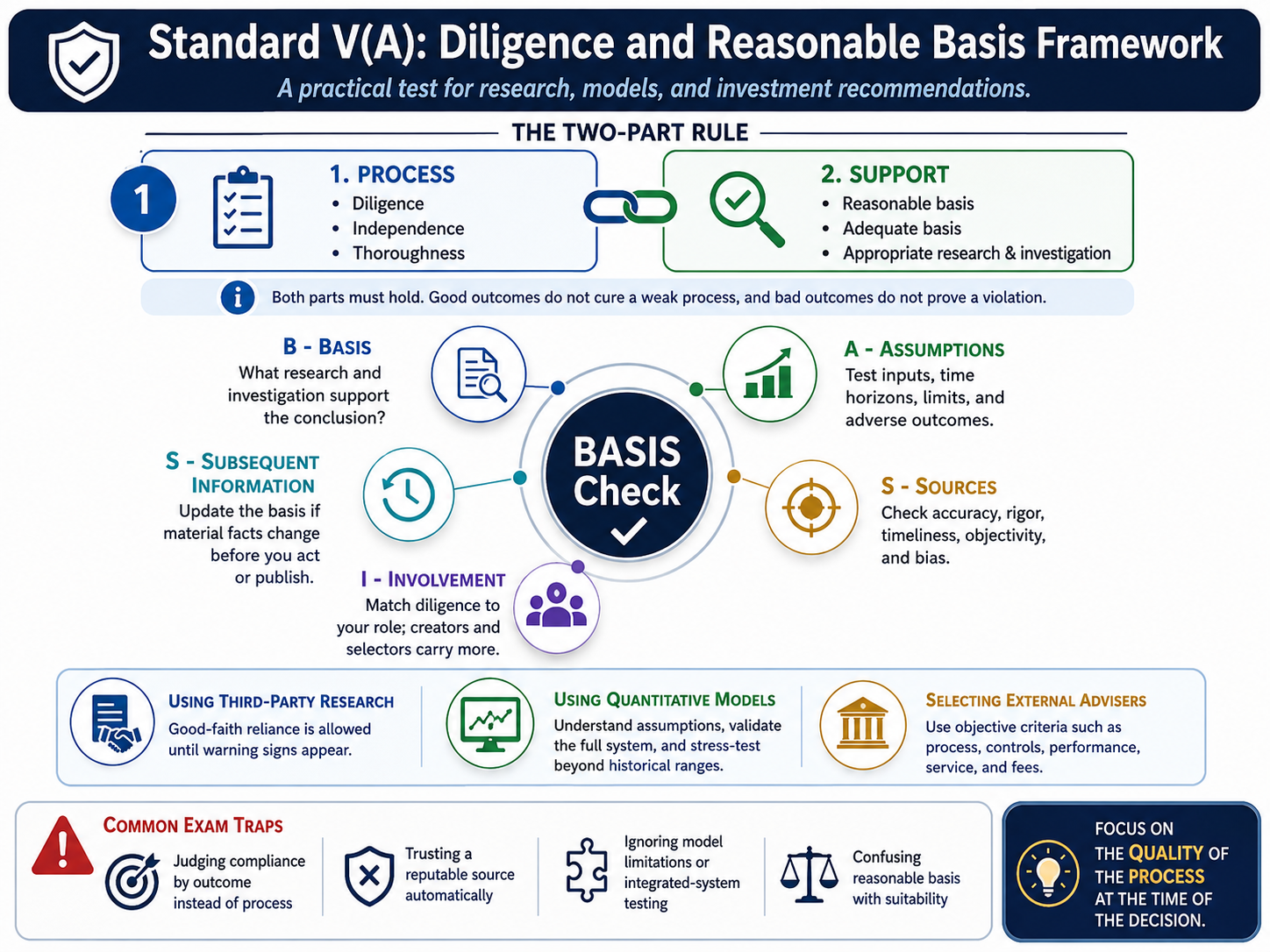
Standard V(A): Diligence and Reasonable Basis sets two requirements you have to meet before you analyze an investment, make a recommendation, or take an investment action. You must work with diligence, independence, and thoroughness, and your conclusion must rest on a reasonable and adequate basis supported by appropriate research and investigation. The Standard judges the quality of your process, not whether the investment later made or lost money.
Quick Answer
Standard V(A) has two parts. First, exercise diligence, independence, and thoroughness when analyzing investments, making recommendations, or taking action. Second, base every conclusion on a reasonable and adequate basis supported by appropriate research. How much work counts as enough depends on the investment, your role, and the decision. A sound process can still pick a losing investment, and a lucky result does not fix a weak one.
Key Takeaways on Standard V(A): Diligence and Reasonable Basis
The rule has two linked parts: a diligent, independent, thorough process and a reasonable, adequate basis behind the conclusion.
The depth of research is not fixed. It scales with the product, the strategy, your role, your firm's resources, and how complex or illiquid the investment is.
Process is judged at the time of the decision. A poor outcome does not prove a violation, and a profitable outcome does not cure a weak basis.
You can rely in good faith on firm-approved internal or external research, but warning signs or known material changes end that reliance.
Model users must understand the assumptions, inputs, and limits, validate the whole system, and stress-test beyond historical ranges.
A reasonable basis for the investment is separate from whether it suits a specific client, which sits under Standard III(C).
What You Need to Know
Standard V(A) lives inside Standard V: Investment Analysis, Recommendations, and Actions. It governs the engine room of your work, the research and judgment behind a call, rather than how you explain that call to clients or what records you keep afterward.
Diligence means careful, consistent, thorough effort. A reasonable and adequate basis means a rational, well-considered process that uses judgment and care suited to the circumstances. Both parts have to hold. You can be thorough and still reach a conclusion the evidence does not support, and you can have a defensible thesis built on careless work. The Standard asks for both the effort and the support.
How Much Diligence Is Enough?
There is no universal source count or fixed checklist. The required depth depends on the product, the strategy, your investment philosophy, the resources available to you, and where you sit in the decision process.
A familiar, liquid, low-complexity instrument may need less investigation. A complex, illiquid, or hard-to-value asset needs deeper research and more careful validation. Pertinent issues can include economic and industry conditions, a company's operating and financial history, fund fees and management history, model limitations, asset quality, and the choice of a peer group. Relying on a single source is not automatically a violation, and stacking up many sources does not automatically prove compliance. Source quality and the adequacy of the process are what matter.
Using Secondary and Third-Party Research
You can build on work done by others, but you remain responsible for the basis of your recommendation. Two terms help here. Secondary research is work produced by another person inside your own firm. Third-party research is work produced outside the firm.
Before you rely on either, look at the assumptions, analytical rigor, timeliness, objectivity, independence, data quality, and known limits of the work. A strong reputation, an award, or past recognition does not replace that review. Good-faith reliance is allowed: if your firm has a sound process for approving a vendor or a research source, you can usually rely on it unless you have reason to question the information or the process. The moment a warning sign appears, good-faith reliance stops and you investigate.
Relying on Quantitative Models
When you use a model or algorithm, you need to understand its material inputs, parameters, assumptions, time horizons, and limitations, and how the output feeds your decision. You do not have to be an expert in every technical detail, but you cannot treat the output as automatically correct.
Models must be validated before use across a broad range of assumptions and adverse scenarios, not only the conditions seen in the historical record. When components interact, test the complete system, not just each piece in isolation. People who build or oversee a model carry a higher diligence burden than people who use validated output.
Selecting External Advisers and Subadvisers
Choosing an outside manager is itself an investment decision that needs a reasonable basis. Use objective selection criteria: the adviser's investment process, how closely it sticks to its stated strategy, its compliance controls, its performance record, the quality of its service, and its fees. The lowest fee on its own is not a sufficient reason to select a manager.
Group Research and When to Dissociate
You do not have to remove your name from a group recommendation just because you disagree with the final conclusion. You can stay associated when the process was independent and objective and the conclusion still has a reasonable basis. The disagreement, in that case, is about judgment, not about a defective process. You should dissociate when you believe the recommendation has no reasonable basis at all.
New Information Before You Publish
A reasonable basis has to be current. If material new information reaches you before a recommendation or report goes out, and it affects the basis, you incorporate it. Stale support that you know is stale is not a reasonable basis.
The BASIS Check
This is a KeyPoint study aid, not an official CFA Institute acronym. Use it to work through a Standard V(A) fact pattern quickly.
B - Basis. Identify the research and investigation behind the recommendation.
A - Assumptions. Test the material inputs, assumptions, time horizons, limits, and adverse outcomes.
S - Sources. Assess accuracy, rigor, timeliness, objectivity, independence, and possible bias.
I - Involvement. Match diligence to your role. Creators and selectors carry more.
S - Subsequent information. Reassess the basis when material facts change before you communicate or act.
Recommended Procedures for Compliance
Firms support Standard V(A) by setting a written research policy, keeping a documented methodology for reviewing and approving research before it goes to clients, maintaining records that show how a conclusion was reached, and requiring testing and validation for models and the data behind them. You support it by understanding the work you rely on, flagging gaps, and refusing to put your name behind a conclusion you cannot defend.
Scenarios
Violation: relying on research you know is out of date
Situation. Priya covers contract manufacturers in specialty pharma. Her firm approves an outside research vendor, and she uses its valuation report on a manufacturer she follows.
Conduct. The vendor's report is 14 months old. Priya knows the manufacturer recently lost its largest customer, which had supplied close to 40% of revenue, a change the report does not reflect. She forwards the vendor's original "buy" without reworking the analysis.
Analysis. Firm approval let Priya rely on the vendor in good faith at the start. The known, material change in the revenue base is a warning sign that ends that reliance. By not reassessing, her recommendation no longer has a reasonable and adequate basis, so she violates Standard V(A).
Takeaway. Good-faith reliance is not blind reliance. A material change you know about creates a duty to update the basis before you act.
Compliant: staying named on a recommendation you disagree with
Situation. A research team issues an "overweight" on a regional utility, built from a multi-factor model the firm revised last quarter.
Conduct. Marcus, on the team, would have rated it "neutral." He has reviewed the revised model, confirmed the inputs were validated, and seen that the integrated model was stress-tested across rate and demand scenarios beyond the historical range. He stays named on the report.
Analysis. Marcus's disagreement is about judgment, not about a flawed process. The conclusion is independent, objective, and reasonably supported, so the Standard does not require him to dissociate.
Takeaway. Disagreeing with a conclusion is not the same as identifying a deficient process. Dissociation is for the absence of a reasonable basis, not for a difference of opinion.
Common Exam Traps
Assuming a bad investment result proves weak diligence, or that a profitable result cures a weak process.
Treating a reputable source, a famous analyst, a colleague, or a firm-approved vendor as automatically reliable in every case.
Believing that crediting third-party research satisfies V(A) without checking whether the work is sound.
Counting sources instead of judging their quality, relevance, and timeliness.
Assuming model users need no grasp of assumptions or limits, or testing components separately but never the combined strategy.
Ignoring adverse scenarios because they are missing from the historical data.
Picking an external adviser on fees, reputation, or past returns alone.
Treating disagreement with a group conclusion as an automatic reason to remove your name.
Confusing an inadequate basis under V(A) with client-specific unsuitability under III(C).
Practice Question
A four-person team issues a "buy" recommendation generated by a valuation model the firm modified two weeks earlier. The model combines three components, each independently validated in the past. One analyst disagrees with the "buy" but believes the research was thorough. During review, it emerges that no one tested the modified model as an integrated system after the three components were combined. Which fact most likely creates a violation of Standard V(A)?
One analyst disagrees with the "buy" conclusion but remains named on the report.
The integrated model was never tested after the three validated components were combined.
The model was modified only two weeks before the recommendation was issued.
Correct Answer: B
When components interact, the complete system must be validated, not just each piece. An untested integrated model means the recommendation lacks a reasonable and adequate basis under Standard V(A).
Option A is incorrect. Disagreement with a conclusion does not require dissociation when the process is sound and the basis is reasonable. Staying named is permitted here.
Option C is incorrect. A recent modification is not a violation on its own. The problem is the missing validation of the combined model, not the timing of the change.
Continue Your CFA Level I Prep With KeyPoint
Use structured lessons, practice questions, mock exams, and progress tracking to focus on the time you have left
FAQs About Standard V(A): Diligence and Reasonable Basis
Does a losing investment mean I violated Standard V(A)?
No. Compliance is judged on the process and information available when you made the decision, not in hindsight. A sound, well-supported process can still pick an investment that loses money without breaching the Standard.
Can I rely on my firm's approved research vendor?
Usually, yes, in good faith. If your firm has a sound process for vetting and approving a vendor, you can rely on it unless you have a reason to question the information or the process. A known material change or a clear warning sign ends that reliance and calls for your own investigation.
Do I need to test every part of a model myself?
You need to understand the material inputs, assumptions, and limits, and how the output drives your decision, not master every technical detail. When components interact, the integrated system must be validated, and the testing should reach beyond historically observed conditions. People who build or oversee a model carry more responsibility than people who use validated output.
How is Standard V(A) different from suitability?
Standard V(A) asks whether the investment analysis has a reasonable basis. Standard III(C): Suitability asks whether a specific investment fits a particular client's circumstances and policy. A recommendation can have a solid basis under V(A) and still be unsuitable for a given client under III(C).