
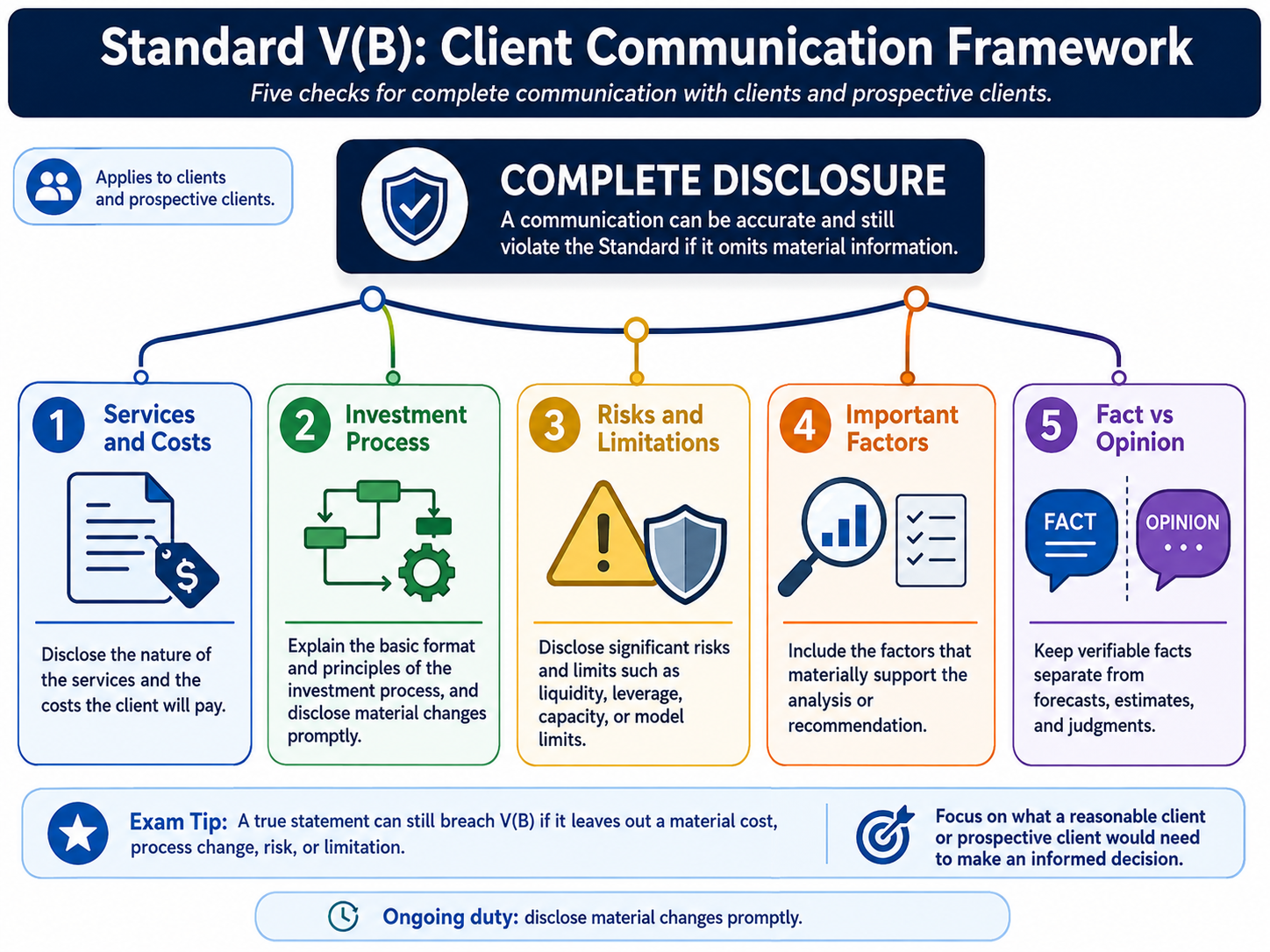
Standard V(B): Communication with Clients and Prospective Clients sets five current requirements for what you must tell clients and prospects so they can make informed decisions. You disclose the nature and cost of your services, explain your investment process and any material changes to it, flag significant risks and limitations, include the factors that matter to your analysis, and keep fact separate from opinion. The duty runs before and during the relationship, in any format.
Quick Answer
Standard V(B) requires five things. Disclose the nature of your services and their costs. Explain the basic format and principles of your investment process, and promptly disclose material changes. Disclose significant risks and limitations. Use reasonable judgment to include the factors important to your analysis. And distinguish fact from opinion. A statement can be accurate and still violate the Standard if it leaves out something material.
Key Takeaways on Standard V(B): Communication with Clients and Prospective Clients
There are five current requirements, and the services-and-cost disclosure added in January 2024 is one of them.
The duty covers both clients and prospective clients, not just people who have already signed on.
Disclosure is ongoing. A material change to your process, services, costs, risks, or limitations must be communicated promptly.
Format does not change the obligation. Reports, calls, email, text, websites, social media, and broadcasts all count.
A communication can be technically accurate yet still breach V(B) by omitting an important factor.
Forecasts, estimates, price targets, and model outputs are opinions and must not be presented as established facts.
What You Need to Know
The goal of Standard V(B) is a client who understands what you do, what it costs, how you make decisions, what could go wrong, and which judgments are facts versus opinions. When a client understands those things, they can decide whether to engage you and whether your work still fits their objectives.
The five requirements work as a set. You can think of the test as five checks: services and costs, process, risks and limitations, important factors, and fact versus opinion. Completeness is the theme. The question is not only "is each sentence true," but "does the reader have the material information needed to make an informed decision."
Disclose the Nature of Services and Their Costs
Clients and prospects must understand what services they will receive and what those services will cost. You give a reasonable amount of detail on costs. You do not have to quote an exact dollar figure when you cannot, for example a fee charged as a percentage of assets under management, but you describe how the cost works. The duty reaches costs from affiliates, related entities, or third parties that are part of delivering the service, not only the fee charged by the entity the client deals with directly. Best practice is to set this out in writing at the start of the relationship.
Explain Your Investment Process and Material Changes
Clients should understand the basic format and general principles of how you analyze investments, select securities, and build portfolios. When the process changes in a way that could materially affect them, you disclose it promptly, and you disclose it to current clients and prospective clients. Updating marketing material alone is not enough.
If your firm lowers a screening threshold, swaps a core valuation model for one that depends more on forecasting, shifts stock selection from individual analysts to a committee, or starts using external managers for part of the portfolio, those are material process changes. Each one can shift the character of what a client is buying, so each one has to be communicated.
Disclose Significant Risks and Limitations
You disclose the significant risks and limits you know about at the time. Depending on the strategy, that can include market or systematic risk, interest-rate risk, country risk, counterparty risk, credit risk, downside exposure, the use of leverage, liquidity restrictions, lock-up periods, minimum investment requirements, capacity limits, and model or data limitations.
Two points matter for the exam. You disclose risks known to you at the time, so a loss from a risk you genuinely could not have known about may point to a diligence problem under V(A) rather than a V(B) breach. And a capacity limit counts even when the fund is far from reaching it, because current and prospective investors still need to know it exists.
Include the Factors Important to Your Analysis
Use reasonable judgment to decide which factors are important, then include them so the reader can follow and challenge your reasoning. You can emphasize some areas, touch on others briefly, and leave out matters you reasonably judge unimportant, as long as you make the scope of the report clear. What you cannot do is bury the basis of the recommendation under immaterial detail, or omit a factor a reader would need to understand the call.
Keep Fact Separate from Opinion
Facts are verifiable. Opinions are professional judgments, forecasts, estimates, and model-based conclusions. A forecast presented as a fact is a violation. Earnings estimates, dividend outlooks, future price levels, and the output of a quantitative model are opinions, and you must say so, along with the relevant assumptions or limits. Promoting the perceived accuracy of a model as if its output were a certainty is exactly the failure the Standard targets.
The Five-Part Communication Check
Check | What to confirm |
|---|---|
Services and costs | The client understands what you provide and the costs they will pay. |
Process | The client understands your basic approach and any material change to it. |
Risks and limitations | Meaningful constraints and risks are disclosed: liquidity, leverage, capacity, model limits, and more. |
Important factors | The inputs and considerations that materially support the recommendation are included. |
Fact versus opinion | Forecasts, estimates, expectations, and model outputs are labeled as opinion. |
Use it to separate complete disclosure from wording that is merely technically accurate.
Recommended Procedures for Compliance
Selecting the relevant factors is an analytical skill, so reviews tend to be case by case rather than checklist driven. Encourage your firm to keep a rigorous methodology for reviewing research before it is published, maintain records of the nature of the research, and be ready to supply additional detail on factors not included in a report if a user asks. When firm-generated disclosures fall short, supplement them, document your objections, and, if you cannot fix them, take steps to dissociate.
Scenarios
Violation: an accurate deck that still leaves out what matters
Situation. Lena runs a quantitative equity-income strategy and presents it to prospective clients in a short webinar deck.
Conduct. The slides show historical income and describe the broad process. They omit a recent change to the dividend-screening methodology, a capacity limit the strategy reaches at roughly $400 million, and a higher advisory fee tier for the new vehicle. One slide states "7% annual income" with no qualifier.
Analysis. Each omission is a separate failure. The methodology change is a material process change that must be disclosed. The capacity limit is a significant limitation, even though the strategy is below it now. The fee belongs in the services-and-cost disclosure. And "7% annual income" is a forecast presented as a fact. Lena violates Standard V(B) on several fronts at once.
Takeaway. Every figure on the deck can be true and the deck can still breach V(B). Completeness and the fact-versus-opinion line are what the Standard tests.
Compliant: communicating a change to everyone who needs it
Situation. A firm tightens the minimum credit-quality screen on a short-duration bond strategy.
Conduct. The portfolio manager notifies current clients and updates prospective-client materials, describes the new screen and why it changed, labels the projected yield as an estimate with its assumptions, and restates the advisory fee and a 90-day redemption notice.
Analysis. The manager treats the screen change as a material process change communicated to both current and prospective clients, discloses the limitation and the cost, and keeps the forecast labeled as opinion. This meets all five requirements.
Takeaway. Prospective clients are not an afterthought. Material changes, costs, limits, and the fact-versus-opinion line apply to them too.
Common Exam Traps
Treating V(B) as a rule about written reports only.
Forgetting the services-and-cost disclosure requirement added in 2024.
Assuming initial disclosure is enough after a material process change.
Believing a true statement cannot violate the Standard even when a material fact is omitted.
Treating model forecasts or price targets as facts.
Assuming every detail must be disclosed, rather than focusing on significant and material information.
Confusing communication completeness under V(B) with reasonable basis under V(A).
Practice Question
An adviser presents a new strategy to a prospective client. The firm recently changed a core part of its investment process, the strategy carries a meaningful liquidity constraint, and the adviser's outlook includes a projected return. Which action by the adviser most likely complies with Standard V(B)?
The adviser describes the strategy's past performance accurately but does not mention the recent process change or the liquidity constraint.
The adviser discloses the risks and the liquidity constraint but does not mention the higher fee for the new strategy.
The adviser discloses the recent process change and the liquidity constraint, states the fee, and identifies the projected return as an estimate based on stated assumptions.
Correct Answer: C
It covers the material process change, the significant limitation, the cost, and the fact-versus-opinion line, which is what Standard V(B) requires for an informed decision.
Option A is incorrect. Accurate past performance does not cure the omission of a material process change and a significant limitation.
Option B is incorrect. Disclosing risks while hiding the cost fails the services-and-cost requirement added in 2024.
Continue Your CFA Level I Prep With KeyPoint
Use structured lessons, practice questions, mock exams, and progress tracking to focus on the time you have left
FAQs About Standard V(B): Communication with Clients and Prospective Clients
What are the five requirements of Standard V(B)?
Disclose the nature and cost of your services. Disclose the basic format and principles of your investment process and promptly disclose material changes. Disclose significant risks and limitations. Use reasonable judgment to include the factors important to your analysis. And distinguish fact from opinion. The first one, services and costs, was added to the Standard in January 2024.
Does Standard V(B) apply to prospective clients?
Yes. The duty covers clients and prospective clients. A frequent exam trap is communicating a material change to current clients while failing to inform prospective clients through marketing or onboarding materials.
Can an accurate statement still violate Standard V(B)?
Yes. A communication can be true in every line and still breach the Standard if it omits a material factor, hides a cost, or presents a forecast as a fact. Completeness, not just accuracy, is the test.
How is V(B) different from V(A)?
V(B) governs how you communicate the process, risks, costs, and reasoning to clients and prospects. V(A) governs whether the research basis behind the recommendation is adequate in the first place. A scenario can involve one, the other, or both.