
Standard V(C): Record Retention requires you to develop and maintain the records that support your investment analyses, recommendations, actions, and client communications. The records should let you, your firm, or a reviewer reconstruct how a decision was reached and show that the process was followed. The seven-year figure many candidates memorize is a default, not a universal legal rule.
Quick Answer
Standard V(C) requires you to keep records that support your analysis, recommendations, actions, and communications, including reviews that end in no action. Records made as part of your job generally belong to your firm, so you cannot take them when you leave without permission. For the retention period, follow the law first, then firm policy. If neither sets a period, CFA Institute recommends keeping records for at least seven years.
Key Takeaways on Standard V(C): Record Retention
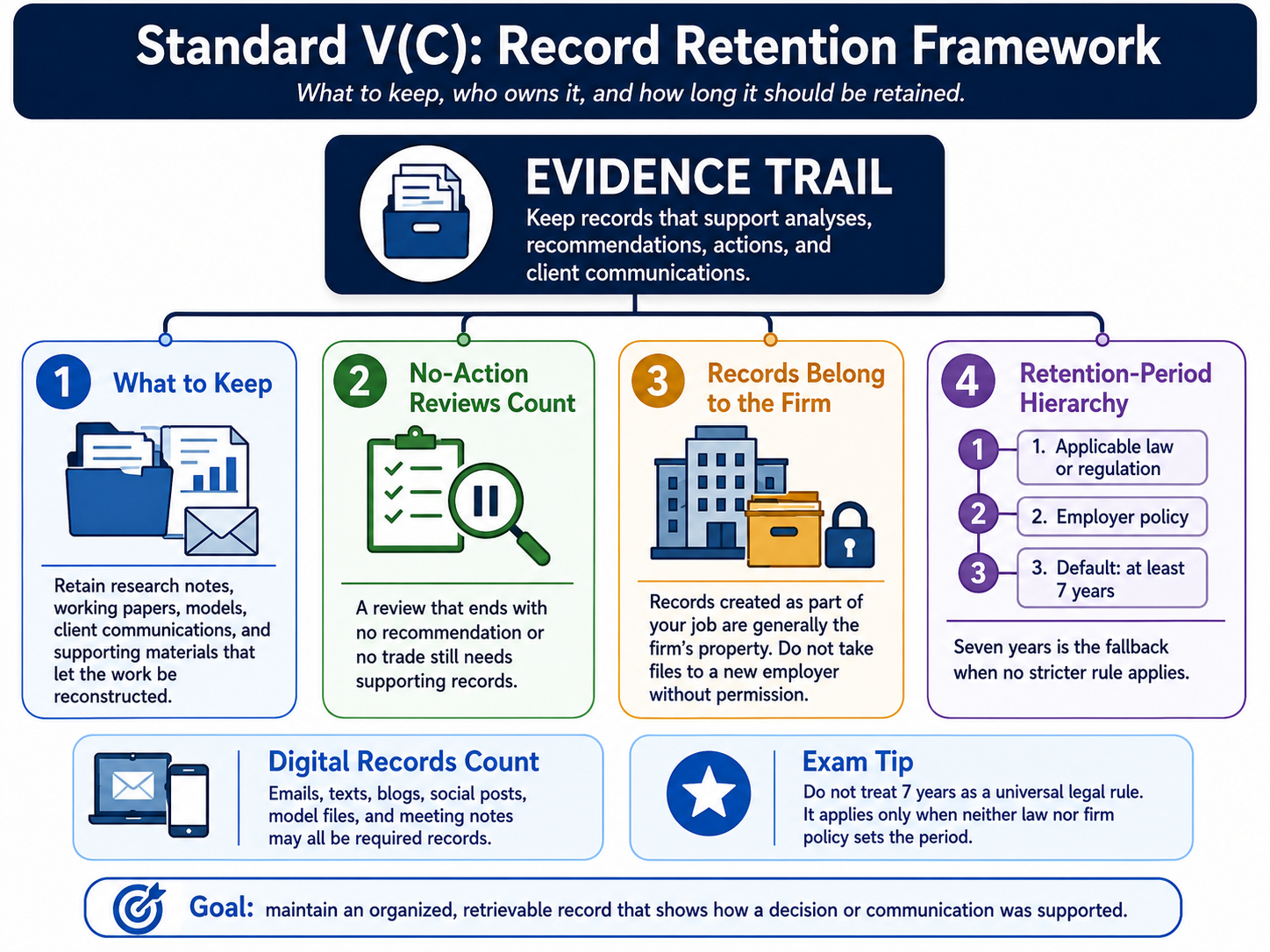
Records must support analyses, recommendations, actions, and communications, and that includes reviews that lead to no recommendation or no trade.
Records made as part of employment are generally the firm's property. Personal memory does not transfer ownership.
The retention period is a hierarchy: applicable law, then firm policy, then a default of at least seven years when neither exists.
Digital communications count. Email, texts, blogs, social posts, model files, and meeting notes can all be required records.
The firm usually owns the retention system, but you still preserve enough support for your own work.
A poor outcome is not misconduct when records show the documented process and mandate were followed.
What You Need to Know
The core duty is an evidence trail. For any decision or communication, you should be able to point to the record that supports it, identify who owns that record, and apply the right retention period. Records do real work. They support the reasoning behind a call, confirm what you disclosed, show that risks were discussed, help resolve disputes, demonstrate that you followed the investment policy statement, and give continuity when responsibilities move between people.
A useful way to read a V(C) fact pattern is four questions: what decision or communication is being supported, what evidence supports it, who owns and maintains it, and how long it must be kept.
What Records You Need to Keep
Supporting material is broad. It can include research notes and working papers, financial statements and company reports, model inputs and outputs and validation records, press releases, email and text correspondence, client communications, personal notes used in the research, blog or social-media posts, presentations and marketing materials, the criteria used to select outside advisers, and documents behind investment-policy or benchmark decisions.
The format can be physical or digital. The real question is whether the material is organized, retrievable, and sufficient to support the work you performed.
Keep Records Even When You Do Not Act
A common mistake is keeping records only when a recommendation or trade happens. Standard V(C) also covers reviews that end in no action. If you analyze a position and decide to make no change, the support for that decision is still a required record. Deleting the model output because "no trade occurred" removes the evidence that you followed a sound process.
Who Owns the Records
Records created as part of your employment are generally the firm's property. When you leave, you cannot take research files, client records, models, or supporting materials without the employer's consent, even if you created them yourself. The fact that you remember the work, or built it, does not make the files yours to carry out the door.
How Long to Keep Records
There is a clear order, and the seven-year figure sits at the bottom of it, not the top.
Applicable law or regulation. Follow the retention period set by the rules in your jurisdiction.
Employer policy. Where the firm's policy meets the Standard, follow it.
Default. If neither a law nor a firm policy applies, CFA Institute recommends retaining records for at least seven years.
Stating "seven years" as a flat, universal mandate is a trap. It is the fallback when no stricter rule exists. The firm usually carries primary responsibility for the retention system, but you still preserve enough support for your own work, and using outside research does not remove the need to retain evidence of the basis for relying on it.
Records and the No-Misconduct Defense
Complete records can show that a disappointing result followed an agreed process rather than a breach. If an investment policy statement requires tracking a benchmark, the benchmark allocation is followed, the mandate is documented, and the records exist, then underperformance in a sector does not by itself establish misconduct. The records are what let you demonstrate that the process was sound.
Recommended Procedures for Compliance
The firm should maintain a records system that captures supporting material across formats, set a retention period that meets the strictest applicable requirement, and govern what departing employees may and may not take. You should keep your work organized and retrievable, preserve support for no-action reviews as well as trades, and avoid removing firm records without written permission.
Scenarios
Violation: deleting evidence and taking files on the way out
Situation. Devi reviews a client portfolio and decides not to rebalance after studying her model's output and her notes.
Conduct. Because no trade resulted, she deletes the model output. She keeps a personal copy of selected research notes, and when she moves to a new firm a few months later, she takes those files with her without asking her former employer.
Analysis. Two failures. The no-action review still needed supporting records, so deleting the model output breaches the duty to retain support for decisions. And the research notes are the firm's property, so taking them without consent breaches the ownership rule under Standard V(C).
Takeaway. No trade does not mean no record, and "I created it" does not mean "I own it."
Compliant: retaining support when no rule sets a period
Situation. An analyst at a small advisory firm completes a recommendation. No local regulation sets a retention period, and the firm has no formal records policy.
Conduct. He files the research notes, model inputs and outputs, and client communications in the firm's records system and retains them for at least seven years.
Analysis. With no law and no firm policy in place, the CFA Institute default applies, and keeping the supporting records in the firm's system for at least seven years satisfies Standard V(C).
Takeaway. When the hierarchy reaches its default, the seven-year period is the floor, and the records belong in the firm's system, not a personal drive.
Common Exam Traps
Treating seven years as a legal requirement in every jurisdiction.
Keeping records only when a recommendation or trade is made.
Assuming digital communications are outside the Standard.
Believing the analyst owns records because the analyst created them.
Taking work files to a new employer without permission.
Assuming the firm's weak procedures remove the individual's responsibility.
Confusing record retention under V(C) with client confidentiality under III(E).
Practice Question
An analyst completes an investment review and makes a recommendation. There is no applicable law or regulation setting a record-retention period, and the analyst's firm has no formal records-retention policy. Which action most likely complies with Standard V(C)?
The analyst keeps only the final recommendation and discards the underlying model output and research notes once the work is delivered.
The analyst retains the supporting research, model inputs and outputs, and communications in the firm's records system for at least seven years.
The analyst saves a personal copy of the supporting records to a private drive in case it is needed at a future employer.
Correct Answer: B
With no law and no firm policy, the CFA Institute default applies, and retaining the supporting records in the firm's system for at least seven years meets the Standard.
Option A is incorrect. Discarding the underlying support leaves no way to reconstruct the basis for the recommendation, which the Standard requires.
Option C is incorrect. The records are the firm's property and belong in the firm's system. Saving a personal copy to carry to a future employer sets up an ownership breach.
Continue Your CFA Level I Prep With KeyPoint
Use structured lessons, practice questions, mock exams, and progress tracking to focus on the time you have left
FAQs About Standard V(C): Record Retention
Is the seven-year period a legal requirement?
No. Seven years is the CFA Institute default that applies only when no law or regulation and no firm policy set a retention period. If a stricter rule applies, you follow that instead. Presenting seven years as a universal legal mandate is a common error.
Do I have to keep records when I decide not to trade?
Yes. Standard V(C) covers reviews that end in no recommendation or no transaction. The support for a no-action decision is still a required record, because it shows you followed a sound process.
Can I take my own research files when I change jobs?
No, not without permission. Records created as part of your employment are generally the firm's property. The fact that you created them or remember them does not transfer ownership, so taking them without consent breaches the Standard.
Do emails and texts count as records?
They can. Email, text messages, blogs, social-media posts, presentations, and model files may all form part of the required record when they support analysis, recommendations, actions, or communications. The format does not exempt them.