
A conflict of interest is any relationship, interest, or incentive that could impair your judgment or interfere with your duties. CFA® Standard VI, Conflicts of Interest, covers how you handle them across three connected responsibilities. The current Standard puts avoidance first, then asks for disclosure when avoidance is not reasonable. On top of that, it sets the priority between personal and client trading and requires transparency about referral compensation.
Quick Answer
CFA Standard VI, Conflicts of Interest, has three parts.
VI(A) Avoid or Disclose Conflicts asks members and candidates to avoid conflicts where reasonable and to make full, fair disclosure when avoidance is not practical.
VI(B) Priority of Transactions places client and employer transactions ahead of personal ones.
VI(C) Referral Fees requires disclosure of any benefit paid or received for a referral.
Key Takeaways About CFA Standard VI Conflicts of Interest
Avoidance is generally stronger than disclosure, which is why the current title leads with "avoid."
An apparent conflict matters because it can damage trust even with no proven bias.
Disclosure has to help the recipient understand the source and likely effect of the conflict.
Client and employer trades take priority over your personal trades.
Referral arrangements can bias a recommendation and raise the client's total cost.
One conflict can trigger several Standards at once.
What You Need to Know for CFA Level I
Learn the names and order of VI(A) through VI(C), and use the current VI(A) title, Avoid or Disclose Conflicts. Be able to separate actual, potential, and apparent conflicts. Understand avoidance, mitigation, and disclosure as a sequence rather than a single step. Know the personal-trading priority rule and the referral-fee disclosure rule. Standard VI overlaps with I(B) Independence and Objectivity, IV(B) Additional Compensation Arrangements, and III(B) Fair Dealing, so expect those connections.
What Does Standard VI Cover?
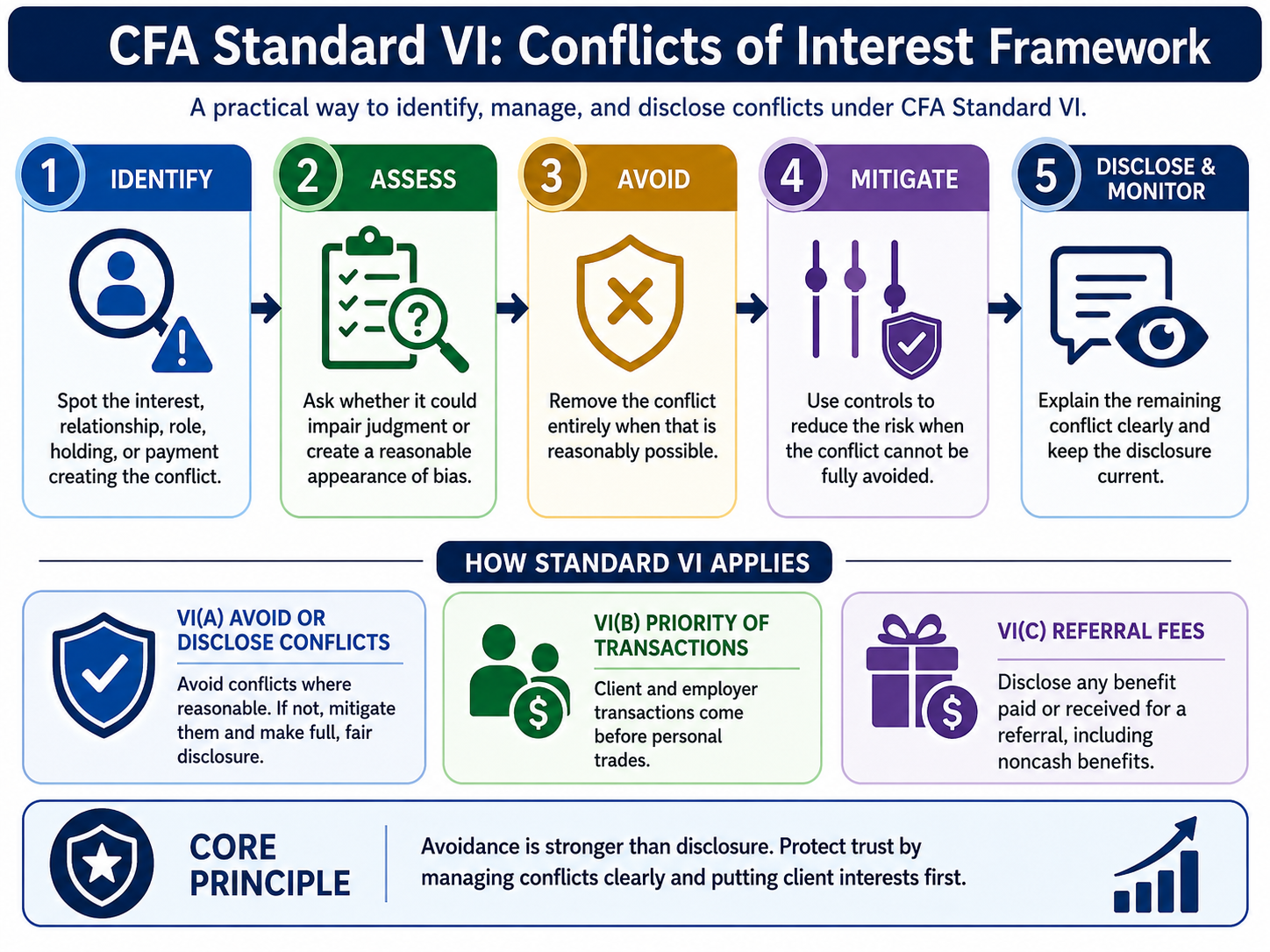
Standard VI covers general conflicts, personal-trading priority, and referral compensation. The framework below moves from spotting a conflict to deciding what to do about it.
Standard VI(A): Avoid or Disclose Conflicts
Standard VI(A) starts by asking you to identify anything that could impair your independence and objectivity or interfere with your duties. Where reasonable, you avoid conflicts of interest outright. Where a conflict cannot be fully avoided, you mitigate it and then make full and fair disclosure. The disclosure has to be prominent, in plain language, and effective enough that the recipient can act on it, and you update it when the conflict changes.
The rule also reaches the appearance of conflict of interest, not just proven bias. The phrase disclosure of conflicts of interest still describes part of the duty, but disclosure is the fallback, not the first move.
Standard VI(B): Priority of Transactions
Standard VI(B) puts client transactions ahead of personal ones, and employer transactions take priority too where relevant. Personal trading is not banned. It just cannot disadvantage clients or take advantage of pending client information. Accounts held by family members or where you have beneficial ownership can raise the same concern. Controls such as restricted lists, preclearance, blackout periods, and reporting belong on the child note, which covers the procedures in detail.
Standard VI(C): Referral Fees
Standard VI(C) requires you to disclose any benefit you pay or receive for referrals, whether the benefit is cash or something else. You inform employers, clients, and prospective clients as relevant. The disclosure should describe the nature and the value, or expected value, well enough for the recipient to judge possible bias and any added cost. A referral arrangement is not prohibited just because money changes hands. The duty is to be transparent about it.
Standard VI Comparison Table
Substandard | Conflict Type | Main Risk | Core Response |
|---|---|---|---|
VI(A) Avoid or Disclose Conflicts | Relationship, interest, role, holding, compensation | Biased judgment or divided duty | Avoid, mitigate, and disclose |
VI(B) Priority of Transactions | Personal versus client or employer trading | Personal benefit ahead of protected accounts | Give client and employer transactions priority |
VI(C) Referral Fees | Paid or received referral benefit | Biased recommendation and hidden cost | Disclose the arrangement and benefit |
A Five-Step Conflict Management Framework
This is a KeyPoint learning framework, not official quoted language. It mirrors the logic of the current Standard:
Identify: What interest, relationship, role, holding, or payment creates the conflict?
Assess: Could it impair judgment or create a reasonable appearance of bias?
Avoid: Can the conflict be removed entirely?
Mitigate: What controls reduce the risk that remains?
Disclose and Monitor: Has the remaining conflict been explained clearly and kept current?
How Standard VI Differs From Related Standards
Several Standards sit near VI, and the exam likes the seams between them. VI(A) is broad conflict transparency, while I(B) protects independence and objectivity in your analysis.
VI(A) also differs from IV(B): one handles conflicts created by outside compensation in general, the other handles the specific consent you need for additional compensation arrangements.
VI(B) is about personal-trading priority, while III(B) is about treating multiple clients fairly.
And VI(C) is the narrow duty to disclose referral compensation, while V(B) is the broader duty to communicate with clients.
Conflict of Interest Bias Examples
Four short conflict of interest bias examples show how the subsections sort out:
An analyst owns shares in a company she covers. The bias is personal financial gain coloring her research. The likely subsection is VI(A), and she should disclose the holding, or better, avoid covering it.
A portfolio manager sits on the board of an issuer held in client portfolios. The bias is a divided duty between the issuer and clients. This is VI(A), calling for disclosure and, where possible, mitigation of the dual role.
An adviser trades a stock in his own account just before placing client orders in the same stock. The bias is personal benefit ahead of clients. This is VI(B), and client transactions must come first.
An adviser sends clients to an outside tax firm in exchange for a fee. The bias is an incentive to refer that may not serve the client. This is VI(C), requiring disclosure of the referral benefit.
Common Exam Traps
Treating disclosure as the first and only solution instead of considering avoidance.
Ignoring an apparent conflict because no actual bias has been proven.
Assuming personal trading is always prohibited.
Forgetting that employer transactions also receive priority.
Disclosing that a referral arrangement exists but leaving out the nature of the benefit.
Using the outdated VI(A) title, "Disclosure of Conflicts," as the current name.
Practice Question
An adviser refers clients to an outside tax-planning firm and receives a fee for each client who signs up. She does not mention the fee to those clients. Which Standard VI subsection is most directly implicated, and what is required?
VI(A); the adviser must avoid all outside relationships.
VI(C); the adviser must disclose the referral compensation to clients.
VI(B); the adviser must give client transactions priority over personal trades.
Correct Answer: B
VI(C) Referral Fees requires disclosing any benefit paid or received for a referral. The arrangement is not prohibited, but the clients need to know about it so they can judge possible bias and cost.
Option A overstates the rule, since avoiding every outside relationship is not required and this is not the general-conflict subsection.
Option C concerns personal versus client trading, which is not the issue here.
Continue Your CFA Level I Prep With KeyPoint
Use structured lessons, practice questions, mock exams, and progress tracking to focus on the time you have left
FAQs About Guidance for Standard VI: Conflicts of Interest
What is CFA Standard VI?
CFA Standard VI, Conflicts of Interest, covers how members and candidates handle conflicts. Its three parts are VI(A) Avoid or Disclose Conflicts, VI(B) Priority of Transactions, and VI(C) Referral Fees.
Is disclosure always enough to manage a conflict?
No. The current Standard puts avoidance first. Disclosure is required when a conflict cannot reasonably be avoided, and you should also mitigate the conflict where you can.
What is an appearance of conflict of interest?
It is a situation that could reasonably look like it might bias your judgment, even if no actual bias is present. Standard VI(A) treats appearances as worth addressing because they can undermine trust.
Which transactions receive priority under Standard VI(B)?
Client transactions come first, and employer transactions also take priority where relevant. Personal transactions come last and must not disadvantage clients.
Do referral fees need to be disclosed?
Yes. Standard VI(C) requires disclosure of any benefit paid or received for a referral, including nonmonetary benefits, so recipients can evaluate possible bias and cost.
What is the current name of Standard VI(A)?
The current title is Avoid or Disclose Conflicts, effective with the 2024 update to the Code and Standards. The older title, Disclosure of Conflicts, should not be taught as current.