
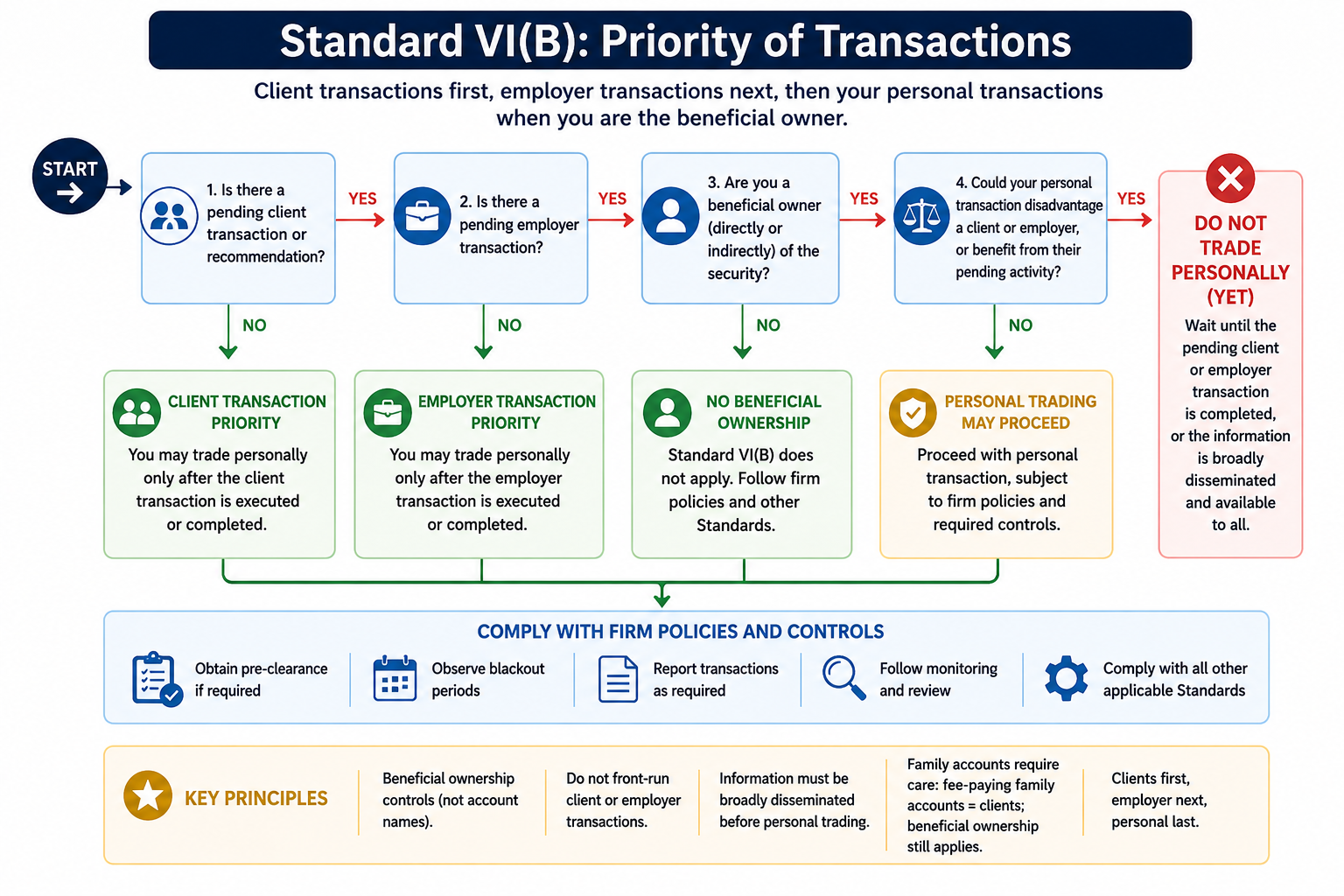
Standard VI(B): Priority of Transactions requires that transactions for clients and employers come before transactions in which you are a beneficial owner. The rule turns on beneficial ownership and on whether a client or employer is disadvantaged, not on whose name is on the account. Personal trading is not banned. It is restricted so it never exploits or undermines client or employer activity.
Quick Answer
Standard VI(B) gives client transactions priority over employer transactions, and both over transactions in which you are a beneficial owner. You can still invest personally, as long as clients and the employer are not disadvantaged, you do not benefit from their pending activity, and you follow firm controls. The test is beneficial ownership and disadvantage, not the label on the account.
Key Takeaways on Standard VI(B): Priority of Transactions
Client transactions come first, employer transactions next, and personal transactions last when you are the beneficial owner.
The rule works through beneficial ownership, a direct or indirect economic interest, not the name on the account.
Personal trading is permitted when clients and the employer are not disadvantaged and firm controls are met.
Front-running, trading ahead of a known client order to benefit from its expected impact, is a violation.
Pending client orders or recommendations may require waiting until the information is broadly disseminated and clients have had a fair chance to act.
A fee-paying family account treated as a client account generally gets the same treatment as comparable client accounts.
What You Need to Know
The shorthand "client, then employer, then employee" is useful but incomplete. The current rule rests on two ideas: whether you are a beneficial owner of the security, and whether a client or employer is disadvantaged. Beneficial ownership is a direct or indirect economic interest, so an account in a spouse's name or a joint account can still be yours for the purposes of this Standard.
The policy goals are straightforward. Clients and the employer should not be disadvantaged. You should not benefit personally from their transactions. And your personal trades should follow applicable firm policies. When those conditions hold, you are free to invest for your own account.
Whose Interest Comes First
Question | Direction |
|---|---|
Is a client or employer transaction pending? | If yes, it has priority. Do not trade personally first. |
Do you have beneficial ownership? | If yes, personal-trading controls apply even if the account is in another name. |
Could your personal trade disadvantage a client or employer, or benefit from their activity? | If yes, delay or do not place it. |
Has the recommendation or information been broadly disseminated, with a fair chance for clients to act? | Personal trading may proceed only after required waiting periods and controls are satisfied. |
Are firm policies followed? | Complete preclearance, reporting, blackout, and monitoring requirements. |
Avoid reducing this to a rigid universal hierarchy that ignores beneficial ownership and the circumstances of an account.
Personal Trading Is Not Prohibited
You may trade for your own account. The violation happens when personal activity disadvantages a client, benefits from pending client activity, uses knowledge of client orders, or receives better treatment than client accounts. Within those limits, personal investing is allowed.
Front-Running and Pending Transactions
Front-running is trading for personal benefit before a known client or employer transaction is executed or completed, to profit from the expected market impact. A pending client order or an undistributed recommendation can require you to wait. You hold off on a personal trade until the information is broadly available and clients have had a fair opportunity to act. Trading right after a recommendation is drafted, but before it is broadly disseminated, is a classic breach.
Family Accounts Need Care
Family accounts are where account labels mislead people. Two situations differ.
A fee-paying family account that is treated as a client should generally get the same treatment as other comparable client accounts. It is not automatically pushed behind every unrelated client just because the holder is a relative. Doing that can actually disadvantage a paying client.
An account in which you have beneficial ownership is different. Even if it sits in a relative's name, your economic interest in it means personal-trading controls can still apply. The question is always beneficial ownership and disadvantage, not the family label.
Preventing Violations
Firms use restricted lists and watch lists, blackout periods, preclearance of personal trades, duplicate trade confirmations, personal-trade reporting, and review of employee trading. Failing to report a personal transaction can itself be a violation, even when the underlying trade would otherwise have been allowed. The aim is not to turn the page into a compliance manual, but these controls are how the priority rule is enforced in practice.
Recommended Procedures for Compliance
Firms should define beneficial ownership clearly, require preclearance and reporting of personal trades, maintain restricted and watch lists, set blackout periods around recommendations and client orders, and review personal trading against client activity. You should preclear and report your trades, wait for broad dissemination before acting on a recommendation personally, and never let a personal position jump ahead of a client or employer transaction.
Scenarios
Violation: trading ahead of a client order
Situation. Sofia, a portfolio manager, decides to buy a thinly traded micro-cap for several client accounts. The orders will take time to fill because the stock is illiquid.
Conduct. Before the client orders are complete, she buys the same stock in an account she holds jointly with her spouse. Separately, she manages a fee-paying account for her parent under the same allocation policy she uses for other clients.
Analysis. The joint account is indirect beneficial ownership, and buying ahead of the pending client orders in an illiquid name is front-running, a violation of Standard VI(B). The parent's account, by contrast, is a fee-paying client account and is not automatically placed behind every other client. Treating it like other comparable client accounts is correct.
Takeaway. Look at beneficial ownership and disadvantage, not the account name. The spouse account triggers the rule. The fee-paying parent account does not become last simply because it is family.
Compliant: waiting until client orders clear
Situation. An analyst issues a "buy" recommendation that will go out to the firm's clients.
Conduct. He waits until the recommendation has been broadly disseminated and client orders have been completed, then preclears and places a trade in his own account.
Analysis. Client transactions received priority, the information was broadly disseminated before he acted, and he followed firm controls. His personal trade complies with Standard VI(B).
Takeaway. Personal trading is fine once clients have had their fair opportunity and the controls are satisfied.
Common Exam Traps
Treating every family account as a personal account that must always trade last.
Looking only at the account name instead of beneficial ownership.
Believing all personal investing is prohibited.
Focusing only on client transactions and forgetting employer transactions.
Assuming disclosure of the personal trade cures front-running.
Confusing fair allocation among clients under III(B) with priority over personal transactions under VI(B).
Trading right after a recommendation is drafted but before it is broadly disseminated.
Practice Question
A portfolio manager plans to buy an illiquid small-cap stock for client accounts and also wants to buy it in an account she holds jointly with her spouse. She separately manages a fee-paying account for her sibling under the same allocation policy as her other clients. Which action most likely complies with Standard VI(B)?
She buys the stock in the joint account first to establish a position before the client orders move the price.
She completes the client orders and satisfies firm controls before buying in the joint account, and she treats the sibling's fee-paying account like her other comparable client accounts.
She places the sibling's fee-paying account behind every unrelated client account because the holder is family.
Correct Answer: B
Client transactions take priority over the joint account, which is beneficial ownership, and the fee-paying family account is treated like other comparable client accounts rather than pushed to the back.
Option A. Buying in the joint account ahead of the pending client orders is front-running and exploits beneficial ownership.
Option C. A fee-paying family client account should not be automatically placed last. Doing so can disadvantage a paying client.
Continue Your CFA Level I Prep With KeyPoint
Use structured lessons, practice questions, mock exams, and progress tracking to focus on the time you have left
FAQs About Standard VI(B): Priority of Transactions
Is personal trading banned under Standard VI(B)?
No. You can trade for your own account. The Standard restricts personal trading only so it does not disadvantage clients, benefit from their pending activity, use knowledge of client orders, or receive better treatment than client accounts.
What is front-running?
Front-running is trading for personal benefit before a known client or employer order is executed, in order to profit from the order's expected market impact. It violates client priority, and disclosing the trade afterward does not cure it.
Does a family account always trade last?
No. A fee-paying family account treated as a client generally gets the same treatment as other comparable client accounts. The key question is beneficial ownership. If you have a beneficial interest in the account, personal-trading controls can apply, regardless of whose name is on it.
How is VI(B) different from fair dealing?
Standard VI(B) governs the priority of transactions when you have a personal interest. Standard III(B): Fair Dealing governs how you treat clients fairly relative to one another. A single scenario can raise both, but they answer different questions.