
Standard I(B): Independence and Objectivity protects your professional judgment from anything that could pull it off course. It asks you to use reasonable care to stay independent and objective, and to refuse benefits that could reasonably be expected to compromise your judgment or someone else's. CFA® Level I exam questions on objectivity and independence usually turn on who offered the benefit, why, and whether a safeguard like disclosure is enough or whether the benefit should be declined.
Quick Answer
Standard I(B) requires you to use reasonable care and judgment to keep your professional work independent and objective. You must not offer, solicit, or accept any gift, benefit, or compensation that could reasonably be expected to compromise your own or another person's judgment. Modest business entertainment can be acceptable. Client gifts call for employer disclosure, and third-party inducements demand stricter caution.
Key Takeaways About Objectivity and Independence
The test is whether a benefit could reasonably be expected to influence judgment, not whether bias is ever proven.
Source and purpose matter. The same item can be fine from one party and a problem from another.
Disclosure does not automatically cure an unacceptable inducement. Some benefits should be declined, not just disclosed.
Gifts from existing clients are treated differently from benefits offered by issuers, brokers, vendors, or anyone competing for your business.
Issuer-paid research can be acceptable when the analysis is independent, conflicts are disclosed, and pay is a flat fee that is not tied to the conclusion. A common trap is assuming disclosure makes everything acceptable.
What You Need to Know for CFA Level I
The standard looks at appearances, not just proven bias. If a benefit could reasonably be expected to compromise judgment, that is enough to raise a problem. Disclosure helps, but it does not turn an unacceptable inducement into an acceptable one.
Treat client gifts and third-party benefits differently. A reward from an existing client can be a form of extra compensation and must be disclosed to your employer. A benefit from an issuer, broker, vendor, or a party competing for business is offered to influence a decision and deserves far more caution. Issuer-paid research is not automatically off limits, as long as the work stays independent, conflicts are disclosed, and pay does not depend on the result. Pressure from an employer or a banking relationship never excuses biased research.
What Does Standard I(B) Require?
You must use reasonable care and judgment to achieve and maintain independence and objectivity, and you must not offer, solicit, or accept benefits that could reasonably be expected to compromise judgment. Independence means freedom from outside influence. Objectivity means unbiased judgment grounded in the analysis itself. The Standard covers both actual compromise and circumstances that could reasonably be expected to compromise judgment, which is why perception carries weight.
How Do You Assess a Threat to Objectivity and Independence?
Run the same four questions through every fact pattern, whether it involves a gift, a meal, a donation, a job referral, paid travel, or a compensation structure.
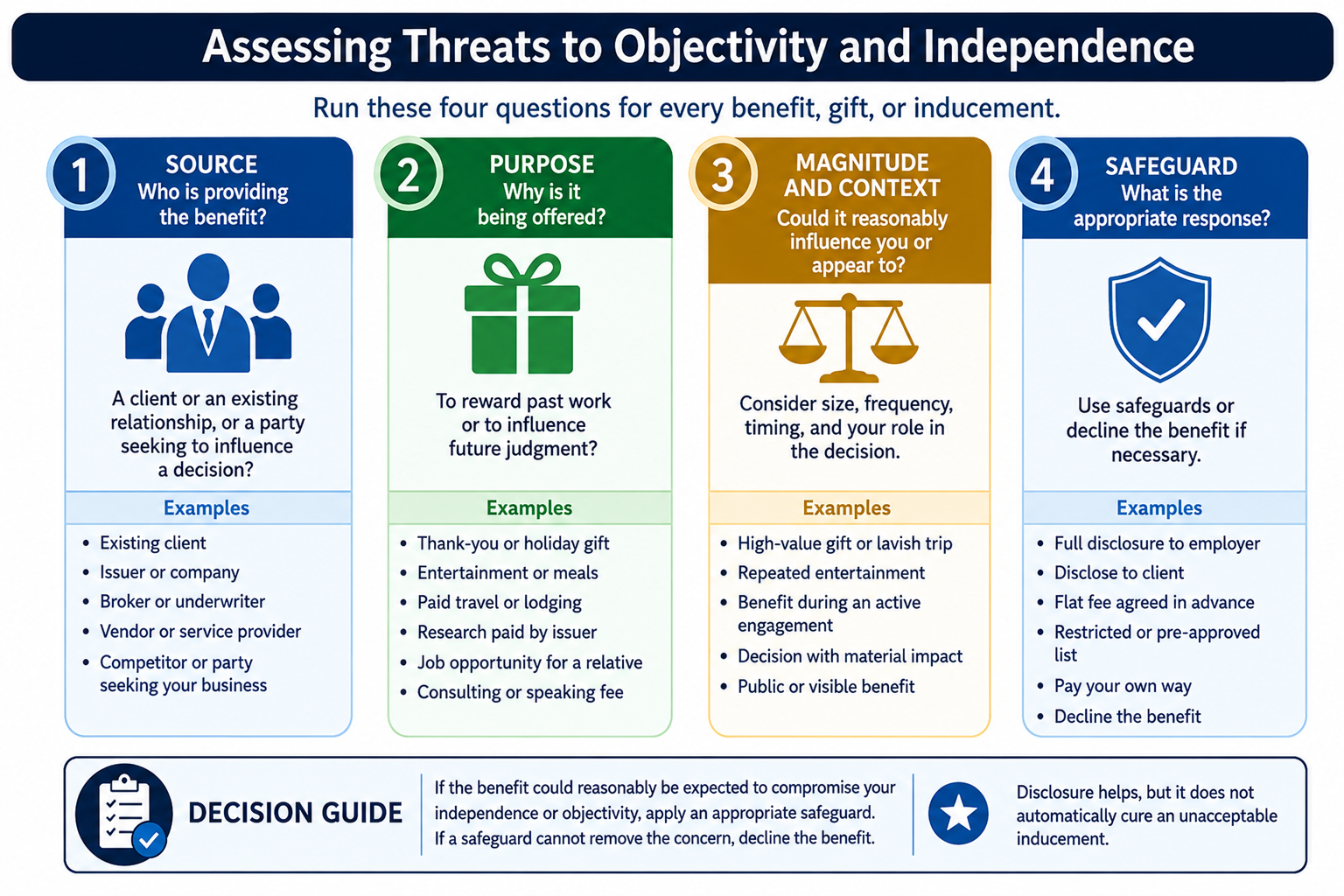
Source. Who is providing the benefit? A client, or a party seeking to influence a decision?
Purpose. Why is it being offered? To reward past work, or to shape future judgment?
Magnitude and context. How large is it, and could it reasonably be expected to sway you or appear to?
Safeguard. What response does the situation require? Disclosure, a flat fee, a restricted list, paying your own way, or declining outright.
Because source and purpose drive the answer, the same dinner or trip can be acceptable in one setting and a violation in another.
Gifts From Clients vs Benefits From Third Parties
A gift from an existing client is often a thank-you for results already delivered. It can still influence future work, so it functions as supplementary compensation and must be disclosed to your employer. A benefit from an issuer, broker, vendor, or a firm courting your business is different, because it is usually offered to shape a decision you have not made yet. Avoid inventing a fixed dollar threshold for what is acceptable. The analysis runs on context and reasonableness, not a single number.
Issuer-Paid Research and Compensation
Issuer-paid research can be done well. It requires thorough, unbiased analysis and full disclosure of the conflict. Agree a flat fee before the work begins, and keep that fee separate from the outcome. Compensation must not be tied to a favorable conclusion, to investor response, to the stock price, or to warrants or equity that rise with a positive view. Keep fact separate from opinion, and make sure every conclusion has a reasonable basis.
Employer Pressure, Manager Selection, and Travel
When an employer or a banking relationship pushes for a favorable view, the answer is to protect the research, not bend it. Firms can use a restricted list or withdraw coverage rather than publish a biased report. Watch manager-selection situations too, where gifts or political and charitable contributions are used to influence who wins an allocation. For travel, employer-paid or self-paid commercial arrangements are preferred, because they keep you free of obligation. A modest issuer-arranged trip may be acceptable only when no practical commercial alternative exists.
Recommended Procedures for Compliance
Follow research-independence policies and keep information barriers intact. Limit gifts to token items and ordinary business entertainment that is not meant to influence. Disclose client gifts and any relevant compensation arrangements. Use restricted lists, independent review, flat-fee issuer-paid research, and a documented travel policy so judgment calls do not fall on individuals alone.
Compliant Scenario
Situation: A mid-size issuer hires Daniel to write a research report on its upcoming debt offering. Before starting, Daniel agrees a fixed cash fee that is paid regardless of what he concludes, and he discloses the paid arrangement prominently in the report.
Issue: Issuer payment creates a conflict that could be expected to compromise objectivity if it is handled poorly.
Correct action: Daniel performs his own independent analysis, finds the issuer's high debt and refinancing risk concerning, and publishes a cautious conclusion that the evidence supports.
Why it complies: A flat fee set in advance, full disclosure of the conflict, and an evidence-based conclusion mean the payment did not drive the result. Being paid by the issuer is not, by itself, a violation.
Violation Scenario
Situation: An asset owner is choosing an external manager. One competing firm offers to fund a sizable donation to a charity that the selection officer personally chairs. The officer receives no money directly but accepts the arrangement and keeps the firm in the running.
Violation: The donation is a benefit offered to influence the selection. Even without a personal payment, it could reasonably be expected to compromise the officer's objectivity and the appearance of a fair process.
Required alternative: The officer should decline the arrangement, disclose the offer, and evaluate every competing firm on the merits alone.
Why the original action fails: An indirect benefit still creates a conflict. The test is reasonable expected influence and appearance, not whether cash changed hands personally.
Common Exam Traps
Assuming disclosure fixes everything. Some inducements must be declined. Disclosure does not make an unacceptable benefit acceptable.
Treating all client gifts as banned. Client gifts are generally allowed but must be disclosed to the employer. They are not the same as third-party inducements.
Looking only for proven bias. The question is whether compromise could reasonably be expected, not whether bias is demonstrated.
Dismissing indirect benefits. A charitable or political contribution can influence judgment even when no one is paid personally.
Going all-or-nothing on issuer-paid research. It is neither always banned nor always fine. The conditions decide.
Practice Question
Two analysts work at the same firm. Analyst 1 receives a watch from a long-standing client who is pleased with a multi-year track record, and Analyst 1 reports the gift to her employer. Analyst 2 is offered ongoing event tickets and a future referral by a broker who openly wants Analyst 2 to route more trading volume to the broker's desk. Under Standard I(B), which analyst most likely needs to decline the benefit rather than simply disclose it?
Analyst 1, because any gift from a client compromises independence.
Analyst 2, because the benefit comes from a party seeking to influence future decisions.
Neither, because disclosure resolves both situations.
Correct Answer: B
The broker's offer is a third-party inducement tied to future business. Because it could reasonably be expected to compromise objectivity, it should be declined, not just disclosed.
Why A is wrong: A client gift for past results is generally acceptable if disclosed to the employer. It does not automatically compromise independence.
Why C is wrong: Disclosure handles the client gift, but it does not cure an inducement designed to shape future decisions.
FAQs About Standard I(B): Independence and Objectivity
Can a CFA charterholder accept a gift from a client?
Usually yes, when it is a reasonable thank-you for past work, but you must disclose it to your employer because it can act as extra compensation. The caution rises sharply when the benefit comes from a party trying to influence a future decision.
Does disclosing a gift remove an independence and objectivity violation?
Not always. Disclosure is the right step for many client gifts, but it does not cure an inducement that could reasonably be expected to compromise judgment. Some benefits must be declined.
Is issuer-paid research allowed under Standard I(B)?
Yes, when it stays independent. Agree a flat fee before the work begins, keep that fee separate from the conclusion, disclose the arrangement, and base the report on your own analysis. It crosses into a violation when pay is tied to a favorable conclusion, investor response, the stock price, or equity that rises with a positive view.
Continue Your CFA Level I Prep With KeyPoint
Use structured lessons, practice questions, mock exams, and progress tracking to focus on the time you have left