
Standard III(D) covers how you communicate investment results. It asks for fair, accurate, and complete reporting, so clients and prospective clients can judge a record on the full picture rather than a flattering slice of it. Most CFA® Level I exam questions test whether a presentation misleads through selection, omission, or unclear labeling, even when the numbers are correct. Good past performance disclosure is about honest context, not only honest math.
Quick Answer
Standard III(D) requires you to make reasonable efforts to keep any communication about investment performance fair, accurate, and complete. It covers past and expected results, whether the communication concerns single accounts, composites, pooled funds, recommendations, or a claimed personal track record. A short summary is acceptable only when its limits are clear and detailed supporting information is available on request.
Key Takeaways
The rule asks for fair, accurate, and complete performance across every communication, not just the figures a firm likes best.
The decision framework tests three things together: the scope of what is shown, the accuracy of the calculation, and the completeness of the surrounding context.
A single strong account is not a substitute for an appropriate composite, and terminated accounts cannot be dropped because they performed poorly.
Returns must be labeled clearly as gross or net of fees, before or after tax, actual or simulated, and current-firm or prior-firm.
A correct number can still mislead. Cherry-picked periods or accounts are the most common exam trap.
GIPS compliance is encouraged but not required. A false or incomplete GIPS claim is itself a violation.
What You Need to Know for CFA Level I
A performance claim must not imply that one strong account, strategy, or year represents the whole firm or a result clients should expect to repeat.
Composite presentations should include the relevant similar portfolios and should not omit terminated accounts simply because the results were weak.
Every return needs a clear label: gross or net of fees, before or after tax, actual or simulated, current-firm or prior-firm.
Past results may be shown only with enough context that no reader treats them as a guaranteed or expected future return.
GIPS compliance is recommended, not mandatory under this Standard, and a false GIPS claim is misleading on its own.
Records that support each published result must be kept and made available where required.
What Does Standard III(D) Require?
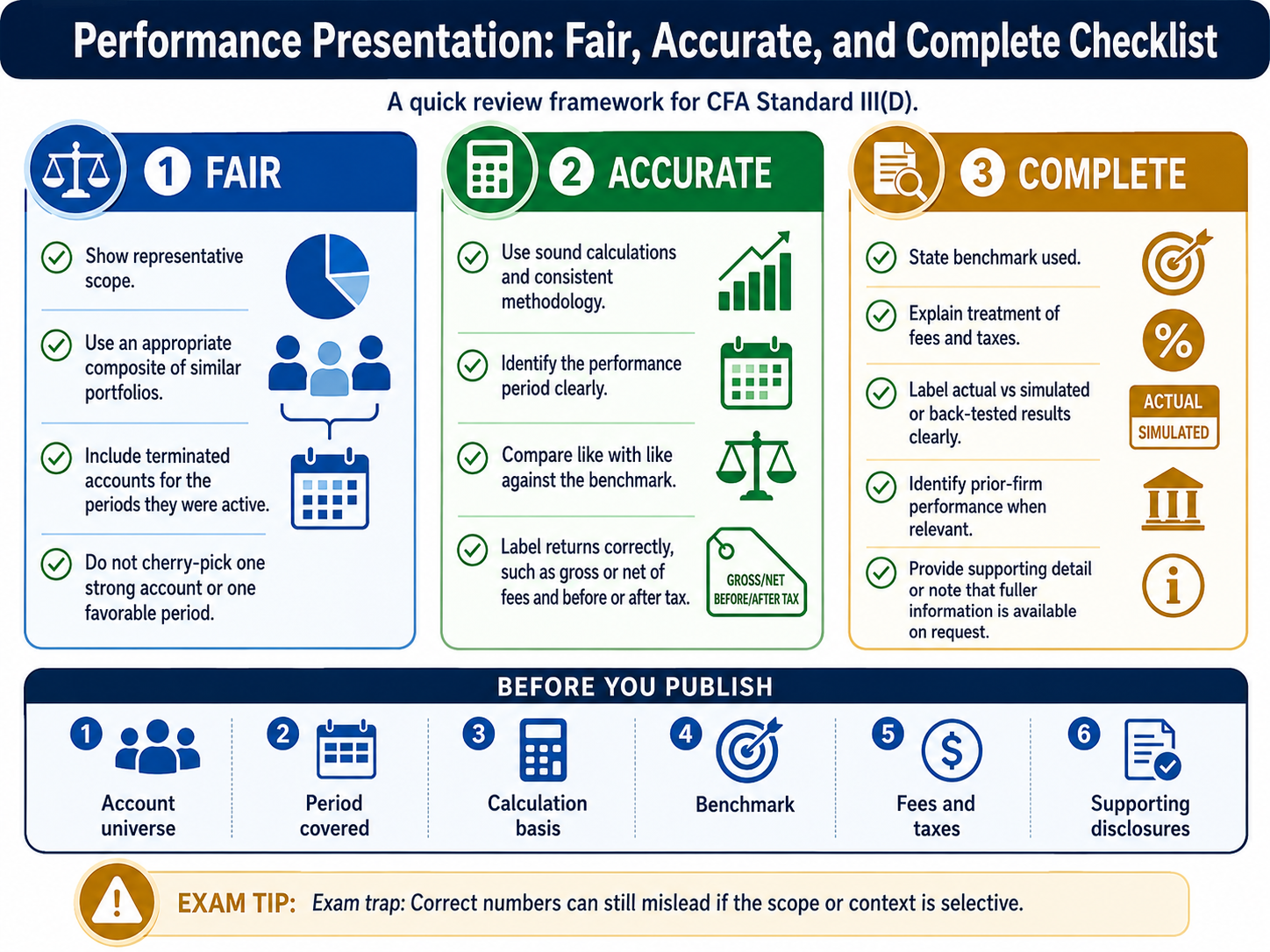
The Standard asks for reasonable efforts to make any performance you or your firm communicate fair, accurate, and complete. Treat those three words as one test. Fair means the scope is representative, accurate means the math and methodology are sound, and complete means the context a reader needs is present. It applies whenever you or your firm communicate performance you claim responsibility for, from a one-page ad to a full pitch book.
What Makes a Performance Presentation Fair, Accurate, and Complete?
Run a short evidence checklist before any number goes out: account universe, period covered, calculation basis, benchmark, treatment of fees and taxes, material changes, and supporting disclosures. Accuracy alone does not clear the Standard, because a perfectly calculated figure can still mislead when the accounts or periods around it tell a slanted story. You can tailor the depth of detail to the audience, but not drop information a reader needs to judge the result.
How Should Accounts and Composites Be Presented?
Prefer an appropriate composite of similar portfolios over a single account chosen because it looks good. A composite shows what the strategy delivered across clients, not what one lucky portfolio managed in one window. Terminated accounts belong in the historical composite for the periods they were active, since removing them rewrites history in the firm's favor. If the firm claims to follow a particular method, its weighting and calculation choices have to match that method, not whichever approach flatters the result.
What Past Performance Disclosures Are Required?
Identify the performance period and resist showing only a favorable year or market phase. State whether results are gross or net of fees and before or after taxes, since the same portfolio can look very different under each. Name the benchmark and explain any material gap between the portfolio and that benchmark. Label model, back-tested, hypothetical, or simulated results plainly. When a record was built at a prior firm, say so and describe the individual's role in producing it.
Can Past Results Be Used to Describe Expected Performance?
Historical results can give useful context, but they cannot be presented as a promised or steady future return. There is a real difference between a reasonable forecast that states its assumptions and an unsupported leap from one strong period to a number clients should "expect." Where the communication also carries a broader false impression, the conduct can reach Standard I(C): Misrepresentation as well.
Does Standard III(D) Require GIPS Compliance?
No. Compliance with the Global Investment Performance Standards (GIPS) is encouraged and is the preferred method for presenting managed-asset performance, but a firm can satisfy Standard III(D) without a GIPS claim as long as the presentation is fair, accurate, and complete. The catch runs the other way: a firm that does claim GIPS compliance must meet all applicable GIPS requirements and disclosures, so a partial process or an overstated claim is itself misleading. The KeyPoint Learning GIPS guide covers the detailed requirements.
Recommended Procedures for Compliance
These are recommended practices, not extra rules of the Standard.
Keep documented calculation and presentation policies so results are produced the same way each time.
Maintain the source data and records behind every published result.
Have someone independent review advertisements, pitch books, websites, and attribution before release.
Use standard disclosures for fees, taxes, benchmarks, simulated results, prior-firm records, and composite definitions.
Correct identified errors promptly and tell affected recipients when a correction is material.
Compliant Scenario
Situation. Northrange Capital runs a one-page advertisement for its dividend-equity strategy. It shows the five-year return of the full strategy composite, including two accounts that were closed during the period.
Relevant issue. The firm has to decide how much to show on a single page without leaving out information that changes how a reader reads the number.
Correct action. The ad reports the composite return net of fees, names the period and the benchmark, notes that closed accounts are included for the time they were active, and states that detailed supporting information is available on request.
Why it complies. The summary is short but fair and accurate, and nothing material is hidden. The "available on request" line gives readers the path to full detail, which is what the Standard expects of a brief presentation.
Violation Scenario
Situation. Vetra Advisors prepares a pitch book for new prospects. It features the single best-performing account from one unusually strong year, leaves out a terminated account that lost money, and shows the account's gross return next to a net-of-fees benchmark. The cover line calls the figure "the return new clients can expect."
Violation. The selection is unfair (one account, one year), the comparison is inaccurate (gross portfolio against net benchmark), the record is incomplete (terminated account dropped), and the expectation claim implies a result the firm cannot promise.
Required alternative. Show the relevant composite across a full multi-year period, include the terminated account for the time it was active, compare like with like on fees, and present the history as context rather than a forecast.
Why the original action fails. Each number may be arithmetically correct, yet the presentation as a whole is built to mislead. Standard III(D) judges the full picture, not isolated figures.
Common Exam Traps
Treating correct math as automatic compliance. A return can be accurate and still violate the Standard if the chosen accounts or periods slant the story.
Passing off one account as the whole strategy. A single portfolio is not a substitute for an appropriate composite of similar accounts.
Dropping terminated accounts. Removing closed accounts from history flatters the record and breaks the completeness test.
Vague labeling of results. Model, back-tested, simulated, or prior-firm performance has to be identified clearly, or the reader is misled about what they are seeing.
Assuming GIPS is required, or that a partial process supports the claim. The Standard does not mandate GIPS, and a half-finished GIPS process cannot back a GIPS-compliant claim.
Using past results as an implied guarantee. History is context. Presenting it as an expected return crosses into a promise the Standard forbids.
Practice Question
A prospective client receives three advertisements for the same equity strategy.
Advertisement 1 shows a five-year composite return, net of fees, with the benchmark and period named and a note that supporting detail is available on request.
Advertisement 2 shows only the firm's single best-performing account for its strongest 12-month period.
Advertisement 3 shows clearly labeled simulated results but states that the figures are "GIPS-compliant," even though the firm has not met the applicable GIPS requirements.
Which advertisement most likely complies with Standard III(D)?
Advertisement 1
Advertisement 2
Advertisement 3
Correct Answer: A
Advertisement 1 is fair, accurate, and complete. It uses a composite rather than a single account, names the period and benchmark, labels the fee basis, and points readers to fuller detail, which is exactly what a brief presentation should do.
Option B. Advertisement 2 is wrong because selecting one account over its best single year is a classic unfair, incomplete presentation, even if the number itself is real.
Option C. Advertisement 3 is wrong because a GIPS-compliance claim is misleading unless the firm actually meets all applicable GIPS requirements, so labeling the simulation as GIPS-compliant is a violation regardless of how clearly the simulation is marked.
Continue Your CFA Level I Prep With KeyPoint
Use structured lessons, practice questions, mock exams, and progress tracking to focus on the time you have left
FAQs About Standard III(D): Performance Presentation
Does CFA Standard III(D) require GIPS compliance?
No. GIPS compliance is encouraged and is the preferred method for presenting managed-asset performance, but a fair, accurate, and complete presentation can satisfy the Standard without it. A firm that claims GIPS compliance must meet all applicable GIPS requirements.
Can a firm show only its best-performing account?
Not as a stand-in for the strategy. Featuring one account chosen because it looks good is an unfair and incomplete presentation. An appropriate composite of similar portfolios is the fair way to show what a strategy delivered.