
Standard III(C) requires that a recommendation or investment action fit the client it is meant for. Investment suitability connects what you know about the client to what you do with their money, and it protects clients from advice that ignores their real situation. In a scenario question, you usually decide whether an advisory relationship exists, then whether the investment fits the client's profile and total portfolio. Suitability is judged in context, not by whether the investment is risky or attractive on its own.
Quick Answer
Investment suitability means deciding whether a recommendation or action fits the client's experience, objectives, financial situation, constraints, and total portfolio. In an advisory relationship, you must make a reasonable inquiry into the client's circumstances, keep that information current, and act in line with the written objectives and mandate. Suitability does not guarantee a profit, and a loss does not prove the original recommendation was unsuitable.
Key Takeaways About Investment Suitability
The full suitability duty applies when you have an advisory relationship with the client.
Suitability is based on the client's experience, objectives, financial circumstances, and constraints.
Judge an investment in total-portfolio context, not by its standalone risk or return.
Keep client information current and review the investment policy statement regularly.
An unsolicited unsuitable request still needs discussion and documentation, not automatic execution.
What You Need to Know for CFA Level I
The full suitability duty applies when the member or candidate has an advisory relationship with the client. Gather the client's investment experience, risk tolerance, return objectives, financial circumstances, time horizon, liquidity needs, tax situation, legal constraints, and any unique preferences. Assess both the individual investment and its effect on the total portfolio. Review the investment policy statement regularly, at least annually as a recommended practice, and whenever material circumstances or recommendations change. A portfolio manager following a mandate has to stay within its objectives and constraints. An unsolicited request that does not suit the client needs discussion, education, acknowledgment, documentation, and possibly an update to the policy statement.
What Is Investment Suitability?
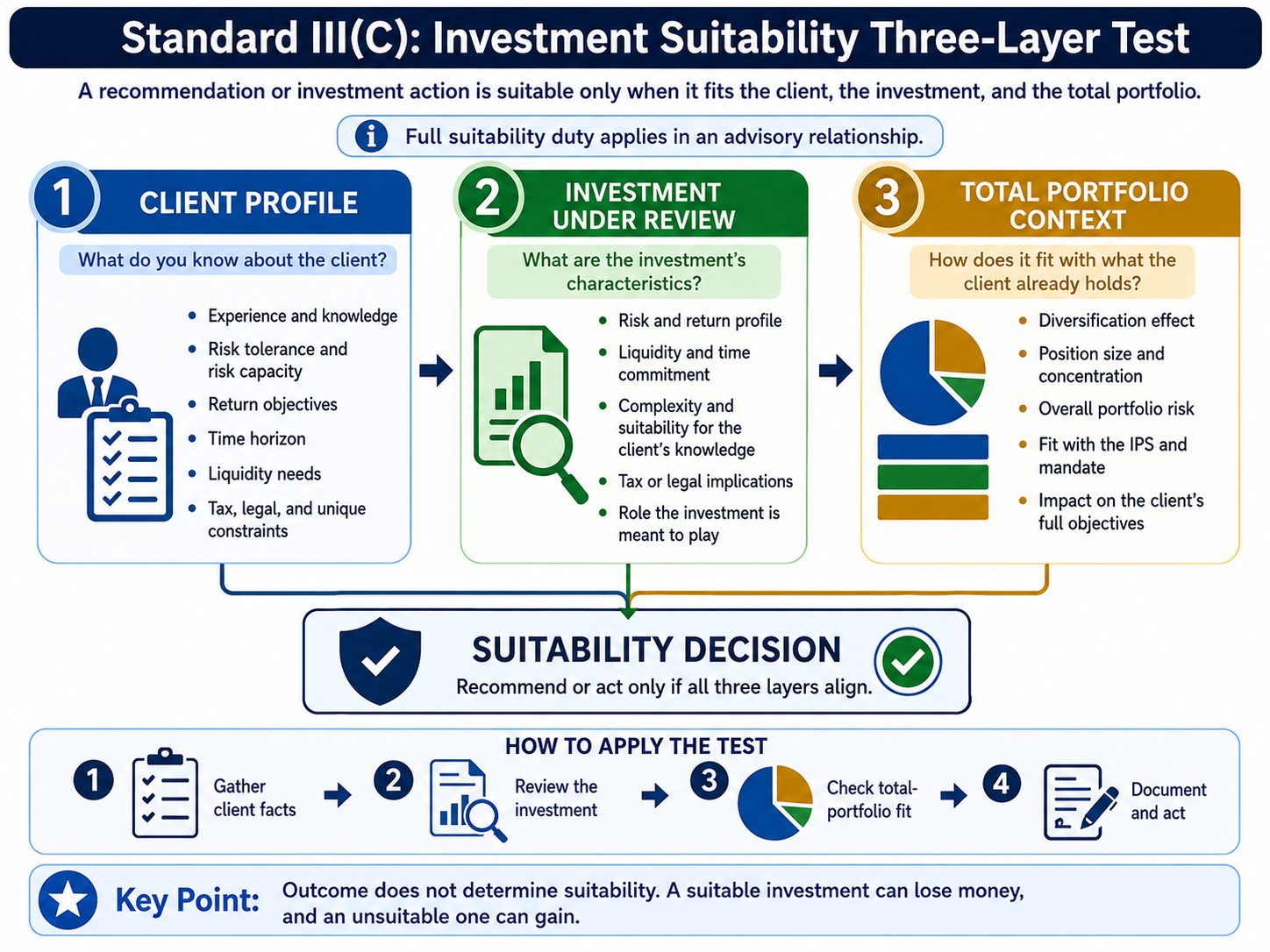
Standard III(C) requires that recommendations and investment actions suit the client. Investment suitability links three things: the facts about the client, the characteristics of the investment, and the context of the client's existing portfolio. You cannot judge suitability from the investment alone.
One point matters for the exam more than any other here. A suitable recommendation can still lose money, and an unsuitable one can happen to make money. Outcome does not equal suitability. A loss does not prove the recommendation was wrong when it was made, and a gain does not excuse a recommendation that never fit the client.
When Does the Suitability Rule Apply?
The full duty applies in an advisory relationship, where you are advising the client on what to do. It works differently for execution-only service, where you carry out a client's specific instruction without advising, and for general sell-side research aimed at a broad audience rather than a particular client.
A professional who only executes a client's instruction may not have the same opportunity or duty to evaluate suitability for that client. The caution is that this distinction cannot be used as a loophole. If you are really advising the client, you cannot relabel it as execution to dodge the suitability duty.
What Must Suitability Be Based On?
Suitability has to be based on a real inquiry into the client's situation. That means the client's investment experience, risk and return objectives, financial resources, time horizon, liquidity needs, tax concerns, legal factors, and any unique constraints, plus age and occupation where they are relevant.
Client information | Why it matters |
|---|---|
Investment experience and knowledge | Shapes which products are appropriate |
Risk tolerance and risk capacity | Willingness and ability to bear loss |
Return objectives | What the portfolio needs to achieve |
Time horizon | How long the money can stay invested |
Liquidity needs | When cash will be required |
Tax and legal constraints | Limits on what can be held or done |
Unique circumstances | Preferences, restrictions, or special needs |
Risk has two sides that are easy to blur. Willingness to take risk is about attitude; ability to take risk is about financial capacity. A single questionnaire score does not capture both, so weigh them together rather than collapsing them into one number.
How Does an Investment Policy Statement Support Suitability?
The investment policy statement is the written bridge between the client's facts and the actions you are allowed to take. It records objectives, constraints, the direction for asset allocation, the responsibilities of each party, and the schedule for review.
Treating the policy statement as a one-time document is a mistake. Client information should be reassessed regularly, and the policy statement should be reviewed at least annually as recommended guidance, plus whenever a material change occurs in the client's life or in the recommendation. The point is to keep the written record in step with the client's actual situation, so that suitability decisions rest on current facts.
Why Must Suitability Be Judged in Total-Portfolio Context?
An investment's suitability depends on how it interacts with everything else the client holds. Diversification means a position that looks aggressive in isolation can be appropriate as a small part of a balanced portfolio.
A high-risk security can be suitable as a small diversifying position and unsuitable as a concentrated holding, for the same client, at the same time. The difference is size and context, not the security itself. One limit is worth naming. You can base the analysis only on the information the client actually gives you. Encourage clients to disclose outside assets, but you are not expected to account for holdings you were never told about.
What Does Suitability Mean for a Fund Mandate?
When you manage to a stated mandate, suitability means staying consistent with that mandate, its strategy, its style, and its constraints. The fund manager follows the mandate rather than judging whether the fund suits every individual end investor.
For example, an income fund that quietly shifts a large share of assets into speculative growth names has broken its mandate, even if those names might be attractive on their own. The end investor chose the fund for income. Deciding whether the fund as a whole suits a particular investor is a separate question, handled at the point of advice rather than inside the fund.
What Should You Do With an Unsolicited Trade Request?
An unsolicited trade is one the client initiates, rather than something you recommended. When the request fits the client, you carry it out normally. The hard case is an unsolicited request that conflicts with the client's policy statement.
Do not simply execute a known unsuitable request. First, discuss how it conflicts with the policy statement and educate the client on the issue. Document the conversation and obtain the client's acknowledgment that the trade goes against your advice. If the request would materially affect the portfolio, consider whether the policy statement should be updated to reflect the client's changed wishes. And if a client repeatedly insists on actions that conflict with the agreed policy, reassess whether the advisory relationship can continue on that basis.
Recommended Procedures for Compliance
Use standardized processes for gathering client information and reviewing suitability, keep written policy statements with clear triggers for review, and run pre-trade checks against the client's portfolio and mandate. Document the information the client provided, any disclosures the client declined to make, and the details of unsolicited requests, including warnings given and acknowledgments received.
Where firm policy requires it, escalate unusual or conflicting instructions. The aim is a record showing that each recommendation rested on current client facts and that conflicts were addressed rather than waved through.
Compliant Scenario
Situation. Aisha Rahman advises a financially secure client with a long time horizon, high capacity for risk, and a well-diversified portfolio. She recommends a small allocation to a volatile frontier-markets fund. On its own, the fund is high risk.
Relevant issue. The investment is risky in isolation. The question is whether that standalone risk makes it unsuitable.
Correct action. She sizes the position small, confirms it fits the client's objectives and capacity, and adds it as a diversifying piece of the broader portfolio.
Why it complies. Suitability is judged in total-portfolio context. A volatile asset can be suitable as a small diversifier for a client who can bear the risk, even though it would be unsuitable as a large concentrated holding.
Violation Scenario
Situation. A conservative client with a low-risk policy statement asks Niklas Berg to move most of the portfolio into a leveraged product. Niklas executes the request immediately, without discussing how it conflicts with the policy statement and without documenting the request or any warning.
Violation. Niklas executed a known unsuitable request that materially changed the portfolio's risk, skipping the required discussion, documentation, and reassessment.
Required alternative. He should have explained the conflict with the policy statement, documented the conversation and the client's acknowledgment, and considered updating the policy statement before treating the request as ordinary execution.
Why the original action fails. Client initiation does not erase a known suitability conflict. A request that materially affects the portfolio still requires discussion and documentation, not silent execution.
Common Exam Traps
Judging suitability from return or standalone risk. Suitability depends on the client and the total portfolio, not on whether the investment looks attractive or risky by itself.
Assuming every order-taker has a suitability duty. The full duty attaches to an advisory relationship. Execution-only service may not carry the same obligation, though advice cannot be relabeled as execution to avoid it.
Treating the policy statement as permanent. It needs regular review, at least annually as recommended practice, and whenever material circumstances change.
Reading outcome as suitability. A losing investment is not automatically unsuitable, and a profitable one is not automatically suitable. Judge the decision at the time it was made.
Executing an unsolicited request automatically. A client-initiated trade that conflicts with the policy statement still needs discussion and documentation first.
Confusing fund holdings with fund suitability. A fund manager follows the mandate. Whether the fund suits a particular end investor is a separate decision made at the point of advice.
Practice Question
An adviser manages a portfolio for a client whose investment policy statement is conservative, with a low risk tolerance and limited capacity for loss. The client calls and asks, on their own initiative, to place a large leveraged position that would materially raise the portfolio's overall risk. The adviser confirms the request is genuinely the client's idea.
Under Standard III(C), the adviser's best next action is to:
execute the trade promptly, because the client initiated it and it is therefore an unsolicited request.
refuse the trade outright, because it conflicts with the client's investment policy statement.
discuss the conflict with the policy statement, document the conversation and the client's acknowledgment, and consider whether the policy statement should be updated.
Correct Answer: C
The request is unsolicited, but it materially conflicts with the conservative policy statement. The adviser must address that conflict before acting. That means explaining the issue, educating the client, documenting the client's acknowledgment that the trade goes against advice, and considering whether the policy statement should be updated to reflect a real change in the client's wishes.
Option A. A is wrong because client initiation does not remove the duty to address a known suitability conflict for a trade this significant.
Option B. B is wrong because the adviser is not required to refuse outright. The duty is to discuss, document, and reassess, which may include updating the policy statement, rather than to veto the client's instruction.
Continue Your CFA Level I Prep With KeyPoint
Use structured lessons, practice questions, mock exams, and progress tracking to focus on the time you have left
FAQs About Standard III(C): Suitability
What must investment suitability be based on?
Suitability is based on a reasonable inquiry into the client's situation: investment experience, risk tolerance and capacity, return objectives, time horizon, liquidity needs, tax and legal constraints, and any unique circumstances. The investment is then assessed against the client's total portfolio.
How often should an investment policy statement be updated?
The policy statement should be reviewed at least annually as a recommended practice, and whenever a material change happens in the client's circumstances or in the recommendation. It is not a one-time document.
What does unsolicited trade mean?
An unsolicited trade is one the client initiates, rather than one the professional recommended. When such a request conflicts with the client's policy statement, the professional should discuss the conflict, document it, and obtain the client's acknowledgment before acting.
Can a suitable investment still lose money?
Yes. Suitability is judged at the time of the recommendation, based on how the investment fits the client and the total portfolio. A suitable investment can lose money, and a loss alone does not prove the recommendation was unsuitable.