
A bond's holding period return is the return you earn over the time you actually hold the bond, which is not always its full life. Duration tells you how sensitive that bond's value is to a change in interest rates. Investment horizon matters because a rate change creates two opposing risks at once: price risk and reinvestment risk. For CFA Level I, the goal is to know which of those risks matters more when your horizon is shorter than, equal to, or longer than the bond's Macaulay duration.
Quick Answer
Bond holding period return is the return earned over the time an investor actually holds the bond. The key idea for CFA Level I is that duration links holding period return with investment horizon. When the horizon is close to the bond's Macaulay duration, price risk and reinvestment risk tend to offset each other. When the horizon is shorter or longer, one of those risks usually dominates.
Key Takeaways: Bond Holding Period Return, Duration, and Investment Horizon
Holding period return measures return over the investor's actual holding period, not the bond's maturity.
That return comes from coupon income, reinvestment income, and the price change over the period.
Price risk and reinvestment risk move in opposite directions when yields change.
Macaulay duration is the approximate horizon where price risk and reinvestment risk offset.
If the horizon is shorter than Macaulay duration, price risk usually dominates.
If the horizon is longer than Macaulay duration, reinvestment risk usually matters more.
What You Need to Know for CFA Level I
You should be able to read holding period return as a realized return over a chosen horizon, not as a fixed number set at purchase. Rising yields hurt bond prices but improve the rate you earn on reinvested coupons. Falling yields help bond prices but lower that reinvestment rate. The connective concept is Macaulay duration, which acts as the approximate point where those two effects cancel out. From there, you compare the horizon with duration to decide which risk leads. One habit to avoid is treating yield to maturity as the return you will realize, because that only holds when a specific set of assumptions is met.
What Is Bond Holding Period Return?
Holding period return is the total return an investor earns over the period the bond is actually held. That period can end at maturity, but it often ends earlier when the investor sells.
Three things drive it: the coupons received during the period, the income earned by reinvesting those coupons, and the price change or sale value at the end. Divide the total gain by the initial price and you have the realized return for that horizon.
This is why holding period return can differ from yield to maturity. Yields can move after purchase, coupons may be reinvested at rates higher or lower than expected, and the investor may sell before maturity. At CFA Level I, many questions test this idea through interpretation rather than a long calculation, so the concept matters more than the arithmetic.
How Investment Horizon Affects Bond Return
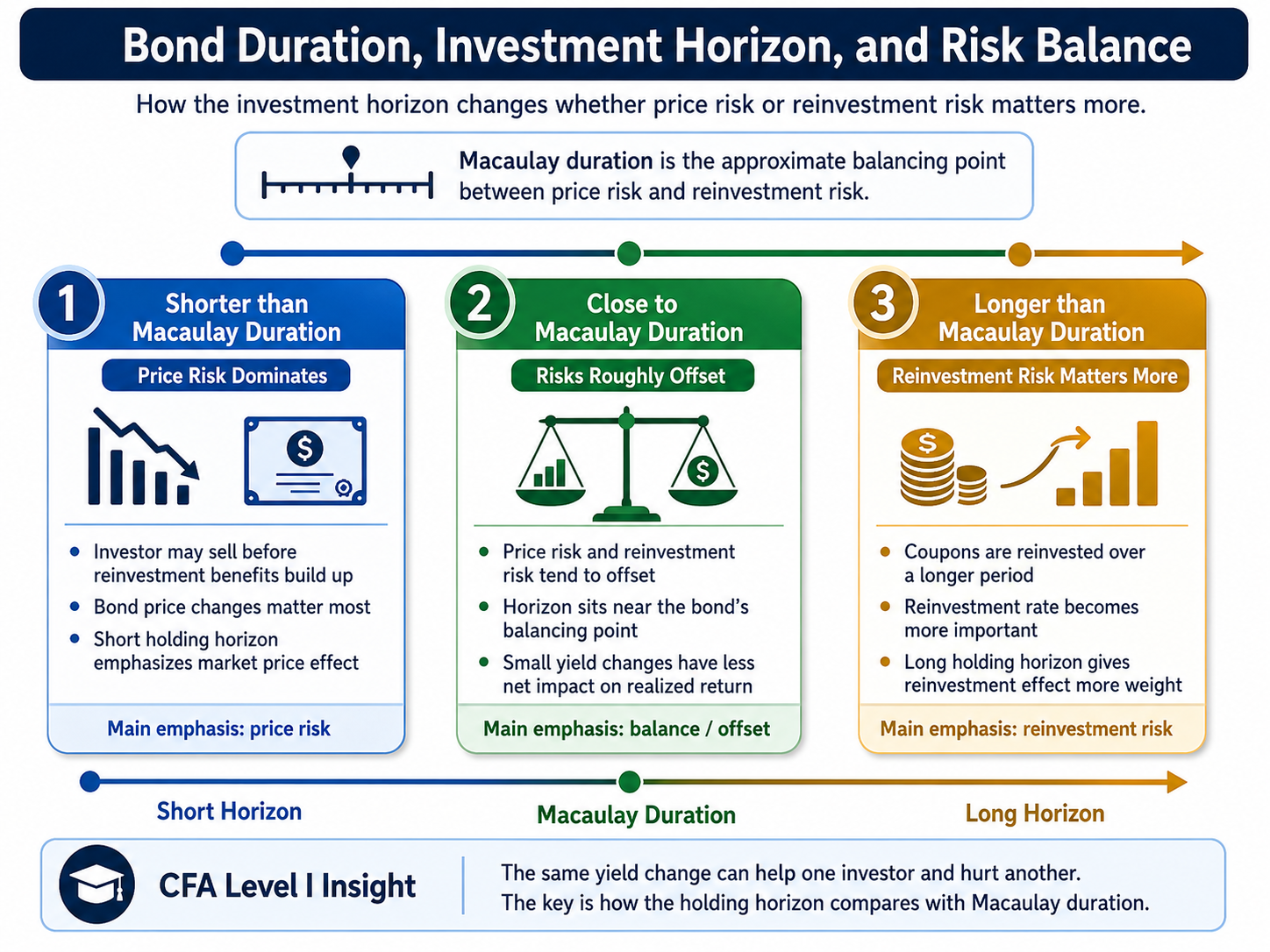
Your investment horizon is the length of time you plan to hold the bond, and it changes which risk you feel most. A short horizon leaves you exposed mainly to market price changes, because you may have to sell before reinvested coupons have had time to add up. A longer horizon gives reinvestment income more time to matter, so the rate you earn on coupons becomes more important than a single price move.
The useful insight is that the same rate change can help one investor and hurt another, depending only on how long each one plans to hold.
Investment Horizon | Main Risk Emphasis | Why It Matters |
|---|---|---|
Shorter than Macaulay duration | Price risk tends to dominate | The investor may sell before reinvestment benefits can offset a price change. |
Close to Macaulay duration | Price and reinvestment risk tend to offset | The horizon sits near the bond's duration balancing point. |
Longer than Macaulay duration | Reinvestment risk becomes more important | Coupon reinvestment rates affect the investor over a longer period. |
Duration, Price Risk, and Reinvestment Risk
Price risk is the risk that a bond's price moves when yields move. Reinvestment risk is the risk that coupons have to be reinvested at a rate different from the one expected at purchase. These two risks pull in opposite directions, and that is the heart of this topic.
When yields rise, the bond's price falls, which is the price effect. At the same time, future coupons can be reinvested at higher rates, which is a positive reinvestment effect. When yields fall, the reverse happens: the price rises, but coupons earn less when reinvested. Duration helps you weigh which effect carries more weight over your horizon.
Yield Change | Price Effect | Reinvestment Effect | Candidate Interpretation |
|---|---|---|---|
Yields rise | Bond price falls | Coupons reinvest at higher rates | Worse for near-term price, better for future reinvestment |
Yields fall | Bond price rises | Coupons reinvest at lower rates | Better for near-term price, worse for future reinvestment |
Relationship Between Macaulay Duration and Investment Horizon
Macaulay duration is often described as the weighted average time to receive a bond's cash flows. In the context of return, it also marks the approximate horizon where price risk and reinvestment risk roughly cancel out.
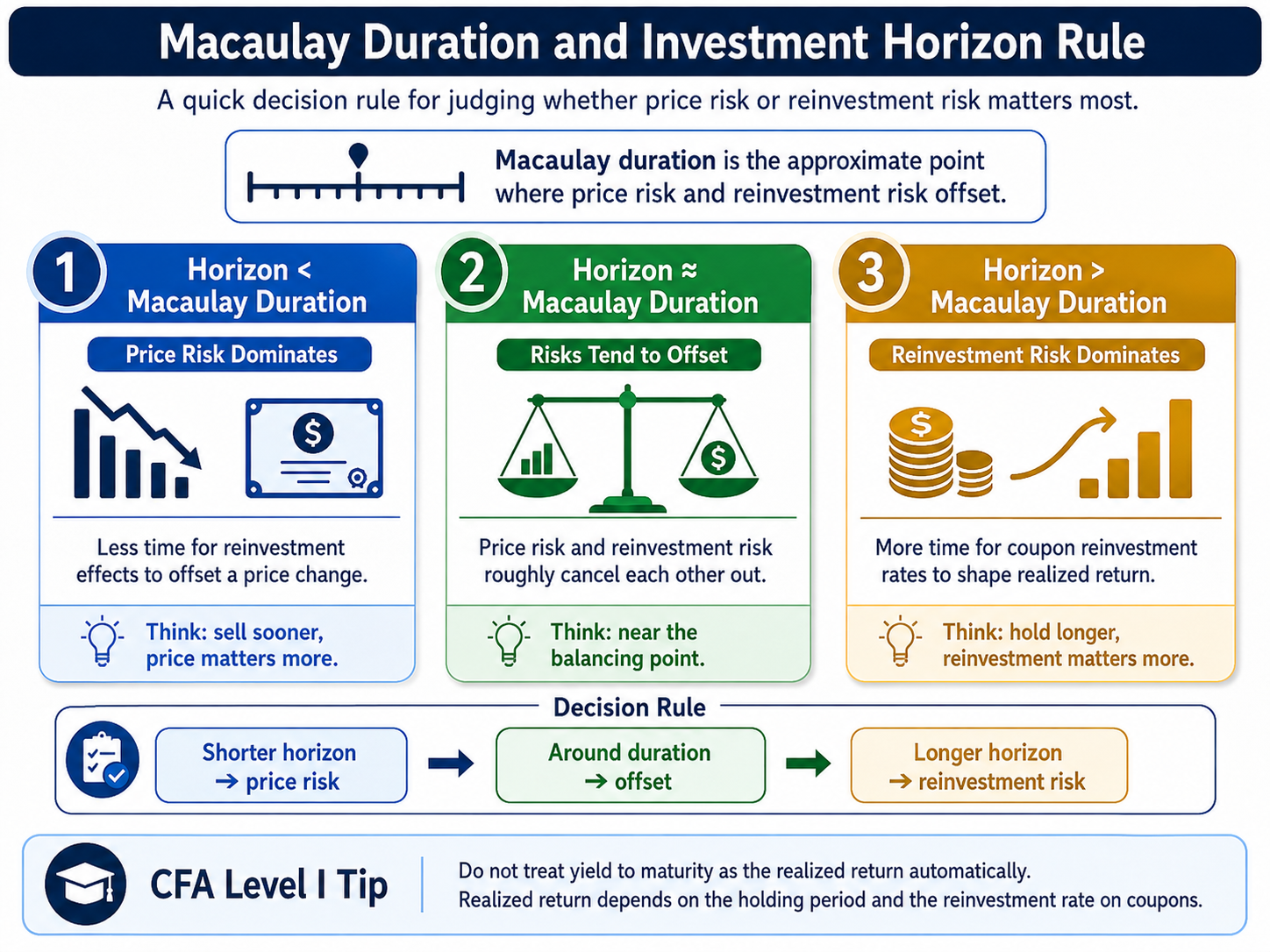
That gives you a clean decision rule. If your horizon is shorter than Macaulay duration, the price effect leads, because there is less time for higher or lower reinvestment to make up the difference. If your horizon is longer than Macaulay duration, reinvestment becomes the bigger factor. If your horizon is about equal to Macaulay duration, the two effects offset, and you are closer to being protected from small yield changes.
Compare investment horizon with Macaulay duration:
Horizon < Macaulay duration: price risk dominates.
Horizon ≈ Macaulay duration: price risk and reinvestment risk offset.
Horizon > Macaulay duration: reinvestment risk dominates.
Worked Example
A bond has a Macaulay duration of 5 years. Three investors hold the same bond but plan different horizons. Yields move shortly after purchase. Which risk matters most for each one?
Investor A plans to hold for 2 years.
Investor B plans to hold for 5 years.
Investor C plans to hold for 8 years.
Apply the rule by comparing each horizon with the 5-year duration:
Investor A: the horizon is shorter than duration, so price risk is more important. There is little time for reinvestment to offset a price change before the sale.
Investor B: the horizon is close to duration, so price risk and reinvestment risk tend to offset. Investor B sits near the balancing point.
Investor C: the horizon is longer than duration, so reinvestment risk becomes the larger concern. Coupon reinvestment rates work on the return for a longer stretch.
Common Exam Traps
Treating holding period return and yield to maturity as the same number.
Forgetting that holding period return depends on the actual horizon, not the bond's maturity.
Remembering duration only as price sensitivity and missing its role in the horizon relationship.
Assuming rising yields are always bad for every investor, even though reinvestment income can improve over a long horizon.
Reversing the rule. A short horizon usually means price risk leads, and a long horizon usually means reinvestment risk leads.
Practice Question
An investor buys a bond with a Macaulay duration of 6 years and plans to hold it for 3 years. If market yields change shortly after purchase, which risk is most likely to dominate the investor's realized return over the planned horizon?
Price risk
Reinvestment risk
Price risk and reinvestment risk offset and neither dominates
Correct Answer: A
The 3-year horizon is shorter than the bond's 6-year Macaulay duration, so price risk is most likely to dominate. The investor may sell before reinvestment effects have time to offset a price change.
Option B is wrong because reinvestment risk leads when the horizon is longer than duration.
Option C is wrong because the two risks offset when the horizon sits close to Macaulay duration, which is not the case here.
Continue Your CFA Level I Prep With KeyPoint
Use structured lessons, practice questions, mock exams, and progress tracking to focus on the time you have left
FAQs About Bond Holding Period Return, Duration, and Investment Horizon
What is bond holding period return in CFA Level I?
It is the return earned over the period an investor actually holds a bond. It reflects coupon income, income from reinvesting those coupons, and the price change or sale value at the end of the period.
What happens if the investment horizon is shorter than duration?
Price risk usually dominates. The investor may sell before reinvestment effects have time to offset a price change, so a yield move shows up mainly through the bond's price.
What happens if the investment horizon is longer than duration?
Reinvestment risk usually matters more. The coupon reinvestment rate affects the return over a longer period, so the rate earned on reinvested coupons carries more weight than a single price move.
What is the difference between price risk and reinvestment risk?
Price risk is the risk that a bond's price changes when yields change. Reinvestment risk is the risk that coupons are reinvested at a different rate than expected. They move in opposite directions when yields shift.