
This hub organizes the full CFA® Level I Ethics curriculum into one study path, from the Code of Ethics through the seven Standards of Professional Conduct and into applied practice. CFA ethics is where rules meet judgment, and most exam questions test whether you can apply a duty to a real situation rather than recite a definition. Select the curriculum that matches your exam year, then work through the rules, examples, exam traps, and practice for each part.
Choose Your Exam Year
The Ethics structure changed between the 2026 and 2027 curricula, so pick the path that matches the exam you are sitting. Studying the wrong year wastes effort on material you will not be tested on. The biggest change is GIPS. The 2027 Level I outline drops it, while the 2026 path still includes it. The dev implementation should present this as a selector with two tabs or cards, default to the candidate's chosen exam window when known, and keep all links crawlable in HTML.
2027 Level I (default). Ethics and Trust in the Investment Profession, the Code of Ethics and Standards of Professional Conduct, Guidance for Standards I to VII as seven separate modules, and Application of the Code and Standards. The 2027 outline does not include GIPS at Level I.
2026 Level I. The existing 2026 path, which also includes the Introduction to GIPS Standards branch. Show the GIPS links only when a candidate selects 2026.
Quick Answer
CFA ethics at Level I is the topic that tests ethical reasoning, the CFA Institute Code of Ethics, the seven Standards of Professional Conduct, and how to apply them to professional conduct. You need to identify the duty in a situation, decide who it is owed to, spot conduct that conforms or violates, and choose the compliant or preventive action. Questions are scenario based, not calculation based.
Key Takeaways About CFA Level I Ethics
Ethics combines rules with judgment, so memorizing definitions is not enough on its own.
The Code of Ethics and the seven Standards form the core professional framework you are tested on.
Scenario practice is necessary because questions reward application, not recall.
Strong answers compare overlapping duties and pin down the party the duty is owed to.
The 2027 outline separates Guidance into one module per Standard, from I to VII.
GIPS appears only in the 2026 Level I path, not in 2027.
What Does CFA Level I Ethics Cover?
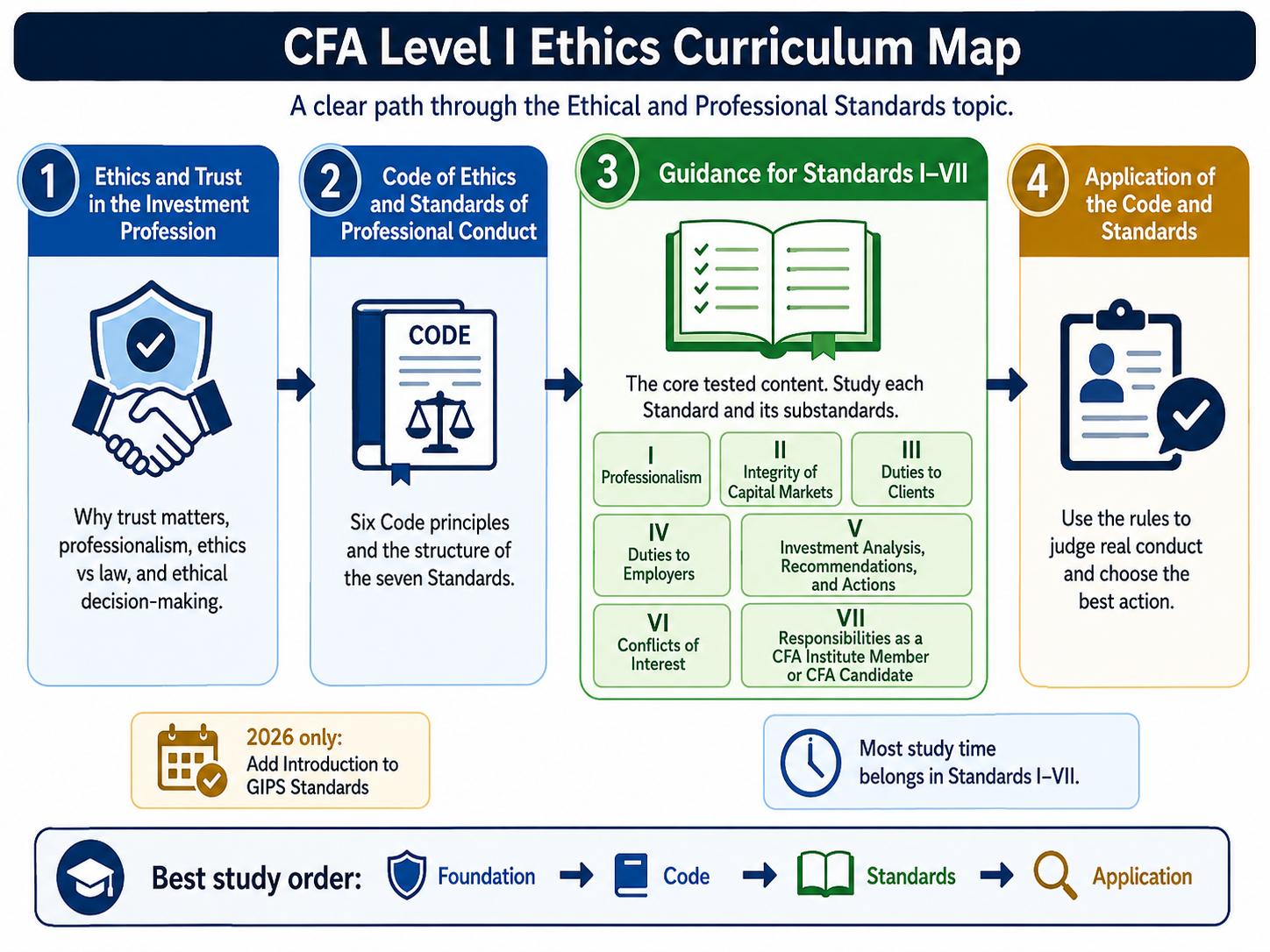
CFA Level I Ethics, the ethical and professional standards topic, covers four permanent branches in the 2027 curriculum. Each one builds toward the same skill: judging conduct against the Code and Standards.
The first branch is Ethics and Trust in the Investment Profession, which explains why trust is the foundation of the profession and introduces professionalism, ethical challenges, law versus ethics, and a decision-making framework. The second is the Code of Ethics and Standards of Professional Conduct, which sets out the six components of the Code and the structure of the seven Standards. The third is Guidance for Standards I to VII, which works through each Standard and its substandards with examples of compliant and violating conduct. The fourth is Application of the Code and Standards, where you move from knowing the rules to evaluating real practices and policies.
You do not need to learn every Standard from this page. Use it as the map, then follow the link into the branch you are studying.
Most of your study time in Ethics belongs in the Standards. They are the largest part of the topic and the part the exam draws from most. The earlier branches exist to make the Standards make sense, so treat them as the setup rather than the main event.
Study CFA Level I Ethics in Curriculum Order
The fastest way through Ethics is to follow the curriculum's own order rather than jumping between Standards at random. Work the sequence below.
Learn why ethics and trust matter, so the rules have a purpose behind them.
Review the Code of Ethics and the structure of the Standards before the detail.
Study Standards I to VII in order, one duty at a time.
Work through scenarios that show both compliant and violating conduct.
Finish with mixed-standard application and timed practice.
This order matters because later Standards assume you already understand trust, the Code, and the idea that conduct is judged against a duty rather than an outcome. If you jump straight to a single Standard, the rule can feel arbitrary. Learn the foundation first, and each Standard becomes easier to place. Run practice alongside your reading rather than saving it for the end, because Ethics marks come from applying rules under time pressure.
Where you start depends on where you are. If Ethics is new to you, begin at the top and follow the order above. If you are reviewing, go straight to your weakest Standards and drill scenarios. Either way, finish with mixed practice so the Standards stop blurring together.
How CFA Level I Ethics Is Tested
Ethics questions are short scenarios, not calculations. You read a situation and decide whether the conduct follows or breaks the Code and Standards. Some questions ask which Standard applies. Others ask for the most appropriate action, or for the best way to prevent a violation.
The skill is the same each time. Find the duty, find the party it is owed to, then test the conduct against the Standard. Outcomes do not decide the answer. A choice that worked out can still be a violation, and a choice that lost money can still comply.
Because the format is steady, practice pays off fast. Once you can read a scenario and name the duty, most questions fall into place.
The question stems are predictable once you have seen a few. Some ask whether a member violated the Code and Standards. Some ask which action is most consistent with the Standards. Some ask what a supervisor or firm should do to prevent a breach. Learn to read the stem, because it tells you whether to judge past conduct or choose the right next action.
Ethics and Trust in the Investment Profession
This module is the foundation of the whole topic. It explains why clients extend trust to people they cannot fully monitor, what makes investment management a profession, and how to reason through a hard case. It also draws the line between ethics and law, which the exam tests often. The five notes below take that foundation apart one piece at a time. You will define ethics, see how a code shapes a profession, learn the pressures that bend good judgment, separate legal duty from ethical duty, and pick up a repeatable method for hard cases. Start here, then move into the Code and the Standards once the groundwork is set.
Module notes:
Code of Ethics and Standards of Professional Conduct
The Code and the Standards are related but not the same. The CFA code of ethics is a short set of principles every member and candidate agrees to uphold, built around six components such as acting with integrity and placing client interests first. The Standards of Professional Conduct turn those principles into seven enforceable rules, each with its own substandards. This section also covers how the CFA Institute Professional Conduct Program investigates and enforces breaches.
Think of the Code as the why and the Standards as the how. The six Code components set the broad commitments, such as integrity, diligence, and putting the client and the market first. The seven Standards then spell out specific duties and the conduct that breaks them. The Professional Conduct Program is the enforcement side. It can investigate complaints and impose sanctions, up to loss of membership or the right to use the designation. The process moves in stages. An inquiry opens, staff gather facts, and the member has a chance to respond. If a violation is found, sanctions follow. You do not need the fine detail for Level I, but you should know the program exists and that the Standards are enforced, not merely suggested.
Code and enforcement notes:
Guidance for Standards I-VII
The seven Standards are the heart of CFA Level I Ethics, and the exam draws heavily from them. Study the cfa standards in order, learn each substandard, and practice telling compliant conduct from a violation. Each Standard below links to its overview and to every substandard page.
The seven Standards are organized by who a duty is owed to, and that map makes scenarios faster to read. Standard I covers your own conduct and the law. Standard II protects the market. Standards III and IV set duties to clients and to employers. Standard V is about the quality and honesty of your analysis. Standard VI handles conflicts of interest. Standard VII covers your conduct as a member or candidate. When you start a scenario, the first question is always whose duty is in play.
Standard I: Professionalism
How members handle the law, protect their independence, represent themselves honestly, conduct themselves personally, and keep their skills current.
Standard II: Integrity of Capital Markets
How members handle material nonpublic information and avoid conduct that distorts prices or trading volume.
Standard III: Duties to Clients
How members act with loyalty and care, treat clients fairly, recommend suitable investments, present performance honestly, and protect client information.
Standard IV: Duties to Employers
How members stay loyal to an employer, handle outside compensation, and meet a supervisor's duty to prevent violations.
Standard V: Investment Analysis, Recommendations, and Actions
How members build a reasonable basis for advice, communicate it clearly, and keep proper records.
Standard VI: Conflicts of Interest
How members avoid or disclose conflicts, give client transactions priority, and disclose referral arrangements.
Standard VII: Responsibilities as a CFA Institute Member or CFA Candidate
How members and candidates conduct themselves in CFA Institute programs and refer to the designation honestly. Standard VII overview.
Standard VII(A): Conduct as Participants in CFA Institute Programs
Standard VII(B): Reference to CFA Institute, the CFA Designation, and the CFA Program
Many scenarios touch more than one Standard, and the exam uses that overlap on purpose. A single act can raise both misrepresentation and misconduct, or set loyalty to an employer against a duty to a client. When that happens, name every duty in play, then decide which one governs the required action. Do not stop at the first Standard that seems to fit.
Application of the Code and Standards: Level I
Application is where the topic stops being about memory and starts being about evaluation. Here you read a set of practices, policies, or conduct and decide whether each one breaks the Code and Standards, and why. It pulls together every Standard at once, which is why it works best after you have studied them individually. These questions feel closest to the real exam. You are not asked to recite a Standard. You are asked to judge conduct, name the duty at stake, and explain why it does or does not comply.
Application of the Code and Standards: Level I
For 2026 Candidates: Introduction to GIPS Standards
This section applies only to candidates following the 2026 Level I curriculum. The published 2027 Level I topic outline does not list GIPS, so 2027 candidates can skip it. If you are sitting a 2026 exam, the Global Investment Performance Standards branch covers how firms present investment performance fairly and consistently.
GIPS is a voluntary set of standards for reporting investment results. The goal is to let investors compare firms on a fair basis, without cherry-picked track records. For 2026 candidates, the Level I treatment stays introductory. You learn what GIPS is for, who it applies to, and the basic ideas behind compliance, composites, and verification.
2026 GIPS notes (show only when 2026 is selected):
Introduction to the Global Investment Performance Standards (GIPS)
Why GIPS Standards Exist, Who Can Claim Compliance, and Who Benefits
GIPS Fundamentals of Compliance, Firm Definition, and Discretion
How Should You Study Ethics for CFA Level I?
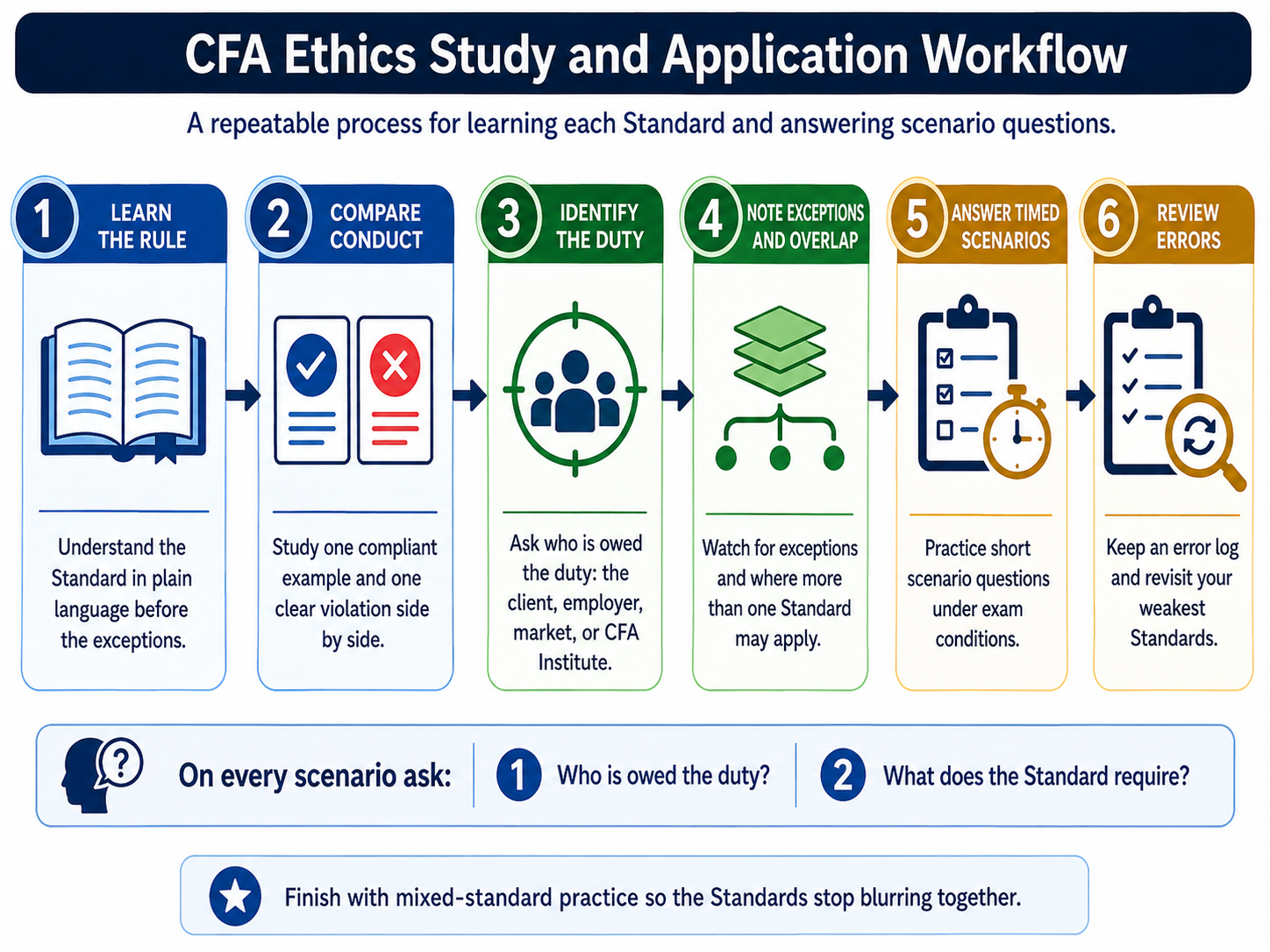
Study CFA ethics by learning each rule, then drilling it against scenarios until you can spot the duty quickly. The checklist below works for every Standard.
Learn the rule in plain language before the exceptions.
Compare an example of compliant conduct with a violation side by side.
Identify who is owed the duty: the client, the employer, the market, or CFA Institute.
Note any exceptions and any overlap with another Standard.
Answer scenario questions under timed conditions.
Keep an error log and return to your weakest Standards.
Reading the CFAstandards once is not enough. The candidates who do well are the ones who practice applying them.
Build a habit of asking two questions on every scenario. Who is owed the duty here, and what does the Standard require. Those two questions answer most Ethics items faster than rereading the rule. When two Standards seem to apply, decide which duty comes first before you choose.
Common CFA Ethics Exam Traps
These five traps cost candidates marks on Ethics more than anything else. Watch for each one as you practice.
Choosing what feels fair instead of what the Standard actually requires. Your sense of fairness is not the test. The duty written in the Standard is.
Judging conduct by how it turned out rather than how the decision was made. A good result can follow a poor process. The exam grades the process.
Missing the party the duty is owed to, which often decides the answer. The same act can comply or violate depending on who is owed the duty. Pin that down first.
Treating disclosure and consent as the same thing when a Standard needs both. Telling a client is not the same as getting their agreement. Some duties require the agreement.
Reading the law as the ceiling, when the ethical duty can sit higher than the law. Legal permission does not end the question. Check the Standard as well.
Practice CFA Level I Ethics
Reading explains the rules, but the exam rewards application, so scenario practice is where Ethics marks are won. Work topic quizzes for single Standards first, then move to mixed-standard sets that force you to identify which duty applies before you answer. Mixed sets matter because the real exam rarely tells you which Standard is in play. Treat every wrong answer as information. Log the Standard you missed and the reason, then come back to it.
Continue Your CFA Level I Prep With KeyPoint
Use structured lessons, practice questions, mock exams, and progress tracking to focus on the time you have left
FAQs About CFA Level I Ethics
What does CFA Level I Ethics cover?
CFA Level I Ethics covers the Code of Ethics, the seven Standards of Professional Conduct, the reasons ethics and trust matter, and how to apply the rules to professional conduct. The 2027 curriculum splits the topic into Ethics and Trust, the Code and Standards, Guidance for Standards I to VII, and Application of the Code and Standards. Most of the testable detail sits in the Standards and their substandards.
How many Standards of Professional Conduct are there?
There are seven Standards of Professional Conduct, numbered I to VII, and together they contain 23 substandards. The Standards run from Professionalism through Responsibilities as a CFA Institute Member or CFA Candidate. Each substandard sets a specific duty, and a single substandard is often enough to decide a question, so learn them individually rather than as a block.
Is GIPS part of CFA Level I in 2027?
No. The published 2027 Level I topic outline does not include GIPS. GIPS appears in the 2026 Level I path only, so use the exam-year selector above to show or hide it based on the exam you are sitting. If you are a 2027 candidate, you can leave GIPS out of your plan entirely.
How should I study CFA Ethics?
Study CFA Ethics in curriculum order, learn each Standard and its substandards, and practice scenarios that contrast compliant conduct with violations. Identify the duty and the party it is owed to in each case, keep an error log, and return to your weakest Standards before exam day. Steady scenario practice matters more than rereading the rules.
Are CFA Ethics questions calculation-based or scenario-based?
CFA Ethics questions are scenario based. You read a short situation and decide whether the conduct conforms to or violates the Code and Standards, rather than running a calculation. The skill being tested is judgment under the rules, which is why practice with realistic scenarios is the fastest way to improve.